

Research on hereditary predisposition to pulmonary arterial hypertension (PAH) has led to the identification of variants in the gene encoding the bone morphogenetic protein receptor type II (BMPR2). About 70 to 80% of cases with hereditary PAH (HPAH) and up to 40% of idiopathic cases (IPAH) are caused by genetic variants in BMPR2. (1)
More than 800 different variants have been described; however, the penetrance is reduced, since only 20 to 30% of carriers develop PAH. The latter suggests the contribution of other genetic, epigenetic, environmental and hormonal factors in the modulation and development of the disease (2,3,4).
Bone morphogenetic protein receptor type II is part of one of the two major signaling pathways that make up the transforming growth factor-β (TGF-β) superfamily: the bone morphogenetic protein (BMP)-growth differentiation factor (GDF) pathway. Cross-communication between this pathway and its counterpart, the TGF-β-activin-nodal pathway, plays a central role in numerous cellular processes that regulate cell proliferation and differentiation. (5)
Variants in BMPR2 result in reduced expression of the functional protein, which alters BMP signal transduction, often together with an increased activin-mediated response. This imbalance is now known to contribute to the pathogenesis of PAH by generating endothelial cell dysfunction, as well as proliferation, resistance to apoptosis, and contraction of pulmonary vascular smooth muscle cells. These mechanisms result in increased pulmonary vascular resistances, increased pulmonary arterial pressure and consequent right ventricular remodeling. The loss of balance between the BMP-GDF and TGF-β-activin-nodal pathways is currently considered the main molecular defect with a critical role in the predisposition and progression of PAH, as well as a novel therapeutic target. (6)
We present the case of a 31-year-old woman, with no medical history, who was admitted to the emergency room with progressive dyspnea as the main symptom. Initial evaluation included a chest angiotomography that ruled out acute pulmonary thromboembolism and a Doppler echocardiogram that showed findings suggestive of pulmonary hypertension (PH): tricuspid regurgitation velocity of 4.02 m/s and right ventricular systolic dysfunction. Further evaluation of PH included pulmonary function tests, pulmonary ventilation-perfusion scintigraphy, liver function tests, viral serologies and collagenogram, with results within normal parameters. In the 6-minute walk test, the distance covered was 420 m (59% of the predicted value), with desaturation (from 96% to 86%). Based on these results, a right heart catheterization was performed, which showed mean pulmonary artery pressure of 52 mmHg; pulmonary artery wedge pressure of 6 mmHg; mean right atrial pressure of 2 mmHg; cardiac output of 4.3 L/min; cardiac index of 2.95 L/min/m² and pulmonary vascular resistance of 11 Wood units. The diagnosis of IPAH was reached and specific treatment was started with double therapy: tadalafil 40 mg/day and ambrisentan 10 mg/day.
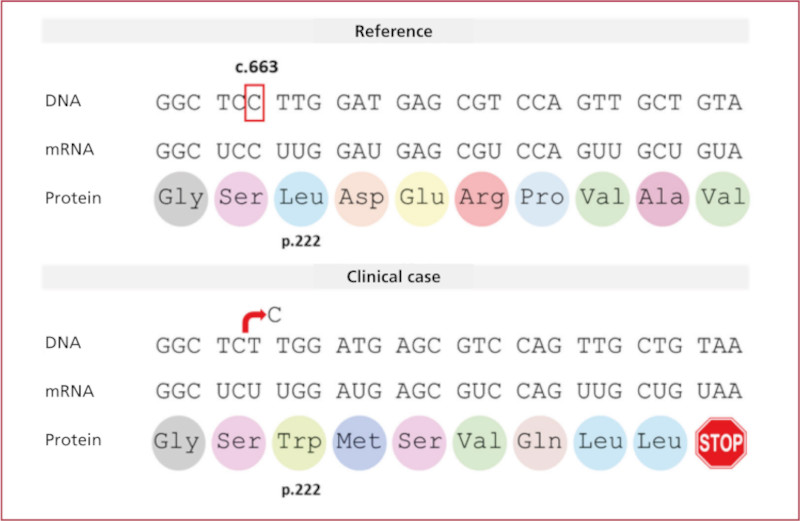
Genetic testing was performed by whole exome sequencing as part of a protocol in our center. A new heterozygous variant was detected in the gene: NM_001204.7:c.663del (p.Leu222Trpfs*8) located in exon 6. Confirmation was performed by polymerase chain reaction (PCR) and Sanger sequencing. The variant consists of a cytosine deletion at position 663 that induces a change in the reading frame and the replacement of leucine by tryptophan at codon 222. This generates a premature termination codon 8 triplets later (Figure 1) leading to the synthesis of a shorter BMPR2 protein, with loss of function. Classification of the variant was performed according to the recommendations of the American College of Medical Genetics and Genomics. It was determined that this variant was not previously described in the general population or in patients with PAH. Based on the analysis performed, it was classified as a probably pathogenic variant.
Fig.1. Analysis
of the c.663del variant in the BMPR2 gene. DNA, mRNA and protein sequences are compared between the case and reference sequence. The case shows the deletion of one cytosine (C) in the 663 nucleotide (red arrow) generating a shift in the reading frame leading to a premature termination codon (STOP). The BMPR2 reference sequence is: NG_009363.1 (gene), NM_001204.7 (transcription) and NP_001195.2 (protein)
With the results obtained and following current international recommendations, clinical and genetic evaluation of first-degree relatives was initiated. A direct molecular study of the variant was performed by PCR amplification of exon 6 and Sanger sequencing in both parents. The patient's father, who also reported compatible signs and symptoms at the time of interrogation, was diagnosed with PAH, which was also positive in the genetic test. The diagnosis of PAH in the father and the detection of the c.663del variant confirmed the familial segregation (Figure 2) and supports the reclassification of this variant as pathogenic. Thus, the diagnosis of both patients as carriers of HPAH was modified.
Fig. 2
Genealogic tree of the patient with the c.663del variant. The relatives diagnosed with PAH are identified in green. The variant was heterozygous in the case index and her father (C/del). The mother´s genotype was C/C and hence does not present the variant, while the sister has not been studied yet. C: Cytosin; del: deletion.

The data obtained indicate that c.663del is a causal variant of PAH unknown until now and also the first BMPR2 variant reported in Argentina. The identification of this variant allowed us to confirm the molecular diagnosis of hereditary disease, of importance both for the clinical and therapeutic management and for the genetic counseling of the patient and her relatives.
Ethical considerations
Not applicable
Conflicts of interest
None declared. (See authors´ conflicts of interest forms on the Web).
Funding
The present study was funded by grants from the Florencio Fiorini Foundation and the Tuteur Laboratory, which were used exclusively for research expenses. The funders were not involved in the design of the study, data collection and analysis, publication of decisions, or preparation of the manuscript. In addition, the authors of the Fiorini Award obtained in 2023 kindly donated funds for this research.