
oral anticoagulation in aortic endovascular reinterventions
pp 15-18
DOI:
https://doi.org/10.7775/rac.es.v87.i1.13764Keywords:
Aneurysm of the abdominal aorta, Endovascular procedures, Endoleak, Anticoagulation / administration and dosing, Oral administrationAbstract
Background: Endoleak is the main cause for reintervention after endovascular aortic repair. Some patients need prolonged oral anticoagulation, which may increase the incidence of postoperative endoleaks.
objectives: Our objective was to determine whether postoperative oral anticoagulation has an impact on the incidence of endoleaks.
Methods: This retrospective analysis included all patients with endovascular treatment of abdominal aortic aneurysm at our center
between 2009 and 2014. Two groups of patients were determined according to the need for oral anticoagulation. Aortic-related mortality, survival free from reinterventions, any endoleak and non-type II endoleaks, survival free of the composite endpoint of mortality associated with the aorta, reinterventions and endoleaks, and reduction of aneurysmal sac diameter was compared between bothgroups.
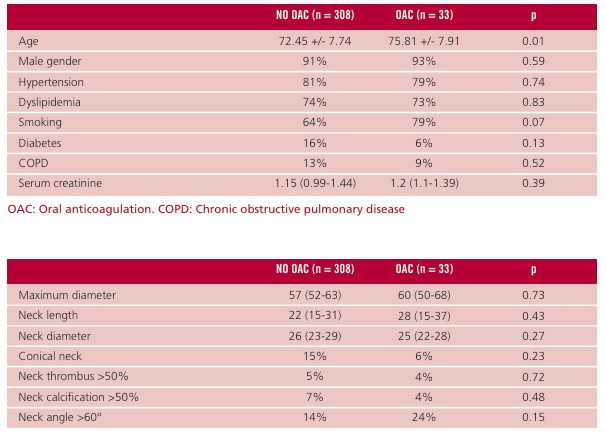
results: Among 341 treated patients, 33 (9.67%) were anticoagulated. There were no differences between the two groups in terms of aorta-related mortality (2.59% vs. 3.03%, p=ns), reintervention-free survival (84.04% vs. 86.2%; p=ns), any endoleak-free survival(82% vs. 89%, p=0.81) or non-type II endoleak-free survival (88% vs. 88%, p=0.52). Similarly, no significant differences were found when analyzing the composite endpoint-free survival (80% vs. 85%, p=ns). The average reduction of aneurysmal sac diameter was
5.19 mm and 3.51 mm (p=0.2).
conclusions: No difference was registered in any of the results analyzed. Postoperative oral anticoagulation had no impact on the results of endovascular aortic treatment
Downloads
Published
Issue
Section
License
Copyright (c) 2025 Argentine Journal of Cardiology

This work is licensed under a Creative Commons Attribution-NonCommercial-ShareAlike 4.0 International License.





