INTRODUCTION
Cardiovascular disease (CVD) is the
leading cause of death in women and its prevalence has increased over the past
decades. Despite this fact, women are less likely to receive guidance or
preventive treatment to reduce it. (1)
The effect of cardiovascular risk
factors (CRF) as hypertension (HT), diabetes (DBT), hypercholesterolemia (HC),
smoking, excess weight and sedentary lifestyle on cardiovascular health is well
known, but the evidence shows that the magnitude of their impact exhibits
sex-related variations. (2) In addition, women are exposed to
unique sex- and gender-specific CRF as low socioeconomic status, certain
psychosocial factors, gender-based violence, low education level, and environmental
pollution. (3-6)
Nowadays, most of the information on
CRF and CVD in women comes from international studies, and although the
national survey of risk factors (NSRF) (7) and the study published by the Heart
and Women Area of the SAC in 2006 (8) collected local information, there
are no current data on women's perception of their own risk.
Through this survey on women's
perception, awareness and management, the Heart and Women Area of the Argentine
Society of Cardiology (SAC) sought to establish a diagnosis of the situation of
self-perception of CRF and CVD, detect their prevalence and investigate the
level of perception and awareness of women on CRF and CVD to define the most
vulnerable groups to guide specific actions.
METHODS
We conducted an observational,
cross-sectional study in July 2021, using a voluntary, anonymous, and
self-administered online survey. A form was created on the RedCap
platform and was accessed via a link distributed through social media and WhatsApp by members of the Heart and Women Area, with broad
participation of the regional SAC districts. The information collected included
age range, CRF, CVD, and risk perception (Appendix 1). In this self-administered
survey, women reported if they perceived they had HTN, DM, dyslipidemia, or a
history of CVD (myocardial infarction, percutaneous coronary intervention,
coronary artery bypass graft surgery or a positive stress test).
Hypercholesterolemia was considered independently of the last time cholesterol
levels were tested. Similarly, we inquired about pregnancies and bad obstetric
history (miscarriage, fetal death, gestational hypertension, gestational DM,
and preterm birth before 37 weeks). Sedentary lifestyle was considered when the
exercise time reported was less than 150 min per week. Former smoker was
considered after 1 year of having quit smoking. Predefined categories of weight
and waist circumference data were provided.
Women >18 years and older from
different geographic locations in Argentina were included, and female doctors
were excluded.
Statistical analysis
The population was divided into two
groups according to age, ≤ 45 years, and > 45 years, to explore
differences in the main variables in two different generations.
Qualitative variables are presented
as frequencies and percentages. Discrete variables were analyzed using the chi
square test or Fisher's exact test. For continuous variables, the t test or the
Mann-Withney test were used. ANOVA and the Kruskal-Wallis test were used for comparisons among 3
groups or greater. A p value < 0.05 was considered statistically
significant.
Ethical considerations
The survey was approved by the
Committee on Ethics of the Argentine Society of Cardiology; informed consent
was not required due to the characteristics of the survey.
RESULTS
Conventional risk factors
A total 3338 women participated in
the survey. Table 1 shows the baseline characteristics of the women surveyed;
34.8% were < 45 years and half of them (50.1%) belonged to the age range
between 46-65 years.
Table 1. Baseline
characteristics of the population surveyed

CAD: coronary
artery disease; CRF: cardiovascular risk factors; CVD: cardiovascular disease;
HT: hormone therapy; HTN: hypertension;
For each
variable, the total number of respondents is indicated.
In response to body measurements,
34.1% reported a weight > 70 kg and this answer was more common in women
> 45 years than in younger women (38% vs. 29%, p < 0.01). A waist
circumference > 80 cm was reported by 43.6% of respondents and was more
common in women > 45 years (48% vs 35%, p <
0.01) (Figure
1).
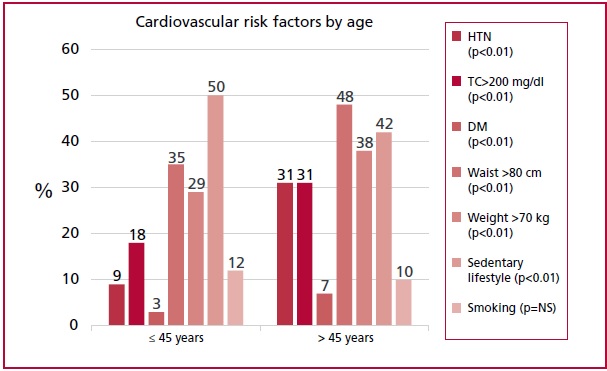
DM: diabetes; HTN: hypertension; TC: total cholesterol
Fig. 1. Comparison of cardiovascular risk
factors by age
Among conventional CRF, 12.1% did not
know their blood pressure (BP) values and 24.2% considered that they had
hypertension (HTN). When they were asked about their BP values, 6.1% responded
their systolic BP was > 140 mm Hg (1.4% corresponded to the group that did not
perceive they had HTN). Considering both criteria (reported HTN and elevated BP
values), 25.6% of all the survey respondents had HTN, more frequent in the age
group > 65 years (37.6%) (Figure 1).
Elevated total cholesterol (ETC)
levels, > 200 mg/ dL were reported by 19.6% of the
survey respondents while 29.2% did not know their values. Of the patients with
ETC levels, 16.7% were taking lipid-lowering agents and 10.1% followed diet and
exercise. Among women who were following an indication to manage ETC levels
(diet, exercise or medication), 37% had values > 200 mg/dL
despite these measures. On the other hand, 23% of women with TC levels > 200
mg/ dL did not follow any recommendation. Elevated TC
levels were more common in > 45 years (31%) compared with those ≤ 45
years old (18%), p < 0.01.
Diabetes was reported by 5.4% and
most survey respondents knew their blood glucose values (only 2.6% were not
aware of them).
A waist circumference > 80 cm was
more common in women with HTN (33.3% vs 16.7%), ETC
levels (22.2% vs. 17.6%) and DBT (8.6% vs. 3.0%). Excess weight was associated
with HTN (35.6% vs. 18%) and DM (10.6% vs. 2.8%).
Women with
systolic blood pressure >140 mm Hg were more likely to have DM (16.5% vs.
5.2%), waist circumference > 80 cm (68.3% vs. 43.2%), and weight > 70 kg
(60% vs. 33.5%).
In addition, women with diabetes had
more prevalence of HTN (57% vs. 22.7%), waist circumference > 80 cm (68% vs.
41.8%) and weight > 70 kg (65% vs 32%). These
differences were statistically significant in all the cases (p < 0.01).
Sex-specific risk factors
The obstetric history was also
explored. Among survey respondents, 82.1% had been pregnant at least once, and
26.9% of them reported at least one of the following complications: HTN (8.2%),
preterm birth (7.9%), miscarriage (7.4%) and gestational diabetes (4.9%). Only
37% underwent cardiology monitoring one year after the index delivery (vs. no
monitoring p < 0.01). A bad obstetric history was more commonly associated
with HTN (34% vs. 24%, p < 0.01), DM (7% vs. 5%, p = 0.04) and current CVD
(14% vs. 11%, p < 0.01).
Oral contraceptives or hormone
therapy was used by 15.2%, and most of these women (65%) belonged to the
younger age group. Hormone therapy was less common in women with HTN (11.8% vs.
26.2%), ETC levels (13.5% vs 21%), waist
circumference > 80 cm (35% vs 45%), and weight
> 70 kg (26% vs 35%). All these differences were
statistically significant (p < 0.01).
Cancer was reported by 7.9% and 91.4%
had not been evaluated by a cardiologist during or after cancer therapy. A
history of cancer was found in 11% of women > 45 years vs. 2% in younger
women (p < 0.01). Hypertension was more common in women with a history of
cancer (35% vs. 23%).
Habits, behavioral factors, and
emotional sphere
Among survey respondents, 45.8% had a
history of smoking and 11.3% were current smokers. Smoking was significantly associated
with a waist circumference > 80 cm, sedentary lifestyle, and alcohol intake
(13% vs. 7%).
We also explored habits as exercise,
diet, and medical check-ups. A sedentary lifestyle was reported by 44.3%, and 57.4% admitted lack of adherence to a healthy and
balanced diet. Sedentary lifestyle was more common in women aged 45 or less
(42% vs 50%, p < 0.01). Women who exercised had
significantly lower prevalence of HTN (21.7% vs. 26.8%), DM (4.4% vs. 7%), smoking
habits (9% vs. 13.3%), waist circumference > 80 cm (38% vs. 50.1%) and
weight >70 kg (27% vs 42.5%).
Most women had undergone
cardiovascular assessment (87%), but this was less common in younger women.
Data on irritability, alcohol intake
and sleep were collected to explore the emotional and behavioral spheres; 62.6%
became easily irritable, mostly women up to 55 years of age (74%), and nearly
half of them reported regular alcohol intake (48.6%). Sleeping difficulty was
more common among women who reported regular alcohol intake (19% vs. 13.5% p
< 0.01). Sleep disorders were reported by 49.5% and there was a significant
association between ETC levels and weight > 70 kg. Sleep disorders were more
common in women > 45 years.
Awareness and perception of
cardiovascular disease
Among survey respondents, 10.9% had
CVD, which was more common in those > 55 years. A history of myocardial
infarction was the most common disease reported (51.1%), followed by
revascularization procedures (30.4%) and indication of medical treatment after
an exercise stress test (28.6%). Stroke was reported by 9.8% of the
respondents.
When awareness of cardiovascular risk
was explored, more than 50% responded that cancer was the main cause of death
in women (62%) and gynecologic tumors were the most common causes reported
(breast cancer in 53.9% and ovarian cancer in 7.5%). Only 34.9% considered CVD
as the main cause of death in women. There were no differences by age on this
question.
DISCUSSION
The present survey shows an increase
in self-reported CRF compared to the data obtained in the previous survey
conducted by the Heart and Women Area in 2006. (8) These findings are in line with the
results of the fourth NSRF. (7) A matter of concern is the increased
prevalence of CRF in the female population at the expense of excess weight,
HTN, DM, and ETC levels over the 15-year period. We observed several CRF in
women > 45 years, in those with known CVD, and a combination of CRF in those
who did not know they had CVD, thus increasing the cardiovascular risk (Figure 1). When HTN
was analyzed, some women did not know their BP levels (12%) and another group
of women (4.7%) who did not consider themselves to be hypertensive had elevated
values (> 140 mm Hg), which demonstrates the lack of awareness of this important
CRF. Something similar occurred with cholesterol levels: 29.2% were unaware of
their values, and among those who recognized that they had ETC, 37% had not
reached the therapeutic targets (<200 mg/dL)
despite drug treatment or hygiene and dietary measures.
In the participating population the
prevalence of a history of pregnancy was high (81.2%) and 26.9% reported
complications. In line with previous series, a bad obstetric history was more
commonly associated with HTN, DBT and future CVD (Figure 2). (3,5,9- 11) The
guidelines on cardiovascular prevention in women highlight the need for
periodic cardiovascular monitoring in women with bad obstetric history due to
the association with atherosclerotic CVD and CVD-related mortality.
Reassessment of the cardiometabolic profile is
recommended one year after the index pregnancy (12-15) to screen for HTN, DM and ETC and to
encourage women to return to their pre-pregnancy weight. In the population
surveyed, only 37% of the women with complications of pregnancy underwent
cardiovascular monitoring one year later, which highlights that women and
probably their health care professionals were not aware of this risk. Something
similar occurred in patients with a history of cancer, as most of them (91.4%)
had not been evaluated by a cardiologist during or after cancer treatment.
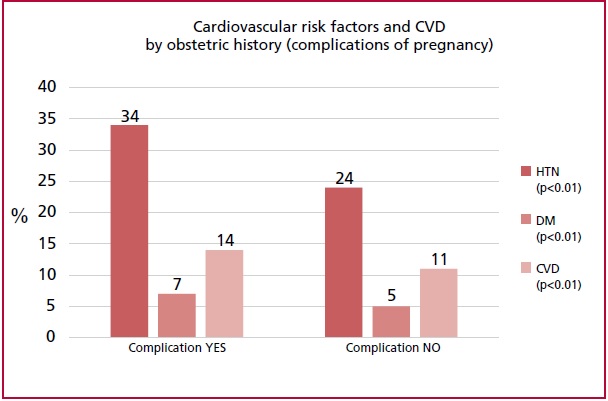
DM: diabetes; HTN: hypertension; TC: total cholesterol
Fig. 2. Cardiovascular risk factors and cardiovascular
disease (CVD) during follow-up according to obstetric history
The use of oral contraceptives was
more common in young women (65% < 45 years) and the prevalence of HTN, ETC
levels and excess weight was lower in those using oral contraceptives. As this
treatment is prescribed by obstetricians and gynecologists, these results could
be due to a selection of the method of contraception indicated, based on the
woman's cardiometabolic risk profile.
Regarding smoking habits, the
implementation of the anti-smoking law 26 687 in 2011 has had a favorable
impact on smoking reduction. (16) In the current survey, 11.3% of the
respondents smoked versus 29.3% in the previous survey in 2006, and these data
agree with the fourth NRFS which showed a reduction in tobacco use. (7)
Women tend to be less active, and,
probably because of cultural issues, girls are less encouraged to engage in sports;
in the population surveyed, there was a high proportion
of sedentary women, particularly among those ≤45 years. This could be due
to the fact that younger women play many roles and activities related to
parenting, household chores and work activities, and have less time available
to adhere to healthy guidelines. Women who exercised regularly had less excess
weight, HTN, DBT and irritability, and better quality of sleep. Irritability
(62.6%) and regular alcohol intake (56.5%) were also more common in young
women.
The importance of sleep in the
prevention of CVD has recently been recognized. (17-19) Fragmented sleep or sleeping less
than 7 hours has been associated with subclinical atheromatosis
in multiple territories and with increased cardiovascular morbidity and mortality.
(20) In the
population surveyed, 49.5% reported sleep disorders that were more common in
those who drank alcohol, and in those with ETC levels and excess weight.
Cardiovascular disease was reported
by 10.9% of the survey respondents and was more common in women > 55 years;
myocardial infarction was the most common CVD. Women with CVD also had more
associated comorbidities (HTN, DM) and excess weight.
As for the cause of death, women still
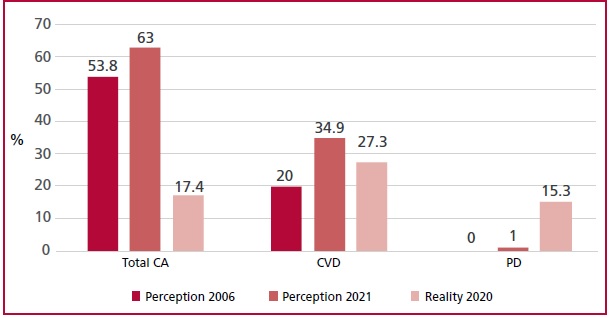
have the erroneous perception that cancer is the main etiology. In the previous
survey conducted in 2006, 53.8% of women considered tumors as the main cause of
death and only 20% considered CVD. Fifteen years later, the discrepancy between
perception and reality persists, since 62% considered cancer and 34.9%
considered CVD as the main cause of death, while according to the vital
statistics published by the Ministry of Health in 2020, (21) 17.4% of
deaths were due to cancer and 27.3% to CVD (Figure 3). This discrepancy between
perception and reality could be associated with the gynecologic cancer
prevention campaigns carried out by the societies of gynecology of our country
and, in some way, exposes the lack of effective communication by the cardiology
community about CRF that have an impact on cardiovascular health and CVD.
Perception
2021
Perception
2006
Ca: Cancer; CVD: cardiovascular
disease; PD: pulmonary disease
Fig. 3. Comparison of perceived cause of
death in 2006 and 2021 versus reality in 2020
CONCLUSION
Women's own perception of their risk
is clearly low, and the data collected from the population surveyed suggests
poor CRF control. Younger women show the greatest difficulty in the adherence
to healthy behaviors, receive less counseling about their risk, and therefore
constitute the most vulnerable population. Actions should be taken to spread
the information and thus reduce the gap between perception and reality of CVD
in women.
Study limitations
The non-probabilistic sampling design
(social media/ WhatsApp/contacts) generates a
response bias, with lower probability of participation of those women with less
access to these resources and without contact with physicians in the SAC area.
Although the survey was distributed nationwide by representatives of SAC regional
districts, the lack of residency data does not allow us to know the
representation of all the regions of Argentina. The distribution by social
media did not allow us to corroborate participants' sex and age. As body
measurements were collected by ranges, it was not possible to calculate excess
weight by body mass index.
Conflicts of interest
None declared.
(See authors' conflict of interests forms on the web/Additional material).
 https://creativecommons.org/licenses/by-nc-sa/4.0/
©Revista Argentina
de Cardiología
1. Vogel B, Acevedo M, Appelman, Y, Bairey Merz CN, Chieffo A, Figtree GA, et al. The Lancet women and cardiovascular
disease Commission: reducing the global burden by 2030. Lancet 2021:397:2385-
438. https://doi.org/10.1016/S0140-6736(21)00684-X.
2.
Yusuf S, Hawken S, Ôunpuu
S, Dans T, Avezum A, Lanas F, et al. Effect of potentially modifiable risk
factors associated with myocardial infarction in 52 countries (the INTERHEART
study): case-control study. Lancet. 2004;364:937–52. https://doi.org/10.1016/S0140-6736(04)17018-9
3. Maas AH,
Rosano G, Cifkova R, Chieffo A, van Dijken D, Hamoda H, et al. Cardiovascular health after menopause
transition, pregnancy disorders, and other gynaecologic
conditions: a consensus document from European cardiologists, gynaecologists, and endocrinologists. Eur
Heart J 2021;42:967–84. https://doi.org/10.1093/eurheartj/ehaa1044
4.
Norris CM, Yip CY, Nerenberg KA, Clavel
M, Pacheco C, Foulds HJ, et al. State of the Science
in Women’s Cardiovascular Disease: A Canadian Perspective on the Influence of
Sex and Gender. J Am Heart Assoc. 2020;9:e015634. https://doi.org/10.1161/JAHA.119.015634
5. Parikh
NI, Gonzalez JM, Anderson CA, Judd
SE, Rexrode KM, Hlatky MA,
et al. Adverse
Pregnancy Outcomes and Cardiovascular Disease Risk: Unique Opportunities for
Cardiovascular Disease Prevention in Women: A Scientific Statement from the
American Heart Association. Circulation. 2021;143:e902-e916. https://doi.org/10.1161/CIR.0000000000000961
6.
Arnett DK, Blumenthal RS, Albert MA, Buroker AB,
Goldberger ZD, Hahn EJ, et al. 2019 ACC/AHA Guideline on the Primary Prevention
of Cardiovascular Disease. Circulation [Internet]. 2019;140. https://doi.org/10.1161/CIR.0000000000000677
7. INDEC: Instituto Nacional de
Estadística y Censos de la República Argentina [Internet]. www.indec.gob.ar. [cited 2022 Aug 18]. Available from: https://www.indec.gob.ar/.../enfr_2018_resultados_definitivos.pdf
8. Rolandi
F, Grinfeld L, Sosa Liprandi
MI, Tambussi A, Kazelian L,
La Bruna MC, et al. Encuesta de reconocimiento de la enfermedad cardiovascular
en la mujer por la mujer. Rev Argent Cardiol 2013;
81:329–35. https://doi.org/10.7775/rac.es.v81.i4.1076
9. Agarwala
A, Michos ED, Samad Z, Ballantyne
CM, Virani SS. The Use of Sex-Specific Factors in
the Assessment of Women’s Cardiovascular Risk. Circulation.
2020; 141:592–9. https://doi.org/10.1161/CIRCULATIONAHA.119.043429
10.
Young L, Cho L. Unique cardiovascular risk factors in women. Heart.
2019;105:1656-60. https://doi.org/10.1136/heartjnl-2018-314268
11. Parikh
NI, Gonzalez JM, Anderson CAM, Judd
SE, Rexrode KM, Hlatky MA,
et al. Adverse
Pregnancy Outcomes and Cardiovascular Disease Risk: Unique Opportunities for
Cardiovascular Disease Prevention in Women: A Scientific Statement from the
American Heart Association. Circulation. 2021;143:e902–e916. https://doi.org/10.1161/CIR.0000000000000961
12.
Cho L, Davis M, Elgendy I, Epps K, Lindley KJ, Mehta
PK, et al. Summary of Updated Recommendations for Primary Prevention of
Cardiovascular Disease in Women. J Am Coll Cardiol 2020;75:2602– 18. https://doi.org/10.1016/j.jacc.2020.03.060
13. Agarwala
A, Michos ED, Samad Z, Ballantyne
CM, Virani SS. The Use of Sex-Specific Factors in
the Assessment of Women’s Cardiovascular Risk. Circulation 2020;141592–9. https://doi.org/10.1161/CIRCULATIONAHA.119.043429
14. Volberg
VI, et al. Consenso de Enfermedad Cardiovascular en la Mujer Área “Corazón y
Mujer” Sociedad Argentina de Cardiología. Rev Argent Cardiol 2021;89(Suplemento 5). https://doi.org/10.31533/pubsaude5.a111
15. Del-Sueldo MA, Mendonça-Rivera MA, Sánchez-Zambrano MB, Zilberman J, Múnera-Echeverri AG,
Paniagua M, et al. Guía de práctica clínica de la Sociedad Interamericana de
Cardiología sobre prevención primaria de enfermedad cardiovascular en la
mujer. Arch Cardiol Méx 2022;92(2). https://doi.org/10.24875/ACM.22000071
16. Ley Nacional 26687: Regulación de
la publicidad, promoción y consumo de los productos elaborados con tabaco.
Legislación en Salud Argentina [Internet]. e-legis-ar.msal.gov.ar.
https://e-legis-ar.msal.gov.ar/htdocs/legisalud/migration/html/17971.html
17.
Lloyd-Jones DM, Allen NB, Anderson CAM, Black T, Brewer LC, Foraker RE, et al. Life’s Essential 8: Updating and Enhancing the
American Heart Association’s Construct of Cardiovascular Health: A Presidential
Advisory from the American Heart Association. Circulation.
2022;145:e18-e43. https://doi.org/10.1161/CIR.000000000000107
18.
Watson NF, Badr MS, Belenky
G, Bliwise DL, Buxton OM, Buysse
D, et al. Joint Consensus Statement of the American Academy of Sleep Medicine
and Sleep Research Society on the Recommended Amount of Sleep for a Healthy
Adult: Methodology and Discussion. J Clin Sleep Med
[Internet]. 2015;15:931-52. https://doi.org/10.5664/jcsm.4950
19. Levine
GN, Cohen BE, Commodore-Mensah Y, Fleury
J, Huffman JC, Khalid U, et
al. Psychological
Health, Well-Being, and the Mind-Heart-Body Connection: A Scientific Statement
From the American Heart Association. Circulation. 2021;143:e763–e783. https://doi.org/10.1161/CIR.0000000000000947
20. Domínguez F, Fuster V, Fernández-Alvira JM, Fernández-Friera L, López-Melgar B, Blanco-Rojo
R, et al. Association
of Sleep Duration and Quality With Subclinical
Atherosclerosis. Journal of the American College of
Cardiology [Internet]. 2019;73:134–44. https://doi.org/10.1016/j.jacc.2018.10.060
21.
Estadísticas vitales
[Internet]. Available from: https://www.argentina.gob.ar/sites/default/files/serie5numero64_web.pdf
Survey on perception, awareness and
measures to prevent cardiovascular diseases in women
All data (All registries and files)
How old are you?
o ≤ 45
years
o Between 46
and 55 years
o Between 56
and 65 years
o > 65
years
Weight:
o ≤ 60
kg
o Between 61
and 70 kg
o Between 71
to 80 kg
o > 80 kg
Height:
o ≤ 150
cm
o Between 151
and 160 cm
o Between 161
and 170 cm
o > 170 cm
Waist:
o ≤ 70
cm
o Between 71
and 80 cm
o Between 81
and 90 cm
o > 90 cm
Do you suffer from hypertension or
are you taking any medication to control your blood pressure?
o Yes
o No
Which is your maximum blood pressure
value?
o ≤ 120
mm Hg
o Between 121
and 140 mm Hg
o Between 141
and 160 mm Hg
o > 160 mm
Hg
o Don't know
Do you know your blood cholesterol
value?
o No
o ≤ 160
mg/dL
o Between 161
and 200 mg/dL
o Between 201
and 240 mg/dL
o > 240 mg/dL
Are you taking any medication to
control your blood cholesterol?
o No
o Yes
o I exercise
and follow a diet
Are you diabetic?
o Yes
o No
o Don't know
Do you smoke?
o Yes
o No, never
o Not now, but
I used to smoke
Do you exercise at least 150 minutes
per week?
o Yes
o No
Have you ever undergone
cardiovascular check-up?
o Yes
o No
Do you have history of cardiovascular
disease?
o Yes
o No
Which one?
o Infarction
o Angioplasty
o Coronary
artery bypass graft surgery
o I started
medication after an exercise stress test
Do you consider you have had or have
cardiovascular disease?
o Yes
o No
o Don't know
Do you have a history of stroke?
o Yes
o No
Do you drink alcohol?
o Never
o 4 days or
fewer
o > 4 days
o Every day
Have you ever been pregnant?
o Yes
o No
Did you have complications during any
of your pregnancies?
o No
o No, but I
need fertility treatment
o I lost
one/all pregnancies
o Hypertension
o Gestational
diabetes
o Delivery
before 37 weeks of gestation
Did you experience early menopause? (before the age of 45)
o Yes
o No
Did you undergo cardiovascular
check-up one year after delivery?
o Yes
o No
Are you taking oral contraceptives or
hormone therapy?
o Yes
o No
Do you have any thyroid disorder?
o Yes
o No
Is there a family history of
cardiovascular disease?
o No
o Yes, before
40 years old
o Yes between
40 and 49 years old
o Yes, between
50 and 70 years old
o Yes, > 70
years old
Which of the following diseases do
you consider is the most common cause of death in women?
o Breast cancer
o Ovarian cancer
o Lung cancer
o
Cardiovascular disease
o
COPD
o Alzheimer
disease
Do you consider your diet is balanced
and healthy?
o Never
o 4 days or
fewer
o > 4 days
o Every day
Do you have any difficulties to fall
asleep or remain asleep?
o Never
o 4 days or
fewer
o > 4 days
o Every day
Do you easily become upset of
irritable?
o Never
o 4 days or
fewer
o > 4 days
o Every day
Do you have or did you have cancer
requiring treatment?
o No
o Yes,
chemotherapy
o Yes,
radiation therapy
o Yes, surgery
o Yes,
immunotherapy: monoclonal antibodies e.g., trastuzumab
(Herceptin), others
o Yes,
chemotherapy and radiotherapy
Have you been examined by a
cardiologist during or after cancer therapy to evaluate if your heart suffered
any damage due to treatment?
o No
o Yes, with an
electrocardiogram
o Yes, with
echocardiography (heart ultrasound)
o
Yes, with both