

INTRODUCTION
Allopurinol, a competitive inhibitor of xanthine oxidase (XO), has been used for more than six decades to treat hyperuricemia and gout. However, its potential role as a cardioprotective agent has attracted increasing interest in recent years, given evidence linking serum uric acid (SUA) to endothelial dysfunction, oxidative stress, arterial stiffness, left ventricular hypertrophy (LVH), and major adverse cardiovascular events (MACE). (1-4) From a pathophysiological perspective, XO is a key source of reactive oxygen species (ROS), and its inhibition by allopurinol may improve nitric oxide bioavailability, reduce vascular inflammation, and attenuate myocardial remodeling. (5-7)
Early clinical studies suggested structural and vascular benefits of allopurinol, including improved endothelial function and reduced left ventricular mass. (5,6) However, recent randomized clinical trials, such as ALL-HEART, did not demonstrate a significant reduction in major adverse cardiovascular events in patients with stable ischemic heart disease. (8,9) This finding has prompted debate as to whether the potential beneficial effects of allopurinol depend on the clinical context (severe hyperuricemia, heart failure, or chronic kidney disease) rather than being universal. (1,10)
In addition, meta-analyses and cohort studies continue to show favorable associations between reductions in SUA levels and improvements in subclinical markers of cardiovascular damage. (11-15) However, recent research in patients with heart failure with preserved ejection fraction (HFpEF) did not suggest that the combination of allopurinol and verinurad may improve symptoms and functional capacity. (16)
This is further supported by evidence from large population-based cohorts. In the Swedish AMORIS study, Ding et al. found that elevated uric acid concentrations were associated with an increased risk of new-onset atrial fibrillation, broadening the spectrum of cardiovascular outcomes potentially linked to urate metabolism. (2)
In terms of causal inference, Mendelian randomization analyses and large-scale epidemiological studies suggest a possible role for uric acid in cardiovascular risk, although the magnitude of the clinical benefit associated with its pharmacological reduction remains uncertain. (4,17)
In this context, this narrative review aims to synthesize the most recent evidence on the cardiovascular effects of allopurinol, integrating pathophysiological, clinical, and epidemiological findings to discuss its potential role in the prevention and management of cardiovascular disease from an interdisciplinary perspective encompassing cardiology, internal medicine, rheumatology, and clinical epidemiology.
METHODS
A narrative review was conducted to evaluate the potential cardiovascular effects of allopurinol. Publications in English and Spanish were searched in PubMed/MEDLINE, Embase, LILACS, the Cochrane Library, and Google Scholar from January 2015 to November 2025, with the last search conducted on November 1, 2025. MeSH terms, Emtree terms, and free-text terms related to allopurinol, xanthine oxidase inhibition, and cardiovascular outcomes were used; the complete search strategies are provided in the Supplementary Appendix.
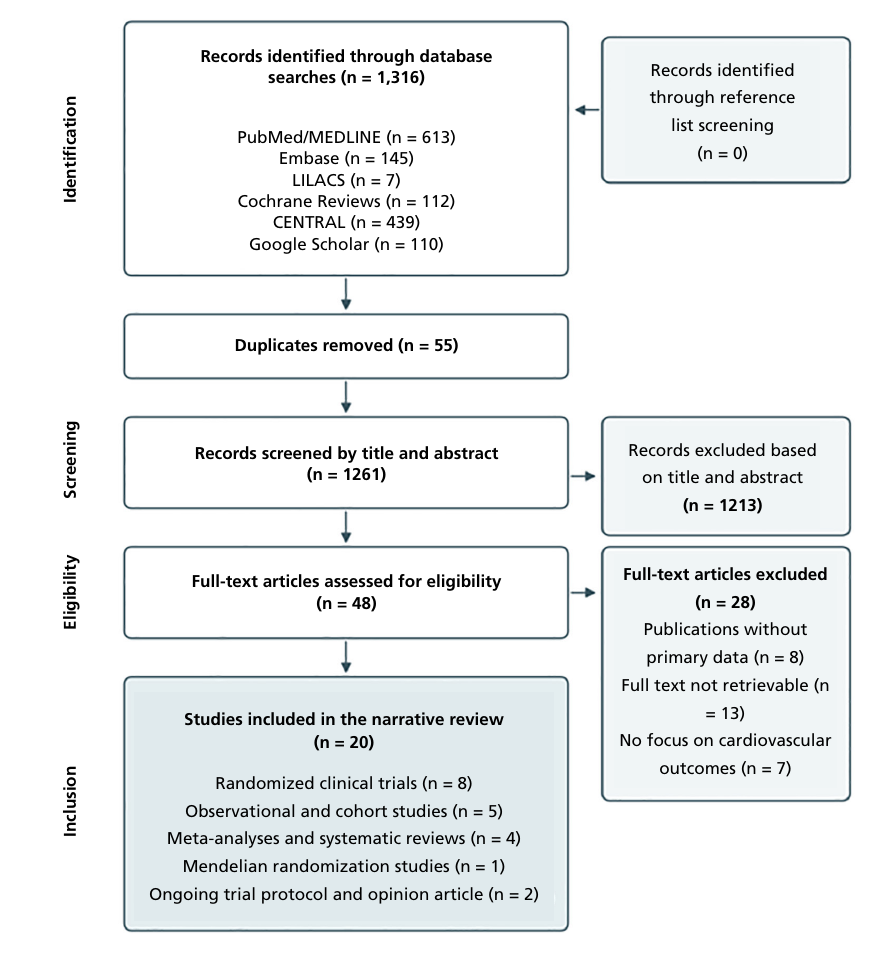
Clinical trials, observational studies, systematic reviews, meta-analyses, Mendelian randomization studies, protocols, and relevant opinion articles were included, with priority given to cardiovascular outcomes, biomarkers, and pathophysiological mechanisms. Duplicate records, conference abstracts, letters without primary data, articles without full text, and studies lacking relevant cardiovascular information were excluded. The first three authors independently screened titles, abstracts, and full-text articles, with discrepancies resolved by consensus. Of the 1,316 records identified, 20 were included in the narrative synthesis (Figure 1).
RESULTS
1. Pathophysiology and cardioprotective mechanisms of allopurinol
The potential cardioprotective effect of allopurinol is based on the inhibition of XO, a key enzyme in purine metabolism that converts hypoxanthine to xanthine and subsequently to uric acid, generating superoxide radicals and hydrogen peroxide as byproducts. (1) This process contributes to vascular oxidative stress, one of the most relevant pathophysiological mechanisms in the development of endothelial dysfunction, myocardial hypertrophy, and atherosclerosis progression. (4,5,7)
a. Modulation of oxidative stress and endothelial dysfunction
Several studies have shown that XO inhibition significantly reduces ROS production, improves nitric oxide (NO) bioavailability, and restores endothelial function. (6,7) In a controlled trial, Borgi et al. evaluated the effect of urate-lowering agents on endothelial function. (6) Gaffo et al. did not observe a decrease in blood pressure with allopurinol in young adults in a crossover trial. (18) Similarly, the systematic review by Alem et al. showed consistent improvements in markers of endothelial function and arterial stiffness in patients with heart failure or chronic kidney disease (CKD). (7)
The reduction in ROS induced by allopurinol may also limit low-density lipoprotein (LDL) oxidation, reduce platelet activation, and attenuate endothelial inflammation—factors that collectively contribute to a more stable vascular microenvironment. (1)
b. Effects on ventricular hypertrophy and myocardial remodeling
XO-derived oxidative stress contributes to prohypertrophic myocardial signaling through pathways such as mitogen-activated protein kinases (MAPK) and nuclear factor kappa B (NF-κB). In the clinical setting, Rutherford et al. evaluated the effect of allopurinol on left ventricular mass index (LVMi) in hemodialysis patients. (5). These findings are consistent with the pathophysiological framework linking XO activity to interstitial fibrosis and myocardial oxidative stress. (1)
The hypothesis of reversible oxidative remodeling proposes that sustained reduction of oxidative stress with allopurinol may partially reverse left ventricular hypertrophy and improve myocardial efficiency, particularly in the early stages of heart failure. (5,7)
c. Influence on inflammation and myocardial energy metabolism
Excess uric acid and increased XO activity activate the NLRP3 inflammasome, promoting systemic and local inflammatory responses that accelerate endothelial injury and atherogenesis. (1) It has been proposed that allopurinol favorably modulates redox balance and reduces the expression of proinflammatory cytokines such as interleukin-1β (IL-1β) and tumor necrosis factor-α (TNF-α). (1)
Furthermore, by limiting ROS generation, allopurinol optimizes myocardial energy metabolism, promotes oxidative phosphorylation, and reduces myocardial oxygen consumption during cardiac work. (1) This mechanism could explain the hemodynamic benefits observed in patients with heart failure with reduced ejection fraction (HFrEF) and hyperuricemia. (19)
d. Effects on metabolic and renal comorbidities
Hyperuricemia is closely associated with cardiorenometabolic syndrome, characterized by insulin resistance, low-grade inflammation, and persistent endothelial dysfunction. (4) In this context, allopurinol may exert a pleiotropic effect, improve metabolic and renal control, and reduce the progression of nephropathy and secondary cardiac overload. (5,13) These integrated mechanisms support the potential role of allopurinol in the secondary prevention of cardiovascular disease in patients with gout, CKD, or high metabolic risk.
2. Clinical evidence on the cardiovascular effects of allopurinol
The potential cardiovascular benefit of allopurinol has been investigated over the past two decades through observational studies, randomized clinical trials (RCTs), and meta-analyses with heterogeneous results. Current evidence suggests that, although allopurinol improves intermediate parameters such as endothelial function, left ventricular mass, or functional capacity, it has not been shown to conclusively reduce MACE in the general population with established cardiovascular disease.
a. Randomized clinical trials
The ALL-HEART study remains the largest to date on this topic. It included 5721 patients aged ≥60 years with stable coronary artery disease and no history of gout, who were randomly assigned to receive allopurinol (600 mg/day) or usual care. After a median follow-up of 4.8 years, no significant difference was observed in the composite endpoint of cardiovascular death, myocardial infarction, or stroke. These results were interpreted as evidence that XO inhibition does not provide a universal cardiovascular benefit and that its effects may depend on the patient’s clinical and metabolic phenotype. (8)
In the EXACT-HF trial, which included patients with heart failure with reduced ejection fraction (HFrEF) and hyperuricemia, allopurinol reduced SUA levels. However, it had a clinically neutral effect, with no significant improvement in the primary endpoint, symptoms, quality of life, or ventricular remodeling. (19) These findings suggest that, although allopurinol effectively reduces uric acid levels, its clinical effects on cardiac function may depend on specific pathophysiological conditions, such as elevated oxidative stress or severe endothelial dysfunction.
More recently, the ALL-VASCOR study was designed to evaluate whether allopurinol at doses of 200–500 mg/day in patients with high cardiovascular risk but without gout could modify markers of arterial stiffness and left ventricular mass. Although the final results have yet to be published, preliminary reports indicate a neutral effect on major clinical outcomes but modest improvements in subclinical hemodynamic parameters. (10)
Finally, in the context of HFpEF, the study by Kitzman et al. evaluated the combination of verinurad and allopurinol to enhance the reduction of uric acid and oxidative stress. A reduction in serum uric acid levels was observed, along with modest changes in certain functional parameters; however, no significant clinical benefits were demonstrated for the evaluated cardiovascular outcomes. (16) These findings call into question whether combined inhibition of urate metabolism may be more effective than isolated XO blockade.
b. Observational and cohort studies
Large population-based studies have reported associations between allopurinol use and a lower incidence of cardiovascular events, although residual confounding is possible. In the cohort by Drivelegka et al., continuous allopurinol therapy in patients with incident gout was associated with a 15–20% reduction in the incidence of acute coronary syndrome, particularly among those who achieved serum uric acid levels <6 mg/dL. (12) Similarly, Cipolletta et al. reported that patients with gout who initiated urate-lowering therapy—colchicine or allopurinol— had a lower risk of hospitalization for cardiovascular causes. (13)
Furthermore, epidemiological studies and Mendelian randomization analyses suggest a possible causal link between hyperuricemia and cardiovascular risk. Zhang et al., Ding et al., and Liu et al. reported an association between elevated uric acid levels and an increased risk of coronary artery disease, atrial fibrillation, and all-cause mortality, reinforcing the hypothesis that urate acts as a pathophysiological mediator rather than a mere epiphenomenon. (2,3,17)
c. Meta-analyses and systematic reviews
The meta-analysis by Lin et al., which included more than 20 000 patients treated with allopurinol or febuxostat, showed a trend toward a lower risk of cardiovascular mortality with allopurinol, although the difference did not reach statistical significance. (11) Similarly, Van der Pol et al. reported a neutral-to-beneficial effect on major cardiovascular events but noted substantial heterogeneity and low-quality evidence across the observational studies. (14)
These findings should be interpreted with caution. Although the available meta-analyses have reported potentially favorable associations between allopurinol use and certain cardiovascular outcomes, the results are characterized by methodological heterogeneity and are based primarily on observational studies and aggregated data, limiting the strength of the conclusions. (1,15) Furthermore, the lack of consistent findings in large-scale randomized clinical trials such as ALL-HEART and EXACT-HF makes it difficult to establish a definitive cardioprotective effect. (8,19)
d. Clinical interpretation and outlook
Overall, the evidence suggests that allopurinol has a favorable and safe pathophysiological profile, but its cardiovascular clinical benefit is not uniform. While large RCTs in the general population have yielded neutral results, studies in specific contexts—including gout, CKD, HFrEF, and cardiorenometabolic phenotypes—suggest potential effects on subclinical biomarkers and pathophysiological parameters. However, no conclusive evidence of a reduction in major cardiovascular events has been demonstrated.
From an epidemiological perspective, these discrepancies may reflect the influence of confounding biological factors such as baseline uric acid levels, inflammatory activity, or endothelial oxidative stress. Therefore, targeted trials in selected populations with high-risk cardiorenometabolic phenotypes are needed to determine whether sustained XO inhibition can indeed translate into reductions in major cardiovascular events.
DISCUSSION
The accumulated evidence on allopurinol and its potential cardioprotective effects has evolved from promising pathophysiological observations towards a more nuanced understanding of its clinical limitations. Although XO inhibition reduces oxidative stress, improves endothelial function, and attenuates myocardial hypertrophy, large clinical trials such as ALL-HEART have shown that these biological effects do not necessarily translate into a significant reduction in major cardiovascular events. (8) The apparent discrepancy between the observed pathophysiological benefits and neutral clinical outcomes may reflect differences between the effects on intermediate biomarkers and the major cardiovascular outcomes assessed in clinical studies. Although some observational studies and exploratory analyses have suggested potentially favorable associations in certain clinical subgroups, these findings should be interpreted with caution, as they have not been consistently confirmed in large-scale RCTs. (8,10)
The apparent discrepancy between pathophysiological benefits and clinical outcomes may be explained by heterogeneity among the study populations and confounding factors such as baseline uric acid levels, renal function, and systemic inflammatory burden. (10,11,16,19) In patients with stable coronary artery disease and moderate uric acid levels, XO-induced oxidative stress may not be a key determinant of cardiovascular risk. In contrast, subgroups with overt hyperuricemia, CKD, heart failure, or cardiorenometabolic syndrome exhibit significantly greater oxidative and inflammatory burdens, in which XO inhibition might play a more relevant and clinically detectable role. (12-15)
From an epidemiological and mechanistic perspective, Mendelian randomization studies suggest a possible biological link between genetically determined uric acid levels and an increased risk of coronary artery disease, atrial fibrillation, and cardiovascular mortality. (17) Such evidence suggests that uric acid acts as a marker and potentially as a pathogenic mediator within complex metabolic phenotypes. Thus, allopurinol may be considered not merely a urate-lowering agent but also a redox and metabolic modulator whose clinical impact depends on the severity of oxidative stress and the underlying inflammatory context.
In this context, the CARES trial (20) provides highly relevant complementary information. In more than 6,000 patients with gout and established cardiovascular disease, febuxostat and allopurinol showed similar rates of MACE, but higher rates of cardiovascular and all-cause mortality were observed in the febuxostat group. Although CARES was not designed to evaluate the benefits of allopurinol, its results reinforce the favorable cardiovascular safety profile of allopurinol, particularly in high-risk populations. Clinically, this finding suggests that, unlike other XO inhibitors, allopurinol does not increase cardiovascular risk and may have a neutral or even beneficial effect on overall mortality in patients with cardiovascular or renal comorbidities.
Furthermore, recent controlled studies and systematic reviews have shown that reductions in SUA levels with allopurinol are associated with improvements in subclinical parameters of arterial stiffness, endothelial function, and ventricular remodeling. (5-7,18) In patients with HFpEF, XO inhibition may improve functional capacity and reduce myocardial stress, particularly when endothelial dysfunction or persistent hyperuricemia is present. (16) Although not yet definitive, these findings align with the pathophysiological framework linking excessive ROS production to progressive hemodynamic deterioration.
From an epidemiological and public health perspective, discrepancies among experimental, clinical, and observational findings may also reflect the multifactorial nature of the determinants of cardiovascular risk in the general population. In large cohorts, hyperuricemia often coexists with obesity, insulin resistance, hypertension, and CKD, acting more as a marker of systemic metabolic dysfunction than as an isolated pathogenic factor. (4) Therefore, the clinical efficacy of allopurinol may depend not only on its ability to reduce urate levels but also on its effects on redox balance, endothelial function, and metabolic homeostasis in predisposed individuals.
Table 1 summarizes the main lines of evidence supporting the physiological plausibility of a cardioprotective role for allopurinol, integrating findings from randomized clinical trials, subgroup analyses, cohort studies, and Mendelian randomization data. Taken together, these findings suggest a consistent pattern in which allopurinol appears to exert greater benefit in phenotypes characterized by high oxidative stress and metabolic inflammation.
Table 1
Summary of key evidence supporting the physiological plausibility of allopurinol’s cardioprotective effect
| Study type | Key findings | Clinical Implications | Source |
|---|---|---|---|
| ALL-HEART (large randomized clinical trial) | No significant differences in MACE were observed in patients with stable ischemic heart disease. | These findings do not support a universal cardiovascular benefit of allopurinol in stable coronary artery disease. | (8,9) |
| Subgroup studies (marked hyperuricemia, heart failure, chronic kidney disease) | Hemodynamic, endothelial, and structural improvements were observed. In heart failure with preserved ejection fraction (HFpEF), the combination of verinurad and allopurinol was not associated with symptomatic improvement. | These exploratory findings in clinical subgroups require confirmation in prospective studies. | (5-7,16,18,19) |
| Cohort studies (e.g., gout) | Continuous allopurinol therapy was associated with a 15–20% reduction in the incidence of acute coronary syndrome. | These observational associations do not establish a causal cardiovascular benefit. | (12,13) |
| Mendelian randomization studies | These studies suggest a possible role for uric acid in cardiovascular risk. | These findings support the biological plausibility of a potential role of uric acid in cardiovascular disease. | (2,3,17) |
ICFEp: insuficiencia cardíaca con fracción de eyecciòn preservada; MACE: eventos adversos cardiovasculares mayores
Taken as a whole, the available evidence suggests that the cardiovascular effects of allopurinol may vary according to the clinical context and the patient’s metabolic profile. Although large RCTs have shown predominantly neutral results with respect to major cardiovascular events, some observational studies and exploratory analyses have reported potentially favorable associations in patients with hyperuricemia, CKD, or heart failure. However, these findings remain heterogeneous and do not establish a conclusive cardioprotective effect. In this context, the CARES trial (20) provides relevant information on the comparative cardiovascular safety of XO inhibitors, although it was not designed to demonstrate specific cardiovascular benefits of allopurinol.
CONCLUSIONS
Allopurinol remains the drug of choice for the management of gout and hyperuricemia; however, its potential cardiovascular role remains under investigation and appears to depend on the clinical and metabolic context. Current evidence suggests that:
In the general population with stable cardiovascular disease, allopurinol does not significantly reduce major cardiovascular events.
XO inhibition by allopurinol remains a biologically plausible strategy for modulating mechanisms related to oxidative stress, endothelial dysfunction, and cardiovascular remodeling; however, this pathophysiological plausibility has not consistently translated into a reduction in major cardiovascular events in the available RCTs.
The heterogeneity observed across mechanistic, observational, and clinical results suggests that the potential cardiovascular impact of allopurinol may depend on the patient’s baseline metabolic and inflammatory profile, particularly in settings characterized by hyperuricemia, CKD, or heart failure.
Although some exploratory studies and subgroup analyses have shown potentially favorable effects on vascular biomarkers and functional parameters, the current evidence remains insufficient to establish a definitive cardioprotective effect or to recommend the use of allopurinol for cardiovascular prevention.
Future research should focus on carefully phenotyped populations and clinically relevant outcomes to determine whether sustained modulation of XO-dependent oxidative pathways could have clinically relevant therapeutic implications within the cardiorenal and metabolic spectrum.
Funding
This work has not received external funding.