Adrián Charask1 2 MTSAC, Carlos Tajer3 MTSAC, Juan Gagliardi4 MTSAC, Yanina Castillo Costa1 2 MTSAC, Heraldo D’ Imperio3 MTSAC, Flavio Delfino4 MTSAC
1 Clínica Bazterrica, Ciudad Autónoma de Buenos Aires
2 Clínica Santa Isabel
3 Hospital El Cruce, Florencio Varela, Provincia de Buenos Aires
4 Hospital de Agudos Dr. Cosme Argerich, Ciudad Autónoma de Buenos Aires
Address for reprints: Adrián Charask. E-mail: adriancharask@gmail.com
This work received the 49th Argentine Congress of Cardiology Award
Rev Argent Cardiol 2023;91:389-394. http://dx.doi.org/10.7775/rac.v91.i6.20708
SEE RELATED ARTICLE : Rev Argen Cardiol 2023:91:371-373. http://dx.doi.org/10.7775/rac.v91.i6.20706
ABSTRACT
Background: During the COVID-19 pandemic, health care centers and especially intensive care units worldwide were saturated by cases of acute respiratory failure produced by the SARS-CoV-2 virus. Social preventive and mandatory isolation (SPMI), established by law N° 27 541 since March 20, 2020, and extended by Decree N° 260/20 to December 31, 2021, determined home confinement, and during this period coronary angioplasties and central cardiac surgeries decreased. The hypothesis of our study was that during the pandemic acute myocardial infarction (AMI) increased in Argentina, as this is a time-dependent disease, mainly with out-of-hospital mortality.
Objectives: The aim of this study was to evaluate general and COVID-19 mortality in the population ≥20 years during the pandemic and analyze the trend of overall and divided by age and sex AMI mortality.
Methods: Vital statics published by the Ministry of Health of Argentina were analyzed, considering the pandemic period as the two SPMI years and 2019 as the pre-pandemic period. Overall and AMI gross and specific rate of mortality were considered as (number of deaths taking place in the Argentine population during 1 year / total population in the same zone at midyear) × 1000, respectively. Deaths for AMI were those contemplated in the International Classification of Diseases 10th revision (ICD-10) as I21, I22. The mortality trend was analyzed with linear trend in proportions (Chi2 for trends; significant p < 0.05) using Epi-Info software, and including the ≥20 to >85-year population. In the analysis by age the population was divided into ≥ or < 60 years.
Results: During the pandemic mortality increased by 26% with respect to 2019 (p < 0.001) (table). Deaths for COVID-19 were 53 222 and 84 698 for 2020 and 2021, respectively. Acute myocardial infarction mortality increased by 15%, with a greater number of deaths in the young and female population.
Key words: COVID-19 Pandemic - Acute Myocardial Infarction - Vital Statistics of Argentina
Table 1. Overall results comparing the years 2020 and 2021
|
Argentina: vital statistics |
2019 (pre-pandemic) |
2020 (pandemic) |
2021 (pandemic) |
Odds Ratio (Chi2 for trends) |
p |
|
Total population ³20 years |
30 417 141 |
30 822 573 |
31 224 154 |
|
|
|
Mortality ³20 years |
325 486 |
367 807 |
423 112 |
|
|
|
% mortality |
1.07 |
1.19 |
1.35 |
1.26 |
<0.001 |
|
Gross mortality rate |
10.7 |
11.93 |
13.55 |
|
|
|
AMI deaths |
17 789 |
18 881 |
20 901 |
1.15 |
<0.001 |
|
Specific mortality rate |
0.58 |
0.62 |
0.67 |
|
|
|
Male |
10 246 |
10 492 |
11 719 |
1.12 |
<0.001 |
|
Female |
7 471 |
8 227 |
9 064 |
1.19 |
<0.001 |
|
³ 60 years |
16 161 |
16 197 |
18 010 |
1.09 |
<0.001 |
|
< 60 years |
1 628 |
2 684 |
2 891 |
1.73 |
<0.001 |
RESUMEN
Introducción: En todo el mundo, durante la pandemia de COVID-19 los centros asistenciales y especialmente los cuidados intensivos se vieron saturados por los casos de insuficiencia respiratoria aguda producidos por el virus SARS-CoV-2. El aislamiento social, preventivo y obligatorio (ASPO) establecido por Ley N° 27.541 desde el 20 de marzo de 2020, y ampliado por el Decreto N° 260/20 hasta el 31 de diciembre de 2021, determinó el confinamiento en domicilio. Durante el mismo se observó una disminución de las angioplastias coronarias y cirugías cardíacas centrales. La hipótesis de nuestro trabajo es que hubo un incremento de la mortalidad por el infarto agudo de miocardio (IAM) en la Argentina en el periodo de pandemia, dado que es una patología tiempo dependiente y cuya mortalidad es mayormente extrahospitalaria.
Objetivos: Evaluar el incremento de la mortalidad general y por COVID-19 en la población ≥ 20 años en el periodo de pandemia y analizar la tendencia de mortalidad del IAM en forma global y segregada por edad y sexo.
Material y métodos: Se analizaron las estadísticas vitales publicadas por el Ministerio de Salud de la Argentina. Se consideró período de pandemia de acuerdo con los 2 años del ASPO, y prepandemia al año 2019. Se consideró tasa bruta y específica de mortalidad al (número de defunciones acaecidas en la población de la Argentina durante 1 año / población total en la misma zona a mitad del mismo año) × 1000, global y por IAM respectivamente. Las defunciones por IAM son las consideradas en el CIE-10 como I21, I22. La tendencia de mortalidad se analizó por el análisis lineal de tendencias de proporciones (Chi2 de tendencias; p significativa < 0,05) con Epi-info y se incluyó a la población ≥20 años. En el análisis por edad se dividió a la población en ≥ o < 60 años.
Resultados: la mortalidad en pandemia se incrementó un 26% con respecto al año 2019 (p < 0,001) (tabla). Las defunciones por COVID-19 fueron 53 222 y 84 698 para los años 2020 y 2021 respectivamente. La mortalidad por IAM se incrementó un 15%, con un aumento mayor en jóvenes y mujeres.
Conclusión: En la pandemia hubo un fuerte incremento de la mortalidad, atribuible al COVID-19, y un incremento de la mortalidad por infarto agudo de miocardio en especial en mujeres y menores de 60 años, probablemente atribuible a los efectos secundarios del ASPO.
Palabras clave: Pandemia de COVID-19 - Infarto agudo de miocardio - Estadísticas vitales de Argentina
Tabla 1. Resultados generales comparando los años 2020 y 2021.
|
Argentina
Estadísticas
vitales |
2019 (Prepandemia) |
2020 (Pandemia) |
2021 (Pandemia) |
OR (Chi2-tendencia) |
p |
|
Población total ³20a |
30
417 141 |
30
822 573 |
31
224 154 |
|
|
|
Mortalidad ³20a |
325 486 |
367 807 |
423 112 |
|
|
|
% mortalidad |
1,07 |
1,19 |
1,35 |
1,26 |
<0,001 |
|
Tasa bruta de mortalidad |
10,7 |
11,93 |
13,55 |
|
|
|
Muertos por IAM |
17
789 |
18
881 |
20
901 |
1,15 |
<0,001 |
|
Tasa específica de mortalidad |
0,58 |
0,62 |
0,67 |
|
|
|
Varones |
10
246 |
10
492 |
11
719 |
1,12 |
<0,001 |
|
Mujeres |
7 471 |
8 227 |
9 064 |
1,19 |
<0,001 |
|
³ 60 años |
16
161 |
16
197 |
18
010 |
1,09 |
<0,001 |
|
< 60 años |
1 628 |
2 684 |
2 891 |
1,73 |
<0,001 |
Received: 11/15/2023
Accepted: 11/25/2023
INTRODUCTION
The COVID-19 pandemic, originated by the SARSCoV- 2 virus, has had a profound impact in medical care and mortality worldwide. (1)
In Argentina, as in many other countries, the implementation of “Social preventive and mandatory isolation (SPMI)”, according to Law No 27 541, aimed at stopping virus propagation, but also generated secondary effects in medical care of other severe diseases. (2)
Acute myocardial infarction (AMI), a condition that requires immediate medical care, is one of these critical diseases with greater morbidity and mortality risk, and whose early diagnosis and treatment save lives.
During the pandemic, medical centers, including intensive care units, were surpassed by patients with acute respiratory failure due to COVID-19. However, in Argentina this situation occurred later, but generated an immediate effect in the population who refused to attend the emergency rooms for fear of contagion, with delays in consultation and a strong reduction in revascularization treatments. This combination of fear and then strong increase in the demand could have led to delays in AMI care, with significant impact in the increase of mortality. (3,4)
This study was carried out based on official data provided by the Ministry of Health of Argentina, with the aim of analyzing whether the COVID-19 pandemic was associated with a significant increase in total and AMI mortality in the Argentine population. (5-7)
In addition, it examined differences in mortality according to age and gender, to understand how different population groups could have been dissimilarly affected by the secondary effects of the pandemic.
METHODS
Vital 2019-2021 statistics published by the Ministry of Health of Argentina were analyzed (see Supplementary material). The two SPMI years were considered as the pandemic period and 2019 as the pre-pandemic year. Gross and specific rate of mortality were considered, as (number of deaths taking place in the Argentine population during 1 year / total population in the same zone at midyear) × 1000, overall and by AMI respectively. Deaths for AMI were those contemplated in the International Classification of Diseases 10th revision (ICD-10) as I21, I22. The mortality trend was analyzed with linear trend of proportions (Chi2 for trends; significant p < 0.05) using Epi-Info software, and including the ≥20-year population. In the analysis by age the population was divided into ≥ or < 60 years.
Ethical considerations
The study waived the ethics committee evaluation (MSAL Resolution 1480/11) as it was an epidemiological study analyzing sources of secondary data with no identification information on the deceased.
RESULTS
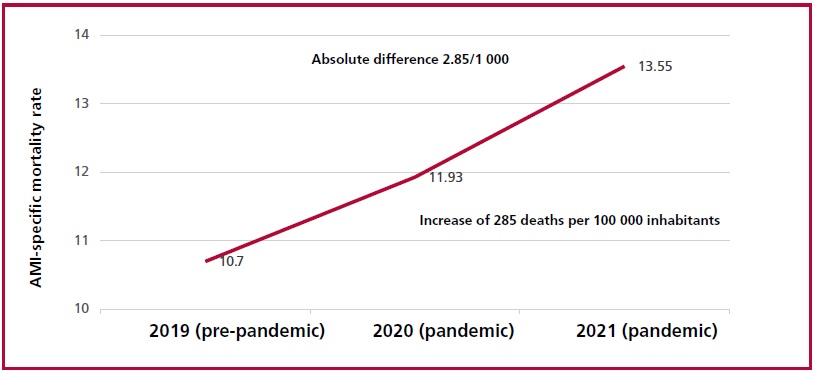
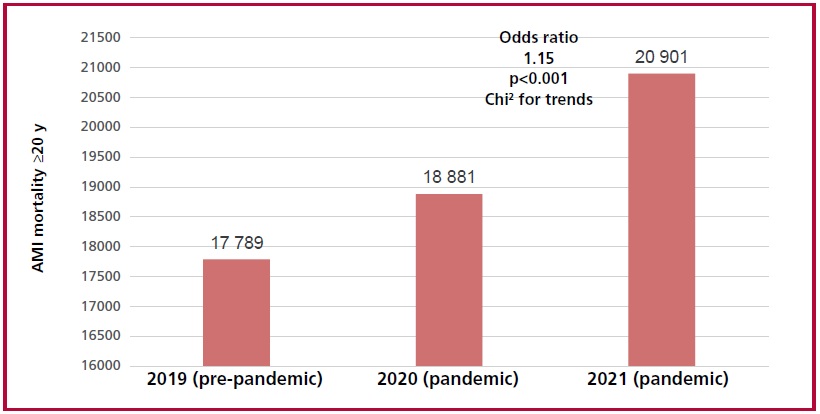
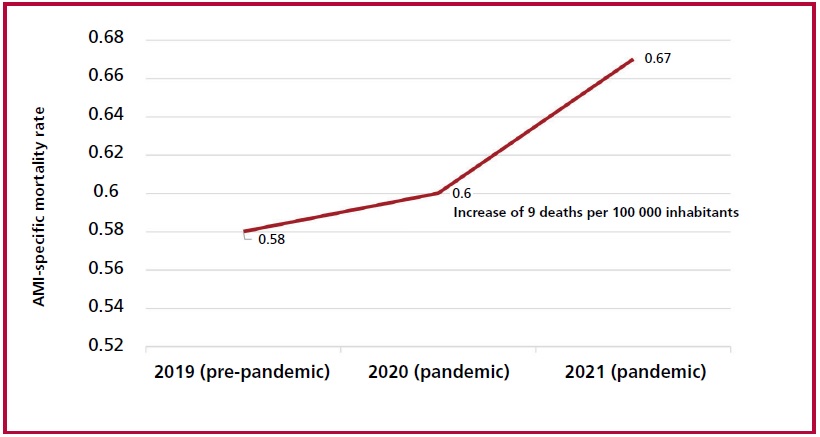
Table 1 shows 26% increase in overall mortality during the pandemic compared with the year 2019 (p < 0.001). This increase was mainly attributed to deaths caused by COVID-19: 53 096 and 84 480 cases in 2020 and 2021, respectively. Gross mortality increased by 13.5% (see Figures 1 and 2), which represents an absolute difference of 2.85 additional deaths per 1000 inhabitants compared with the period prior to the pandemic. In addition, AMI mortality increased by 15% compared with the pre-pandemic year (p < 0.001), following the same trend as overall mortality. The specific mortality rate for AMI was 0.67, which represented an absolute increase of 9 more deaths per 100 000 inhabitants in 2021 (see Figures 3 and 4).
Additionally, mortality for AMI increased by 19% in women compared with men (p < 0.001), together with a marked increase of 73% mortality in patients < 60 years (p < 0.001) (see Table).
DISCUSSION
Overall and AMI mortality
Recent estimations of the World Health Organization (WHO) reveal that the total number of deaths associated directly or indirectly with the COVID-19 pandemic between January 2020 and December 2021, termed as “excess mortality”, reached approximately 14.9 million cases. (8,9)
In accordance with these data, the Ministry of Health of Argentina reported an overall increase in mortality during the pandemic, with a peak of 26% in the first semester of 2021. (10)
These data totally agree with our own findings, despite our study population includes subjects ≥20 years.
Our research shows a significant increase of 15% in AMI mortality with respect to the pre-pandemic period, equivalent to an absolute value of 67 deaths per 100 000 inhabitants in 2021. Although there is lack specific statistical data on the incidence of AMI in Argentina, we base our conclusions on the REGIBAR study performed in Bariloche in 2017 by Calandrelli et al. (11)
This study reported an incidence of ST-segment elevation and non-ST-segment elevation myocardial infarction of 128 cases per 100 000 inhabitants and 46.7% lethality, with 90% of out-of-hospital deaths. When contextualizing these results, we observed that mortality passed from 45% in the pre-pandemic year to 52% in 2021, confirming and agreeing with the findings of the Bariloche study.
The data provided by the Ministry of Health vital statistics do not identify in-hospital and out-of-hospital mortality. However, in line with the REGIBAR study, demonstrating that 90% of AMI deaths are out-of-hospital, the combination of this trend with the marked decrease in procedures such as coronary angioplasties and central cardiac surgeries during the pandemic, together with the delayed times of patient consultation, suggest that excess mortality could be due to a collateral SPMI effect, especially considering that survival in AMI is time-dependent. (12-13)
An additional aspect deserves to be considered when approaching the increase in mortality, focusing on the direct consequences of the COVID-19 infection in the cardiovascular system. Recent investigations underline the virus capacity to directly affect the heart, with inflammatory and procoagulant responses that contribute to cardiovascular complications, evidenced by subendocardial injury and a marked increase of mortality in this group of patients. (14,15)
The relationship between the COVID-19 infection and preexisting cardiovascular conditions has been the subject of extensive attention in the scientific literature. Data from observational studies and meta-analyses suggest that patients with underlying cardiovascular diseases could face a substantially higher risk of severe complications and mortality for COVID-19, in addition to stimulating prothrombotic states. (16,17)
Moreover, it is essential to consider the possibility of erroneous AMI diagnoses, as these might be confused with myocarditis, a well-documented phenomenon in the present pandemic. (18)
This overlapping in the clinical presentations highlights the complexity in the identification between acute cardiovascular events and complications derived from the viral infection, adding a level of difficulty when approaching specific mortality associated with AMI.
Fig. 1.Increase of overall mortality with respect to the pre-pandemic period (2019) Mortality increased by 26% especially due to COVID-19 deaths.
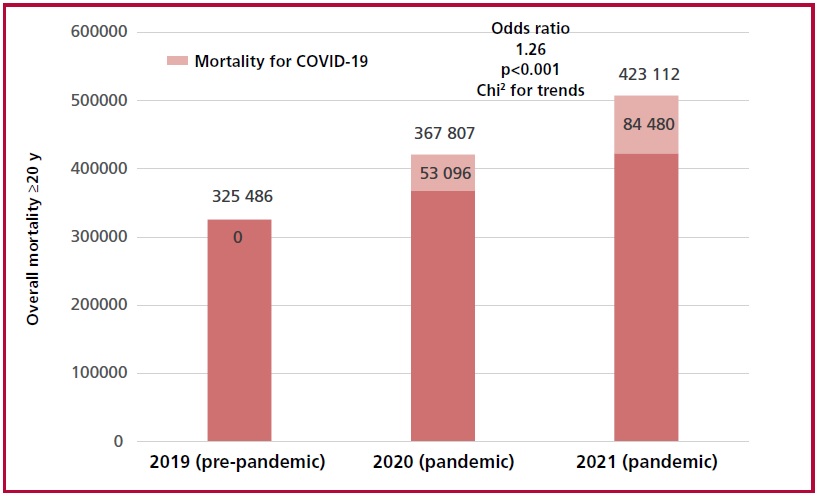
Fig. 2.Increase of gross mortality rate with respect to 2019 and number of deaths per 100 000 inhabitants.
AMI: acute myocardial infarction
Fig. 3.Increase of AMI mortality
AMI: acute myocardial infarction
Fig. 4.Increase of infarct mortality with a peak in 2021. AMI mortality rate.
AMI: acute myocardial infarction
Female subgroups and subjects below 60 years of age
The higher increase of female mortality is an aspect that deserves analysis. Although the underlying causes were not explored in this study, prior investigations have suggested that women tend to present atypical AMI symptoms compared with men, hampering diagnosis and the search for adequate medical care. Social and cultural barriers can also influence in the lower inclination of women to seek medical care, which could have been exacerbated during the pandemic, as well as the lack of knowledge that the main cause of female death is cardiovascular, as shown by Dr. del Sueldo et al. in a recently published survey in 1500 women, who perceived cancer as the main health problem, and where only 16% considered cardiovascular causes as the leading cause of death. (19) The impact of SPMI and the pandemic in younger groups also merit attention. The pronounced increase of AMI mortality in patients below 60 years agrees with a recent publication from the Centers for Disease Control and Prevention (CDC), showing that in younger and middle-age groups, AMI-associated mortality increased by 5.3% and 3.4%, respectively. Hypothetically, this could be attributed to different factors, as the perception of lower risk of cardiovascular disease in young populations, or the concern of hospital viral exposition. These trends are similar to reports on health behavioral changes during the pandemic, as the reduction of physical activity and the increase of an unhealthy diet, especially in the young population. (20-22)
Limitations
Death certificates have a strong limitation to confirm the cause of death in case this is not dubious, due to the lack of necropsies.
Infarct classification in the out-of-hospital setting is always speculative.
The incidence of AMI in Argentina is unknown.
We cannot rule out if only SPMI has been the cause of a greater prevalence of AMI deaths, or if a direct damage caused by COVID-19 could have played a role, due to the cytokine release syndrome, deregulation of the renin-angiotensin system, destabilization of the atherosclerotic plaque or coagulation disorders.
CONCLUSIONS
The present study highlights how a health crisis of great magnitude, as the COVID-19 pandemic, can have a significant impact on AMI mortality. The answers of Public Health, though necessary to control virus propagation, should also carefully consider the involuntary collateral effects in the care of other critical diseases. The adaptation of strategies to balance virus restraint with the provision of adequate medical care is essential to minimize unforeseen negative consequences in situations of crisis. This study contributes to the growing understanding of the complex interactions between cardiovascular medical care and global health rises.
https://creativecommons.org/licenses/by-nc-sa/4.0/

Conflicts of interest
None declared. (See authors' conflict of interests forms on the web).
Financing
None.
©Revista Argentina de Cardiología
REFERENCES
- https://www.who.int/europe/emergencies/situations/covid-19
- Ministerio de Salud de la Nación Argentina. “Ley N° 27.541 - Emergencia Pública en materia sanitaria.” https://www.boletinoficial.gob.ar/detalleAviso/primera/278683/20221230
- Mahmud E, Dauerman HL, Welt FGP, Messenger JC, Rao SV, Grines C, et al. Management of acute myocardial infarction during the COVID-19 pandemic: A Consensus Statement from the Society for Cardiovascular Angiography and Interventions (SCAI), the American College of Cardiology (ACC), and the American College of Emergency Physicians (ACEP). Catheter Cardiovasc Interv. 2020;96:336-45. https://doi.org/10.1002/ccd.28946
- D’Imperio H, Gagliardi J, Zoni R, Charask A, Castillo Costa Y, Marturano MP, y Col. Resultados de la Encuesta COVID-19. Impacto en la atención cardiovascular del Registro Nacional de Infarto ARGEN IAM-ST. Rev Argent Cardiol 2020;88:222-30. https://doi.org/10.7775/rac.es.v88.i3.18150
- https://www.argentina.gob.ar/sites/default/files/serie5numero63.pdf
- https://www.argentina.gob.ar/sites/default/files/serie5numero64_web.pdf
- https://www.argentina.gob.ar/sites/default/files/serie_5_nro_65_anuario_vitales_2021_-_web.pdf
- https://www.who.int/news/item/05-05-2022-14.9-million-excessdeaths-were-associated-with-the-covid-19-pandemic-in-2020-and-2021
- Nef HM, Elsässer A, Möllmann H, Abdel-Hadi M, Bauer T, Brück M, et al. CoVCAD-Study Group. Impact of the COVID-19 pandemic on cardiovascular mortality and catherization activity during the lockdown in central Germany: an observational study. Clin Res Cardiol. 2021;110:292-301. https://doi.org/10.1007/s00392-020-01780-0
- https://bancos.salud.gob.ar/sites/default/files/2023-03/excesomortalidad-argentina-2020-2021.pdf
- Calandrelli ME, Caminos M, Bocian JL, Saavedra ME, Zgaib ME, Bazán A y cols. Incidencia anual y letalidad del infarto agudo de miocardio en la Ciudad de San Carlos de Bariloche. Estudio REGIBAR. Rev Argent Cardiol 2017;85:428-434. Rev Argent Cardiol 2017;85:428- 34. http://dx.doi.org/10.7775/rac.es.v85.i5.10398
- Charask A, Gagliardi J, Tajer C, Castillo Costa Y, D ‘Imperio H, Marturano MP, y cols. Mortalidad por infarto agudo de miocardio en el registro continuo ARGEN-IAM-ST. Su Relación con las diferentes terapias de reperfusión. Rev Argent Cardiol, 2021;89:323-31. http://dx.doi.org/10.7775/rac.es.v89.i4.20412.
- Metzler B, Siostrzonek P, Binder RK, Bauer A, Reinstadler SJ. Decline of acute coronary syndrome admissions in Austria since the outbreak of COVID-19: the pandemic response causes cardiac collateral damage. Eur Heart J. 2020;41:1852-3. https://doi.org/10.1093/eurheartj/ehaa314
- Bonow RO, Fonarow GC, O’Gara PT, Yancy CW. Association of Coronavirus Disease 2019 (COVID-19) With Myocardial Injury and Mortality. JAMA Cardiol. 2020;5:751-3. https://doi.org/10.1001/jamacardio.2020.1105
- Shi S, Qin M, Shen B, Cai Y, Liu T, Yang F, et al. Association of Cardiac Injury With Mortality in Hospitalized Patients With COVID- 19 in Wuhan, China. JAMA Cardiol. 2020;5:802-10. https://doi.org/10.1001/jamacardio.2020.0950
- Nishiga M, Wang DW, Han Y, Lewis DB, Wu JC. COVID-19 and cardiovascular disease: from basic mechanisms to clinical perspectives. Nat Rev Cardiol. 2020;17:543-58. https://doi.org/10.1038/s41569-020-0413-9
- Zhang Y, Xiao M, Zhang S, Xia P, Cao W, Jiang W, et al. Coagulopathy and Antiphospholipid Antibodies in Patients with Covid-19. N Engl J Med. 2020;382:e38. https://doi.org/10.1056/NEJMc2007575
- Siripanthong B, Nazarian S, Muser D, Deo R, Santangeli P, Khanji MY, et al. Recognizing COVID-19-related myocarditis: The possible pathophysiology and proposed guideline for diagnosis and management. Heart Rhythm. 2020;17:1463-71. https://doi.org/10.1016/j.hrthm.2020.05.001
- Del Sueldo M, Brienza S, Lorenzatti A, Gutierrez N, Brocal L, Ribotta M, y cols. Percepción, conocimiento y conductas preventivas sobre enfermedad cardiovascular entre mujeres argentinas. Rev Fed Arg Cardiol 2022;51: 68-77
- Januar Wibawa M. COVID-19 and Cardiovascular Complications: An Updated Review. Open Access Macedonian Journal of Medical Sciences. 2021;9:712-9 https://doi.org/10.3889/oamjms.2021.7235
- Yeo YH, Wang M, He X, Lv F, Zhang Y, Zu J, et al. Excess risk for acute myocardial infarction mortality during the COVID-19 pandemic. J Med Virol. 2023;95:e28187. https://doi.org/10.1002/jmv.28187
- Rodríguez-Leor O, Cid-Álvarez B, Pérez de Prado A, Rossello X, Ojeda S, Serrador A, et al. Impact of COVID-19 on ST-segment elevation myocardial infarction care. The Spanish experience. Rev Esp Cardiol (Engl Ed). 2020;73:994-1002. https://doi.org/10.1016/j.rec.2020.08.002