http://dx.doi.org/10.7775/rac.v91.i1.20599
SPECIAL
ARTICLE
Dimensions of Truth in Cardiology Consultation
Las dimensiones de la verdad en la
consulta cardiológica
Carlos D. Tajer1,
MTSAC, FACC, FESC
1 Hospital El Cruce
Dr. Néstor Kirchner. Provincia de Buenos Aires.
Address
for reprints: e-mail: ctajer@gmail.com
1 This article
initially arose from a first conference at the Academy of Medicine on June 17,
2021 at the Virtual Seminar on Scientific Truth in the Post-truth Era, and a
second on October 22, 2022 at the 48th Argentine Congress of Cardiology.
The clinical practice of consultation requires an interpretation
of the conditions reported by the patients, their diagnostic characterization,
eventual therapeutic indications and an explanation of what can be expected
and what should be done. My intention is to propose a reflection on the
dimensions of truth in each of these steps of the consultation and to what
extent each of them is guided by a solid scientific support that legitimizes
our practice.
How close can we get to the truth about the real suffering of
patients? I report a case. An 83-year-old female patient, whom I have been
treating for many years for easily controlled high blood pressure, referred to
me multiple recent symptoms: dyspnea on exertion, nocturnal palpitations, and
frequent sighs.
- Do I have an enlarged heart? At my age there are many
people who have enlarged hearts. With my age and all that happens to me, it
seems to me that something is going to happen to me, I have little life left.
From a phrase from her husband present at the consultation,
she hinted that he suffers from cognitive problems, an initial Alzheimer.
I examined her, initially ruling out cardiac problems that
would explain her symptoms, and I was encouraged to say:
- I am not a psychoanalyst, but it seems to me that all these
comments about an enlarged heart, the arrhythmias, the sighs, the fear of
death, perhaps hide the desire to get sick and not have to suffer what you see
as a nightmarish future.
- Don't think I haven´t thought about it, doctor.
The fear of death is a frequent reference in cardiology
consultations. The book Staring at the Sun by Irvin Yalom, (1) a psychotherapist with experience in
terminally ill patients, proposes this metaphor about thinking of death: you
can stare at the sun for brief moments, but holding your gaze burns your eyes.
The main conclusion of the book is that this fear indicates a lack of
perspective of personal developments, a scenario in which it is difficult to
imagine future pleasant contexts, as reflected in this patient.
This is a close-up of the truth, the relationship between the
symptom and an eventual disease that must be distinguished from what we could
call life ailments, symptoms that inform us of particular emotional moments. A
very arduous task in the cardiology office, both in healthy people and in
patients with known diseases. Thus, a patient who underwent heart surgery can
also consult for pain, palpitations or dyspnea, and we must explore what is
really happening in his/her life.
Table. Dimensions and
questions about the truth in the doctor’s office

About the disease that I can diagnose
This field is closer to the "scientific truth",
with the help of diagnostic methods, a relevant part of cardiology science. We
know their sensitivity, specificity and predictive value, and we apply them on
a daily basis. In Figure
1 we
exemplify an excellent method, with 90% sensitivity and specificity, applied in
a check-up to an asymptomatic person (1% prevalence). When it is positive, most
people are healthy, they are false positives.

TP: true
positive. FP: false positive.

TP: true
positive. FP: false positive.
Fig. 1.
1A. In a population of 1000 people with a low prevalence of
disease (1%), a method with 90% sensitivity and specificity, when it is
positive, results in a rate of 8% true positives and 92% false positives. 1B. The same method applied to a population
of 1000 people with a disease prevalence of 40%, when it is positive, raises
the rate of true positives to 86% and the rate of false positives to 14%.
Here lies the clinical capacity to listen and define symptoms
and risk, to detect candidates for studies in which they yield the best
benefit, and in the common uselessness of indiscriminate check-ups applied to
healthy people. When we start from a suspected probability of 40% with the same
method, most of the positives are true and false positives are greatly reduced.
This selection is essential; it implies approaching the
disease through the symptom and the epidemiological context. The complexity is
even greater; the disease does not always justify the symptom: patients with
coronary heart disease have chest pain from any other cause. Or an elderly
person with aortic stenosis who is breathless when climbing a flight of stairs,
but perhaps due to lack of exercise the dyspnea is not related to the disease,
with the serious implications the symptoms have that could lead to a surgical
indication.
As a summary, these first two reflections on true diagnoses
and the level of truth that we can achieve through careful listening and
diagnostic methods show us a very complex task, which requires distinguishing
the ailments of life from a serious symptom, where a mistake can be
catastrophic. It is possibly the most relevant role of clinical experience.
About the benefits that my treatments or recommendations will
exert
There is solid scientific data to decide treatments in
different clinical contexts, the powerful arsenal of evidence-based medicine.
Large clinical trials are in many scenarios undisputed scientific evidence that
leads us to a more comfortable perspective that is approached with confidence.
As explained in Figure
2, with
the same degree of conviction as Tulp in body mechanics and clockwork, we trust
the probabilistic approach and the significant p-value for therapeutic
evaluation. (2)

Fig. 2. Rembrandt’s painting,
Doctor Tulp’s Anatomy Lesson. Dr. Tulp pulls an arm tendon with the forceps and
with his left hand he moves the finger. The message is clear: I understand the
mechanics of the human body, I know that pulling this tendon will move this
finger. We added our new conviction at the p level.
As an example, we will consider the EMPEROR-Preserved study (3) (Figure
3) which
reduced the composite event by 21%, with a highly significant p. This finding
guarantees us that empagliflozin is better than placebo, and we feel confident
with its indication. How do we interpret this information for decision-making
in the individual patient? In the first place, the benefit in a large study
will be reflected in the guidelines as an indication with Class I
recommendation, so we start from a strong conviction of its usefulness.

Fig. 3. EMPEROR study.
Empaglifozin in heart failure with preserved systolic function. A reduction in
the cumulative incidence of major events is observed with a highly significant
p. The incidence of the event was 13.8% vs. 17.1% in favor of the drug.
Evidence-based medicine has been of great importance in the
professional life of a cardiologist my age. In my first years of residence,
after an uncomplicated heart attack, a patient was discharged with recommendations
for rest and diet, without any additional treatment. Today patients are
discharged with at least four medications that reduce mortality by 80% and
prolong life for many years, (4) and we clearly perceive this
improvement in the outcome of our patients.
But even with this strength of evidence, the problem is the
dimension of truth to apply to an individual patient.
The empaglifozin trial lowered the incidence of the main
event from 17.1 to 13.8%, an absolute reduction of 3.3% compared with placebo,
a highly statistically significant reduction. What does this reduction mean in
terms of what we now call population medicine? If 100 people with this disease
consulted us, 17 would be hospitalized or have cardiovascular death in the next
26 months, and when we applied empagliflozin we would reduce this risk to 14.
It is clear that 97 of those 100 patients who consulted us will
not change their outcome with the treatment. No complications will occur in 83
patients, 14 will develop complications despite the treatment and we will
change the course of 3. (Figure
4)
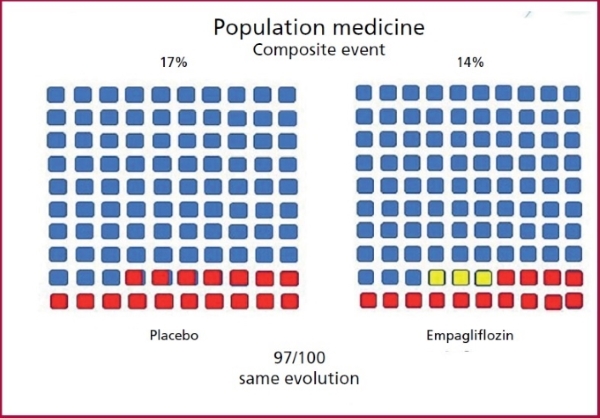
Fig. 4. Conceptual diagram
of the impact of population medicine. On the left, in the placebo group, 100
patients are represented, 83 with blue boxes that will not undergo
hospitalization or cardiovascular death, and 17 with red boxes, who will have
this composite event. On the right, the three patients who modified their
course with empagliflozin and avoided the event are seen with yellow boxes.
Does that give us authority to say that we should prescribe
empagliflozin to all patients with this same problem? Is this true? The
Handbook of the Philosophy of Medicine, (5) dedicates a juicy chapter to evidence-based medicine. I will
only take the epistemological critique regarding the validity of our
demonstration of the truth and its application to the individual patient.
Do clinical trials, on which
evidence-based medicine stands, prove causality? We believe so, without any doubt. In other words, if we
evaluate a comparative treatment in two groups, and the two groups are the same
except for the treatment and this is associated with lower mortality, this
effect is causal.
A first objection that is raised is that causality does not
prove a mechanism. We know that aspirin administered in the first hours of an
infarct reduces mortality, but we do not know why it does so, or whether we can
extend this beneficial effect to other drugs with similar mechanisms. But a
more complex and relevant aspect is whether the evidence from a controlled
trial can assure me that if I prescribe this treatment to a patient, it will be
beneficial for him.
With the same conceptual line, the philosopher Nancy
Cartwright published in The Lancet a critique of the truth of randomized
clinical trials. (6) She claims that the logic of clinical
trials assumes a first premise, that the probabilistic effect in favor of a
treatment requires a causal explanation. That is, if I reduce mortality
probabilistically, that is caused by the intervention. Why? Because the second
premise tells us that the out-of-treatment parameters are the same, since the
treatment assignment was random and the groups were equal. The only possible
logical explanation for the result of the treatment is the change of outcome in
some members of the group. This is very clear. But this statement brings us a
great difficulty: it changed the outcome of the group by changing the outcome
of some of its members.
How do we translate this knowledge that a proven treatment in
the final result of a clinical trial is proof that it will cause this result in
our patient? The result of the trial is only part of an evidentiary argument.
We can tell the patient: this drug empagliflozin is very good; I'm going to
indicate it to you because it is generally beneficial for the health, but it
doesn't do anything to some and it is probably harmful for others. We do not
have a hard truth in that regard. We start from an argumentative basis for
decision making, but it is very difficult to go from these probabilistic
results supported by clinical trials to the detailed and particular knowledge
that we require in the clinical context for an individual person.
We know that it is feasible to reproduce these positive
results in some of our patients. Could we step up and try to identify those
participants who will benefit? What methods do we have?
From subgroup analysis to precision medicine
One tool is subgroup analysis. In the empagliflozin study, it
was observed that patients with left ventricular ejection fraction more than
60% and those under 70 years of age obtained less benefit than the others. But
this observation arouses immediate mistrust in us, at least in cardiologists of
my generation, due to the memory of the ISIS II study. (7) The Lancet required them to publish effects
on subgroups, and researchers who did not wish to do so introduced a misleading
analysis. Aspirin lowered mortality by 20% in the general population; grouped
according to the zodiac signs, Gemini and Libra patients had a 9% increase in
mortality and patients with other zodiac signs had a 28% reduction. (8) The message was very clear: it is
fun to analyze subgroups, but do not believe what it looks like, it is almost
always fictitious. This knowledge left us with a positive methodological mark,
not believing or mistrusting the subgroups, but on the other hand it increased
our uncertainty because each patient has a particular age, gender and history,
that is, each patient belongs to certain subgroups.
In an analysis scheme on the sources of evidence in relation
to the individual case, Upshur (9) proposed dividing into qualitative
aspects that require what we call medical humanism, the quantitative population
aspects, which can be sustained on evidence-based medicine, and the
quantitative personal ones, which we could identify today with precision
medicine (Figure 5).

Fig. 5. Dimensions of the
sources of evidence. Upshur (9).
Could we build precision medicine in cardiology? (10) This approach tends to recognize
that we can resort to immense information in the individual case, from the genome,
transcriptome, proteome, metabolome, exposome, concentrate millions of data, do
stratified analyses and conclude that aspirin will be beneficial for this
person.
The application of genetic markers has had an important
development in oncology, since they condition the natural evolution and
responses to treatments. In cardiology the development is lower and for now
without any practical application. (11) An implicit limitation is the
magnitude of the information: in order to process, analyze and decide with this
future approach, we will need another way of practicing medicine, supported by
artificial intelligence or even robotic medicine. The analysis of this magnitude
of information for the individual case is beyond the reach of our brain.
To summarize this third reflective step on the truth in the
office in front of an individual case, evidence-based medicine gives us confidence
to adopt behaviors, scientific truths that are population and general truths.
But there is a limited amount of evidence for many more problems that are not
studied, and in turn we have the limitation that we practice population
medicine; we do not know what will happen to this person with this new
treatment.
Here I allow myself a small digression on the recommendations
that I try to avoid in the office. It is common that after a heart attack the
patient is told: from now on you have to eat without salt, eat less fat, change
your diet; if you have low vitamin D you should receive a supplement and you
have to lose those extra kilos even if you are not obese. Since each one lacks
evidence or has evidence against it, I do not make these recommendations; at
least I prefer not to tell lies or add unnecessary care.
About what we communicate concerning the disease and the
future scenario
This last reflection is aimed at
exploring the dimension of the truth of what we communicate about the disease
and future prospects. We are entering a different terrain, that of discourses
and metaphors. Lakoff and other authors brought a revolutionary change in the
understanding of metaphors as essential resources of thought. (12) We cannot
think about complex aspects of life without metaphors, and what is most
exciting is the definition that “we inhabit our metaphors”. As an example, we
can ask ourselves what medicine is and what are we doctors: Artists? Priests? Warriors against disease?
Mechanics that repair malfunctioning organs?
If I inhabit the metaphor of medicine as art, I live the
relationship with patients in that way. As an exaggeration, I am the artist and
the patient is a canvas on which I paint my work. We inhabit different metaphors
as ways of dealing with the relationship with patients and relatives from a
medical perspective.
What role does the metaphor play? It allows us to understand
one aspect of one domain through a different domain. If I state that the
paths of life take us here or there, that this journey that we have begun together
will take us wherever it leads, I describe life as a journey. I use the
conceptual metaphor life is a journey through multiple expressions. When
I inhabit the metaphor of life is a journey, just as when I selected to
inhabit medicine with the metaphor of the artist, correspondences are generated
that stick from one domain to another. If life is a journey, it has meaning,
destiny, speed, obstacles, risks, crossroads. Anything that a journey has can
be referred to as a metaphor of life. But life cannot be summarized only as a
journey, it can admit many other metaphors, which is usual for complex
subjects.
Metaphors are very relevant to interpret the patient's story
and communication, to recognize how he explains his condition, his illness and
his future scenario.
In turn, metaphors are a very relevant resource for medical
rhetoric, that is, the discourses that we elaborate a priori, or often
improvise, in order to address the questions and concerns of patients and family
members.
It is a challenge to become aware of the possibility of
building more appropriate metaphors to explain diseases and treatments, which
contribute to generating a more pleasant life and better adherence.
I am going to read you a brief story from a book by Juan
Forn, I will remember for you. (13)
“He came to see doctors for an ailment that did not leave
him. It was a terminal cancer, but no one dared to tell him. They had admitted
him to Hospital de Clínicas with an outpatient permit, while they made him
believe that they were submitting him to studies and preparing him for an
operation. One day wandering through the basement of the hospital, Horacio
Quiroga found a patient named Batistessa. They had him hidden there because of
his physical appearance, caused by a neurofibromatosis known as elephantiasis.
Quiroga demanded that Batistessa be taken out of the basement and transfered to
his room, and in idle hours he told him stories of the jungle. One day Batistessa
heard the doctors talking and went to tell Quiroga that the supposed operation
they had promised him was actually a simple and painful postponement of death.
Quiroga said that he was going for a walk, went to a hardware store to buy
cyanide, returned to the hospital, mixed the powder in a glass with whiskey and
swallowed it.”
Tell the truth.
In medical ethics it implies the moral duty to be honest with
patients about health conditions, medications, procedures and risks, and this
can often be unpleasant, but it is usually necessary.
How do we say it's true? How do we raise it? How do we
empathize with patients?
What is the future scenario that we project to the patient
and his family?
Everything we communicate about the disease and the future
scenario must be true. Hiding implies a metaphor for the horrendous, the
ineffable, what cannot be said or spoken. It is counterfactual, but they could
have informed Horacio Quiroga better, helped him to a better death or perhaps a
last story that would have brightened our lives.
How do we cultivate this subject? One possibility is to
generate metaphorical scenarios through research. The metaphor menu for people
living with cancer is a contribution from linguists that proposes 17 metaphorical
scenarios as opposed to the usual metaphor of the war against cancer. (14)
We can choose from the menu a metaphor according to what we perceive
in the patients. Living with cancer can be a stone in your shoe: you will have
a stone all the time that will bother you, but it will not prevent you from
walking. Or a difficult path, with obstacles, slopes, crossroads and
deviations. Or a roller coaster: you will have a moment of chemotherapy or
perhaps surgery, have dizzying ups and downs, but we will always be here
waiting for you to give you a hand.
These are possible metaphors in cancer communication. We have
a lot of evidence in everyday medicine about the power of language and
narrative to heal, but it can also harm. (15) Words and metaphors are more prone to harm when we do not
have narrative competence, when we say it wrong. I had the evil of collecting
some medical verbal abuse, (16) hundreds of terrifying phrases that
all doctors say, unfortunately, including myself.
How do we acquire narrative competence?
The first step is to approach the subject with humility,
recognizing that we have deficiencies in this sense, and supplying them with
training in reading, writing, and group reflection workshops. With a group of
colleagues in July 2022 we founded the Society for Narrative Medicine and we
are hopeful that it will grow as a discipline in the coming years. (17)
What is the truth and what is the source of legitimacy of
medical practice?
Throughout the article I referred to
the truth, without trying to define it. It is a key question of philosophical
thought. We can resort to one of Aristotle's definitions: “to say of what is
that it is not, or of what is not that it is, is false. To say of what is that
it is and of what is not that it is not, is true.” The truth is a
correspondence between what we say and an objective reality that we know. The
conception of truth has had an infinite number of questions and approaches. One
of Nietzsche's famous phrases there are no facts, only interpretations
accompanies the synthesis that Darío Sztajnszrajber makes of his conception: What
is truth? The
most efficient lie. (18) Truth is thus a cultural, temporary
and relative construction.
As a final thought
It is not easy to reach a firm conviction about our access to
the truth in the four dimensions raised with the limitations that I have tried
to point out, to which is added the great philosophical complexity of the subject.
In the consultation practice, we try to find the truth and thus reach the most
solid scenario, but we go through slippery terrain, from the uncertainty in the
interpretation of the symptoms, in the indications, in the interpretation of
the patients' speech and in the elaboration of our medical rhetoric. This
fragility may question whether we practice true and valuable medicine.
I will resort to the help of another contemporary
philosopher, Fredriksen, (19) who in his article Diseases are
Invisible, explains that medicine is not a positive science, based on
unquestionable facts, but rather a normative science, a practice with values. Values
such as care, compassion and solidarity guide and legitimize medicine, not
precision or truth as such.
I move on to a last metaphorical scenario, medicine for Pérez
Tamayo, which is the one I try to inhabit. (20) Medicine is a space for the encounter between a being
that suffers and another that tries to alleviate it. This relief comes from
a practice with the greatest dimension of scientific and technical truth, based
on the values of care, compassion and solidarity that legitimize it.
Conflicts of interest
None declared.
(See authors' conflict of interests forms on the web/Additional
material.)
1.
Yalom I. Mirar al sol. Editorial Destino.2021
2.
Rembrandt . Lección de anatomía del Dr. Nicolaes Tulp.
1632. La Haya.
3. Anker SD, Butler J, Filippatos G, Ferreira JP,
Bocchi E et al. EMPEROR-Preserved Trial Investigators. Empagliflozin in Heart
Failure with a Preserved Ejection Fraction. N
Engl J Med 2021;385:1451- 61. https://doi.org/10.1056/NEJMoa2107038
4. Yusuf S. Two decades of progress in preventing
vascular disease. Lancet 2002;360:2-3. https://doi.org/10.1016/S0140-6736(02)09358-3
5.
Rogers W, Hutchison K. Evidence-Based Medicine in Theory and Practice:
Epistemological and Normative Issues. 851-872. En Schramme T, Edwards S. Handbook
of the phylosophy of medicine. Springer. 2017. https://doi.org/10.1007/978-94-017-8688-1_40
6. Cartwright N. A philosopher’s view of the long road
from RCTs to effectiveness. Lancet
2011;377:1400–1. https://doi.org/10.1016/S0140-6736(11)60563-1
7. Randomised trial of intravenous streptokinase, oral
aspirin, both, or neither among 17,187 cases of suspected acute myocardial infarction:
ISIS-2. ISIS-2 (Second International Study of Infarct Survival) Collaborative
Group. Lancet 1988;2:349-60. https://doi.org/10.1016/S0140-6736(88)92833-4
8. Sleight P. Subgroup analyses in clinical trials:
fun to look at- but don’t believe them! Current
Control Trial Cardiovasc Med 2000;1:25- 7. https://doi.org/10.1186/CVM-1-1-025
9. Upshur RE. If not evidence, then what? Or does
medicine really need a base? J
Eval Clin Pract 2002;8:113-9. https://doi.org/10.1046/j.1365-2753.2002.00356.x
10.
Tajer C. Medicina de precisión o medicina personalizada en Cardiología.
¿Utopías o distopías? 31-42. En Doval H, Tajer C. Evidencias en Cardiología.
Ediciones GEDIC. 2019
11. Antman E, Loscalzo J. Precision medicine in
Cardiology. Nature Reviews Cardiology 2016;13:591-602. https://doi.org/10.1038/nrcardio.2016.101
12.
Lakoff F, Johnson M. Metáforas de la vida cotidiana. Ediciones Cátedra. 2005.
13.
Forn J. Yo recordaré por ustedes. Emecé. 2021.
14.
Semino EA. Metaphor menu for people living with cancer. Lancaster University
15.
Coulehan J. Metaphor and Medicine: Narrative in Clinical Practice. Yale Journal
of Biology and Medicine 2003;76: 87-95.
16.
Tajer C. Maltratos verbales médicos. https://www.intramed.net/contenidover.asp?contenidoid=86545
17.
Página de la Sociedad Argentina de Medicina Narrativa. https://socmedicinanarrativa.wixsite.com/site
18.
Sztajnszrajber D. La filosofía en 11 frases. Editorial Paidós.2014.
19. Fredriksen S. Diseases are invisible. J Med
Ethics: Medical Humanities 2002;28:71–73. https://doi.org/10.1136/mh.28.2.71
20.
Perez Tamayo R. Serendipia: ensayos sobre ciencia, medicina y otros sueños,
Siglo XXI Editores. 1980