

INTRODUCTION
The integration of artificial intelligence (AI) into clinical practice enables different approaches. In its most basic form, AI is a useful tool for conducting targeted literature searches and answering specific clinical questions. Its value has been demonstrated in research and in the writing of medical texts.
Nevertheless, the most significant potential of AI does not lie in its capacity to provide information in isolation; rather, its true value lies in its integration within an interactive reasoning process. When AI is interrogated by simulating a conversation among colleagues, it enables users to explore hypotheses, refine interpretations, and prioritize evidence within a specific clinical context.
In this sense, it ceases to function as a mere reference tool and evolves into a dynamic aid to clinical reasoning, with the capacity to support, though not to replace, the decision-making process.
The aim of this presentation is to analyze, using a fictional clinical case, the role of artificial intelligence integrated into medical conversation. This analysis will highlight the contributions, limitations, and interactions of artificial intelligence with clinical judgment.
CLINICAL CASE
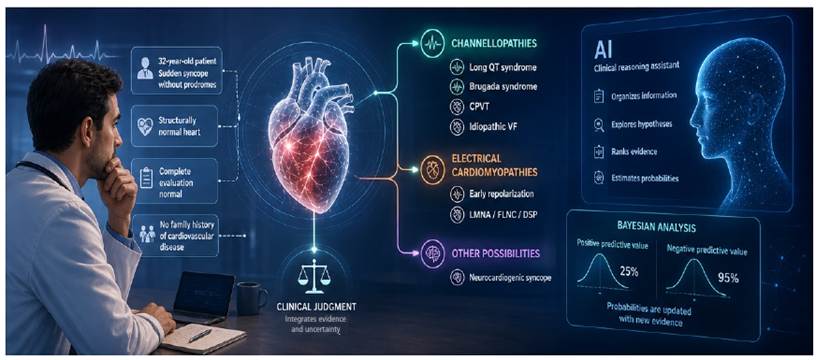
A 32-year-old patient experienced an episode of syncope without prodromal symptoms, accompanied by loss of consciousness, while walking on the street during a heated argument. He recovered quickly and fully after receiving initial care and was transferred to a high-complexity center. The patient was admitted for continuous electrocardiographic monitoring.
The episode was clinically defined as "probable arrhythmic syncope."
A comprehensive cardiovascular assessment was performed.
His medical history revealed no use of medication, vitamin supplements, hormonal treatments, or other substances. There was no family history of cardiovascular disease or sudden cardiac death.
The physical examination and ECG were normal. Laboratory tests, including thyroid function tests, were within normal ranges.
Doppler echocardiography and magnetic resonance imaging ruled out structural cardiovascular disease. The coronary arteries did not present obstructive lesions on coronary computed tomography angiography. The stress test results were normal, with the patient reaching an exercise load appropriate for his age and weight. There were no abnormalities on the ECG during exercise or recovery. A pharmacological test with flecainide also showed no abnormalities.
DIFFERENTIAL DIAGNOSIS
Question
In a young patient with probable arrhythmic syncope and a structurally normal heart, is it appropriate to consider the presence of a channelopathy as a differential diagnosis? What is the likely order of probable etiologies in terms of probability?
Answer
Yes, in this clinical context, the differential diagnosis is primarily directed towards channelopathies. Among the diagnostic possibilities, ranked in order of probability, the following should be considered: (1)
-
Idiopathic ventricular tachycardia
-
Long QT Syndrome (LQTS)
-
Catecholaminergic polymorphic ventricular tachycardia (CPVT)
-
Brugada syndrome
-
Early repolarization syndrome
-
Short QT syndrome
The relative probability depends on the clinical context, the ECG and the results of the ancillary tests.
Question
Are there any particular considerations regarding early repolarization syndrome and short QT syndrome?
Answer
Early repolarization may represent a benign condition when the ECG shows J-point elevation with an upward-sloping ST-segment in inferior or lateral leads. However, even in the presence of probable arrhythmic syncope, the finding should be interpreted with caution. In these circumstances, the morphology of the ST-segment and the clinical context become particularly important, as an isolated ECG finding is insufficient to establish the clinical significance of the pattern. (2)
As for short QT syndrome, its incidence in the general population is extremely low.
ROLE OF GENETIC TESTING
Question
When investigating a channelopathy, would it be appropriate to request genetic testing?
Answer
In a patient with probable arrhythmic syncope and negative initial test results, an implantable loop recorder is a reasonable strategy for documenting the responsible arrhythmia.
At the same time, genetic testing may be considered if the differential diagnosis includes inherited channelopathies such as:
Question
What is the prevalence of these three channelopathies in the general population?
Answer
In the general population, the prevalence of a positive genotype, with or without an associated phenotype, varies for each condition: as a rough estimate, LQTS 2.5%, Brugada syndrome 0.2%, and CPVT 0.07%. Penetrance-the percentage associated with the positive phenotype-averages 15-20% and is much higher in LQTS than in the other two. These prevalences rise substantially when we consider the relatives of an index case.
In the detailed clinical context, the probability of identifying a pathogenic variant is relatively low (approximately 10-20%), and variants of uncertain significance are often identified. Therefore, genetic testing is not a substitute for documentation of arrhythmias. and does not determine the indication for an implantable cardioverter-defibrillator (ICD) by itself. The primary usefulness of genetic testing is for diagnosis and within the context of family screening. (8)
PROBABILITY AND BAYESIAN ANALYSIS
Question
Is it possible to apply Bayesian analysis to assess the impact of genetic testing on clinical management?
Answer
Conceptually, Bayesian analysis can be used to estimate how a test result modifies the probability of a clinical event occurring.
In this scenario, the following definitions could be used:
-
Event to be predicted: future malignant ventricular arrhythmia (resuscitated cardiac arrest or sudden cardiac death).
-
Pretest probability: in this case, the pretest probability is the baseline risk of experiencing the clinical event (malignant ventricular arrhythmia) in a patient diagnosed with ‘probable arrhythmic syncope and a structurally normal heart’ (negative phenotype)
-
Positive test: identification of a pathogenic genetic variant associated with channelopathies as a predictor of the clinical event.
In a theoretical model, the following values can be applied: (9,10)
-
Pretest probability: 10% / 10 years
-
Sensitivity (S): 60%
-
Specificity (Sp): 80% The result of the calculation is:
-
Positive predictive value (PPV): 25%
-
Negative predictive value (NPV): 95%
In other words, according to the calculation, if the test is positive, the probability of experiencing a resuscitated cardiac arrest or an episode of sudden cardiac death is 25% over 10 years; if the test is negative, that probability falls to 5%.
Question
Do the calculated values apply to the three channelopathies selected for evaluation-Brugada, LQTS and CPVT?
Answer
The calculation can be interpreted as an overall estimate for a channelopathy in a patient with arrhythmic syncope and a structurally normal heart. However, genetic sensitivity varies greatly depending on the syndrome, and the test described above applies only to the clinical presentation outlined. (10)
In this case, the PPV and NPV are reasonably reliable for Brugada syndrome and CPVT, but only approximate for LQTS due to its greater heterogeneity and lower phenotypic expression in certain scenarios. However, the overall PPV is comparable across the primary channelopathies when the clinical pretest is similar.
In conclusion, in LQTS the PPV may be lower in cases with a borderline phenotype and a lower pretest probability, but it is not inherently lower.
FAMILY SCREENING FOR CHANNELOPATHIES
Question
Assuming that the same genetic variant as in the patient or index case is confirmed in a relative with no cardiovascular disease or personal history, do the PPV and NPV vary in the index case?
Answer
In this case, the pretest probability of the index case is likely to be higher, at 15%, so that, with the same S and Sp, the PPV rises to 35% and the NPV remains unchanged at 92%. (10,11)
Question
And in the case of the family member, with a positive genotype and negative phenotype (G+ / P−), what are the PPV and NPV?
Answer
The pretest probability, or risk of experiencing a future episode of resuscitated cardiac arrest or sudden cardiac death, is low, perhaps close to 3% at 10 years, meaning that the PPV falls to 9% at 10 years and the NPV rises to 99% over the same period. (10,11). It should be noted that this pretest probability in the general population is much lower than that of relatives of the index case with G+/P−.
Question
Is it possible to create a comparative table of the Bayesian analysis for the three scenarios considered?
Answer
Yes, of course. (Table 1). In these scenarios -index case by relative, with positive or negative genotype, and relatives with positive genotype but negative phenotype- the Bayesian analysis is based on uncertain assumptions; therefore, the numerical estimates are limited. The usefulness of Bayesian analysis lies in its conceptual framework for probabilistic interpretation, which frequently underpins clinical decision-making.
Table 1
Bayesian analysis of the 10-year probability of serious arrhythmic events in the index case with a positive genotype and positive phenotype (G+/P+), according to the genetic status of the family member [negative genotype (G−) or positive genotype (P+)], and in the family member with a positive genotype and negative phenotype (G+/P−). The pretest probability differs between scenarios, whilst sensitivity and specificity are considered constant. Consequently, the positive predictive value (PPV) and negative predictive value (NPV) vary depending on baseline risk.
| Variable | Preliminary test (%) | Sensitivity (%) | Specificity (%) | PPV (%) | NPV ( %) |
|---|---|---|---|---|---|
| Family member G+/P− | 3 | 60 | 80 | 9 | 99 |
| Index case G+/P+ (family member G−) | 10 | 60 | 80 | 25 | 95 |
| Index case G+/P+ (family member G+) | 15 | 60 | 80 | 35 | 92 |
GENETIC TESTING: CONSISTENCY IN RISK ESTIMATION
Question
How reliable are the PPV and NPV calculations resulting from Bayesian analysis?
Answer
In inherited channelopathies as LQTS, Brugada syndrome or CPVT, the sensitivity of genetic testing, derived from series of specialized centers with phenotypically clear patients, is considered relatively reliable. Conversely, the pretest probability and specificity estimated from low-prevalence population-based studies are much more uncertain. This uncertainty mainly affects the estimation of the PPV and NPV, which can vary significantly depending on the population and phenotype definition. (11,12)
Question
So, even if the calculated PPV for the index case was about 25%, could the indication for ICD still be unjustified?
Answer
Although a calculated PPV may indicate a high risk (≈ 25%) in modeled scenarios, for the reasons already discussed it should be interpreted as a relative guide and not as an absolute risk. The clinical decision, such as the indication for ICD, must combine phenotypic evidence with the uncertainty of genetic and clinical parameters, recognizing that, while genetic sensitivity remains more robust, the other statistical factors are less reliable. (13)
Question
So, the conclusion would be…
Answer
Genetics informs and underscores the diagnostic suspicions, but the absolute risk of sudden cardiac death or arrhythmic shock, clinically suspected, remains the primary criterion for indicating an ICD. This is precisely what justifies the observation: "While a Bayesian calculation may show a high PPV, therapeutic decisions require direct phenotypic evidence, as genetics alone does not define absolute risk."
The patient experienced an episode of syncope without prodromal symptoms during emotional stress while walking. Recovery was spontaneous; subsequent electrocardiographic and structural workups were unremarkable, and there was no family history of sudden cardiac death. Upon initial review, this presentation could be classified as "improbable sudden cardiac death", as no instances of ventricular fibrillation or resuscitated cardiac arrest were documented. According to the established guidelines, the indication for an ICD is not rational. Genetic testing may help confirm the diagnosis and guide family surveillance; however, therapeutic decisions should be based primarily on the clinical phenotype (clinical presentation) and documentation of the arrhythmia. Continuous electrocardiographic monitoring and close follow-up are recommended until a high-risk episode is documented. (10-12)
Question
How should the family member be managed?
Answer
In a first-degree relative with a negative cardiovascular assessment who is a carrier of the variant (G+/P−), the recommended approach is: (10)
-
regular clinical monitoring
-
education on warning signs
-
early management of fever
-
avoid proarrhythmic drugs (especially in Brugada syndrome and LQTS)
CARDIOMYOPATHIES WITH EARLY ELECTRICAL PHASE
Question
Is it possible for a structural cardiomyopathy with minimal changes undetectable by standard methods to initially manifest with severe arrhythmias?
Answer
Yes, some cardiomyopathies may initially present an early electrical phase, in which electrical instability precedes evident structural changes. This can be observed in: (13)
-
arrhythmogenic cardiomyopathy
-
dilated cardiomyopathy associated with LMNA, FLNC or DSP variants.
In these cases, cellular changes or microscopic fibrosis may generate arrhythmias before imaging techniques detect structural changes.
From channelopathies to cardiomyopathies
Question
Leaving aside the possibility that this is a channelopathy, can a structural cardiomyopathy with minimal, undetectable changes initially debut with an arrhythmic episode, as in the case that prompted this discussion?
Answer
Once again, there are structural cardiomyopathies that can present with arrhythmias even before structural abnormalities are evident on conventional echocardiography.
Some cardiomyopathies present an early electrical phase in which cellular changes (microscopic fibrosis, myocyte disorganization, or desmosomal alterations) generate electrical instability before imaging tests reveal clear structural disease. (13)
Question
Even with normal cardiac magnetic resonance imaging?
Answer
Yes, microscopic fibrosis may be undetectable by gadolinium enhancement or minor cellular alterations (desmosomes, cytoskeleton) may be present.
Question
How often do severe arrhythmias occur at this stage?
Answer
They can occur, but are rare.
Question
To be clear, in the clinical case presented, is it advisable to investigate genetic variants associated with the cardiomyopathies mentioned?
Answer
The guidelines recommend that genetic testing should focus on the suspected clinical phenotype. The use of broad panels without a highly-specific phenotype-for example, including cardiomyopathy genes in a patient without structural abnormalities-increases the detection of variants of uncertain significance without improving diagnostic performance. (14)
CARDIOMYOPATHIES, GENETIC TESTING AND CLINICAL DECISION-MAKING Question
Setting aside " cardiomyopathies in the early electrical phase," is the limited value of genetic testing applicable to cardiomyopathies in general, as was concluded when discussing channelopathies?
Answer
The clinical value of genetics in channelopathies cannot be extrapolated to structural myocardial diseases. In cardiomyopathies, the genotype can have an impact on prognosis and on the individual treatment strategy. The performance of genetic testing, particularly for diagnosis, is 30-60% and is even lower in channelopathies. (15)
Question
Can you give a specific example of an indication for ICD implantation supported by genetic testing?
Answer
A specific example might be the case of a dilated cardiomyopathy associated with pathogenic mutations such as LMNA. For instance, a patient with left ventricular ejection fraction (LVEF) of 40-45% may not meet the traditional criteria for an ICD based on ventricular function. However, if a pathogenic variant, such as LMNA, is identified, particularly if non-sustained ventricular tachycardia or conduction disorders are present, the arrhythmic risk is significantly higher. In these cases, guidelines recommend implanting an ICD as a primary prevention measure, even with LVEF greater than 35%. In this case, the genetic result directly influences the therapeutic decision. (16)
Question
Does family screening for cardiomyopathies influence the medical decision?
Answer
In family screening, the impact is even greater. For hypertrophic, dilated, or arrhythmogenic cardiomyopathy, identifying a pathogenic variant obviates the need to monitor non-carriers, allowing clinical efforts to focus on carriers. This, in turn, optimizes risk management, follow-up, and resource allocation.
It should be noted that, although a family history of sudden cardiac death increases the baseline risk, it does not replace the phenotype when stratifying individual risk. (15)
The problem of hypertrophic cardiomyopathy
Question
Why has the indication for ICD implantation, supported in part by genetic testing in dilated cardiomyopathies with certain variants, not been successful in hypertrophic cardiomyopathy?
Answer
In hypertrophic cardiomyopathy, the use of genotype as an indication for ICD implantation has not been successful due to significant genetic heterogeneity, variable penetrance, and the absence of a gene consistently associated with high arrhythmic risk. The risk of sudden cardiac death correlates better with the structural phenotype (syncope, wall thickness, fibrosis, gadolinium enhancement) than with the genetic variant itself; therefore, genotyping does not provide sufficient incremental predictive value to guide ICD implantation. (13)
Question
Given the lack of usefulness of genetic testing for prognostic stratification in hypertrophic cardiomyopathy, could the same situation occur in the future with dilated cardiomyopathy caused by the LMNA genetic variant or other variants? Is the evidence strong enough to rule out that possibility?
Answer
As was the case with hypertrophic cardiomyopathy, where genetic testing proved ineffective for prognostic stratification, a similar scenario could occur with dilated cardiomyopathy associated with LMNA. While there is a consistent association with increased arrhythmic risk, the evidence primarily comes from observational cohorts in specialized centers. Therefore, it is possible that the actual predictive value may be lower in larger, less selected populations. (16)
Question
In conclusion, in both the index case and family screening, is the value of genetic testing greater in cardiomyopathies compared with channelopathies?
Answer
Yes, the clinical value is clearly greater in cardiomyopathies. (15)
GENETIC VARIANT, PENETRANCE AND EXPRESSIVITY
Question
During the discussion, it became evident that, for any genetic test, the sensitivity of the test-assessed in case series from genetic centers-is a more reliable indicator than specificity, which is evaluated only partially in population-based studies.
However, in a given phenotype, the detection of a genetic variant implies the presence of other determinants-both genetic and epigenetic-that influence penetrance and expressivity. Is this statement correct?
Answer
The conclusion that sensitivity, as estimated in case series from specialized centers, is a more reliable measure than specificity, which is only partially assessed due to the scarcity of well-designed, large-scale population studies, must be adjusted. Indeed, sensitivity itself must be interpreted with caution due to the inherent selection biases in these series.
On the other hand, it is right to state that, for a given phenotype, the detection of a genetic variant implies the coexistence of other genetic and epigenetic determinants that influence the penetrance and expressivity of the clinical trait. These factors, which contribute to the expression of the phenotype and partly explain the sensitivity observed in clinical series, are not assessed by the genetic test itself, which is limited to identifying only the presence of a specific variant. Consequently, the diagnostic performance observed in selected populations may not be directly extrapolated to other clinical or population-based contexts. (17)
Based on the current state of knowledge, it can be concluded that channelopathies, such as long QT syndrome, CPVT and Brugada syndrome, are genetic disorders with Mendelian inheritance for which mutations in specific genes have been identified. However, their clinical presentation does not follow a strict Mendelian pattern due to incomplete penetrance and the influence of multiple modifier factors, which limits the predictive value of these variants individually.
Question
In comparative terms, are there differences in penetrance between channelopathies and cardiomyopathies?
Answer
Penetrance is lower and more variable in channelopathies and intermediate in arrhythmogenic cardiomyopathy. In contrast, penetrance is high and more constant in LMNA. This difference in penetrance translates into different predictive values for variants and clearly different clinical impact.
In short, genetics has high diagnostic value but limited value for arrhythmic stratification when the phenotype is absent. A particular case is that of the G+ / P− index case in a family with a history of sudden cardiac death where the risk is high.
FINAL INTERPRETATION OF THE CLINICAL CASE
Medical team decision
Returning to the case that prompted this discussion, the genetic panel analysis revealed a variant of uncertain significance.
For decision-making, the issue focuses on how to interpret the episode of loss of consciousness as a determining factor in the strategy to be followed. (18-20)
In this regard, two possible scenarios can be considered:
-
Classifying the episode as a major arrhythmic event, possibly idiopathic ventricular fibrillation. With this interpretation, the guidelines support ICD implantation.
-
Considering the syncopal episode as likely, but not definitively, arrhythmic in origin. This places the patient within the context of primary prevention of sudden cardiac death. In this case, the recommended course of action would include regular clinical follow-up, beta-blocker therapy, and the implantation of a loop recorder.
The medical team considers this second possibility to be more likely.
Both interpretations are possible. However, if the treating team considers the episode to be of uncertain arrhythmic origin, the approach is reasonable. CONCLUSIONS ON THE CONVERSATION
The dynamics of the dialogue underscores several key aspects of assisted clinical reasoning:
● Precise definition of the problem
The initial formulation of the question is a critical step, as it defines the scope of analysis and guides all subsequent developments. A well-constructed question allows the discussion to be focused and prevents digressions into irrelevant clinical scenarios.
● The value of cross-questioning as a cognitive tool.
Cross-questioning not only serves a clarifying function but also acts as an active mechanism for validation and correction. Throughout the exchange, this iterative inquiry enables the detection of ambiguities, the adjustment of implicit assumptions, and the redefinition of the interpretive framework where necessary.
● Internal coherence of reasoning
The storyline remains consistent throughout the dialogue, with no significant conceptual contradictions. This reflects the logical progression of knowledge development, where each answer builds on previous ones.
● Bibliographic support
The concepts developed are supported by the cited literature, which provides strength to the discussion. The evidence is not presented in isolation, but rather integrated into the clinical reasoning process.
● Hierarchization of evidence in situations of uncertainty
A point of tension is identified when the Bayesian analysis suggests a high probability of serious clinical events that could justify major interventions, such as ICD implantation. In this scenario, the deliberative process is not limited to the quantitative result. Rather, it prioritizes the quality of the underlying evidence, giving precedence to clinical practice guidelines overestimates based on parameters with greater uncertainty (pretest probability, specificity).
● Integrating data, context and pathophysiology
The dialog illustrates that clinical, genetic, and statistical data are not interpreted in isolation but rather integrated into a broader clinical context. The meaning of the data depends on the context in which it is interpreted and the underlying assumptions; even if they are technically correct, they may result in partial conclusions if not subjected to critical integration.
● Centrality of clinical judgment
Finally, the process emphasizes that medical decision-making is ultimately based on clinical judgment, even when advanced analytical tools and literature-based evidence are available. The judgment of the treating team acts as an integrating and organizing element in the face of uncertainty.
The dialogue collectively presents a model of clinical reasoning. This model illustrates how the interaction between clinical questions, evidence, quantitative analysis, and medical judgment enables the formulation of prudent decisions. These decisions help avoid both the overinterpretation of data and its underutilization.
Conflicts of interest
None declared.
(See authors' conflict of interests forms on the web/Additional material).
Note
During the preparation of this manuscript, an artificial intelligence model (ChatGPT, OpenAI) was used to support the organization and editorial review of the text. The authors critically reviewed the scientific content, clinical interpretation, and conclusions and assume final responsibility for the work.
The central illustration was created by ChatGPT.