

Rev Argent Cardiol 2026;94::340-343. https://doi.org/rac.v94.i4.21033
Atherosclerotic carotid disease accounts for 20% to 30% of ischemic cerebrovascular events. Its clinical presentation can range from asymptomatic disease to transient ischemic attacks or established strokes.
Persistent carotid-vertebrobasilar anastomoses are remnants of embryonic circulation, and their prevalence in the adult population is low. Among these, the persistent hypoglossal artery is a rare variant. (1) Its clinical significance increases when the vertebrobasilar circulation depends predominantly on this artery, particularly in the presence of bilateral hypoplasia of the vertebral arteries. In these cases, the coexistence of severe carotid stenosis creates a complex hemodynamic situation and poses therapeutic challenges. (2)
We present a 67-year-old male patient who was normotensive and had a history of dyslipidemia with irregular treatment. During a cardiovascular checkup, a non-significant fibrolipid plaque was detected in the left internal carotid artery (LICA), associated with bilateral hypoplasia of the vertebral arteries. Lipid-lowering therapy and clinical follow-up were prescribed.
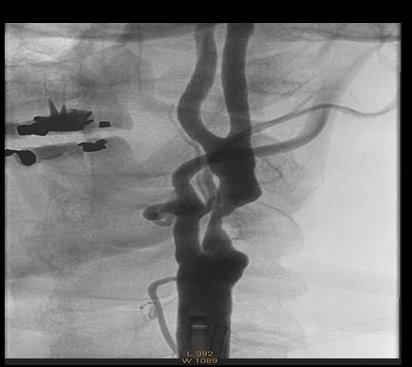
During follow-up, he remained asymptomatic until, years later, he developed episodes of phosphenes and flashes that had been present for three months. Doppler ultrasound of the neck vessels revealed disease progression and severe stenosis of the LICA (Figure 1). Digital angiography confirmed 90% stenosis of the LICA and demonstrated a persistent hypoglossal artery originating from the internal carotid artery above the atheromatous plaque, associated with bilateral hypoplasia of the vertebral arteries (Figure 2).
Figure 1. Color Doppler ultrasound of neck vessels showing severe stenosis of the left internal carotid artery with turbulent blood flow and increased velocities.
Fig. 1
Color Doppler ultrasound of neck vessels showing severe stenosis of the left internal carotid artery with turbulent blood flow and increased velocities.
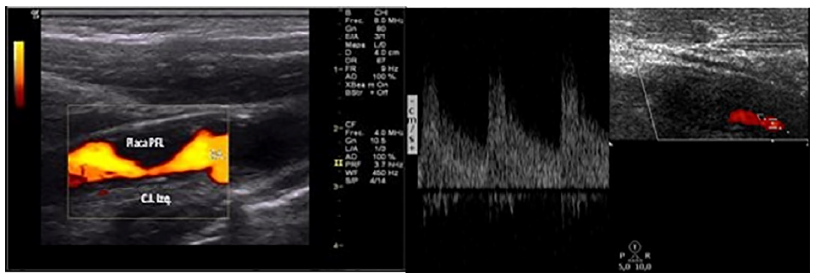
Figure 2
Digital angiography of neck vessels showing critical stenosis (≈90%) of the left internal carotid artery, with the persistent hypoglossal artery arising above the atheromatous plaque.
Given the vascular anatomy, carotid endarterectomy presented significant technical challenges, because of the limited distal segment available for shunt placement and the potential risk of compromising the posterior circulation. Endovascular treatment was therefore performed.
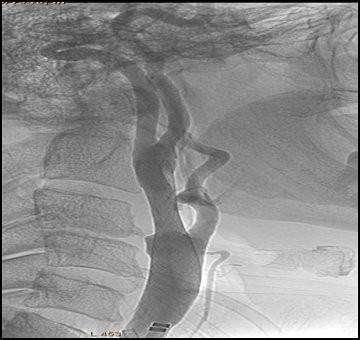
Carotid angioplasty stenting was performed using double embolic protection, with filters placed in both the LICA and the persistent hypoglossal artery. The procedure was performed under conscious sedation, with no technical or neurological complications (Figure 3). Adequate stent expansion was confirmed, with no residual stenosis and preserved flow to both the anterior and posterior circulation (Figure 4). The patient had a favorable clinical course and was discharged 48 hours later, with no new neurological symptoms.
Fig. 3
Angiography during the endovascular procedure showing simultaneous placement of embolic protection devices in both the left internal carotid artery and the persistent hypoglossal artery.
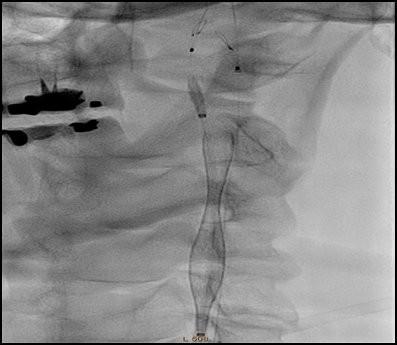
Fig. 4
Post-operative digital angiography showing a well-positioned stent, preserved blood flow and hypoplasia of the vertebral artery.
A persistent hypoglossal artery is a rare vascular anomaly that is generally asymptomatic. However, in cases in which the vertebrobasilar circulation depends on this artery, its association with severe carotid stenosis may compromise both the anterior and posterior circulations.
Conventional surgical treatment may be limited by anatomical complexity and the risk of ischemia during carotid clamping. In this context, carotid artery stenting with embolic protection devices constitutes a valid alternative. (3) The ability to protect both dependent branches is key to minimizing the risk of embolism. (4) Endovascular treatment with double embolic protection successfully addressed a complex vascular anatomy, providing a safe and effective option for selected patients.
Ethical considerations
Not applicable.