

INTRODUCTION
Atherosclerotic cardiovascular disease (ASCVD) remains the leading cause of death and disability worldwide. (1) Genetic, epidemiological, and randomized clinical trial evidence all point to the same conclusion: cholesterol bound to low-density lipoproteins (LDL-C) is a causal factor of atherosclerosis, and reducing it proportionally and cumulatively lowers the risk of major cardiovascular events. (2) On this basis, successive generations of lipid-lowering drugs have been devel- oped: statins—which inhibit HMG-CoA reductase—; ezetimibe—which blocks intestinal cholesterol absorption—; monoclonal antibodies against proprotein convertase subtilisin/kexin type 9 (PCSK9), and, more recently, small interfering RNA (inclisiran) targeting PCSK9 messenger RNA. (3,4) These tools have demonstrated robust reductions in cardiovascular risk in large patient populations and have benefited millions of people worldwide.
However, a significant therapeutic gap persists. A considerable percentage of high-risk patients do not achieve the LDL-C targets recommended by the guidelines, whether due to lack of efficacy, intolerance, cost, barriers to access, or lack of adherence to treatments that require daily administration or periodic injections for life. (5) Against this backdrop, a distinct therapeutic paradigm is emerging: in vivo somatic gene editing, capable of introducing a permanent and targeted modification in hepatocyte DNA with the goal of achieving a lasting or even permanent reduction in LDL-C following a single intravenous infusion.
PCSK9 is the ideal target for this strategy for several reasons, which are discussed in the following section: it is predominantly expressed in the liver, has been validated genetically and pharmacologically for decades, and its complete inactivation—observed naturally in carriers of loss-of-function variants—is not associated with any known adverse clinical consequences. (6) The objective of this review is to summarize, for physicians specializing in cardiovascular prevention and researchers in this field, the current state of knowledge regarding PCSK9 gene editing: its biological basis, the technological platforms used, the results of ongoing clinical trials, and the challenges that still need to be resolved before this technology can be incorporated into clinical practice.
PCSK9: BASIC BIOLOGY AND GENETIC VALIDATION AS A THERAPEUTIC TARGET
PCSK9 is a secreted serine protease, synthesized mainly in the liver, whose physiological function is to regulate the density of the LDL receptor (LDLR) on the hepatocyte surface. (7) Following secretion, circulating PCSK9 binds to the Epidermal Growth Factorlike repeat A (EGF-A) LDLR domain; this binding prevents the normal recycling of the receptor to the plasma membrane following endocytosis of the LDL-LDLR complex, and instead directs it toward lysosomal degradation. (8) The net result is a lower density of hepatic LDLR, reduced clearance of circulating LDL particles, and, consequently, higher plasma concentrations of LDL-C.
The validation of PCSK9 as a therapeutic target arose from human genetics rather than targeted drug development. In 2003, gain-of-function variants in the PCSK9 gene were identified as the cause of autosomal dominant familial hypercholesterolemia. (9) Shortly thereafter, population-based studies identified the inverse phenomenon: individuals carrying lossof-function variants in PCSK9—including nonsense variants that are more common in populations of African descent—exhibited reductions in LDL-C ranging beween 28% to 40%, along with a lifetime reduction in the risk of coronary heart disease of up to 88%. (10,11) Crucially, these carriers showed no apparent adverse phenotype associated with the partial or near-total absence of circulating PCSK9, which laid the conceptual safety foundation for the development of pharmacological inhibitors and, subsequently, strategies for permanent gene inactivation.
This genetic validation quickly translated into effective drugs. Anti-PCSK9 monoclonal antibodies (evolocumab, alirocumab) neutralize the circulating protein, reduce LDL-C by 50–60% compared with statin therapy, and have been shown to reduce major cardiovascular events in secondary prevention in the FOURIER and ODDYSEY Outcome trials. (12) Meanwhile, inclisiran—a small interfering RNA conjugated with N-acetylgalactosamine (GalNAc) that silences hepatic PCSK9 translation—achieves similar reductions with a dosing regimen of just two subcutaneous injections per year following the initial dose. (4) These developments demonstrate that the pharmacological inhibition—transient and reversible—of PCSK9 safely replicates the cardiovascular benefit observed in natural carriers of loss-of-function variants, and constitutes the direct rational basis for attempting to replicate that same effect permanently through somatic gene editing of the PCSK9 gene itself in hepatocytes.
GENE-EDITING TECHNOLOGIES
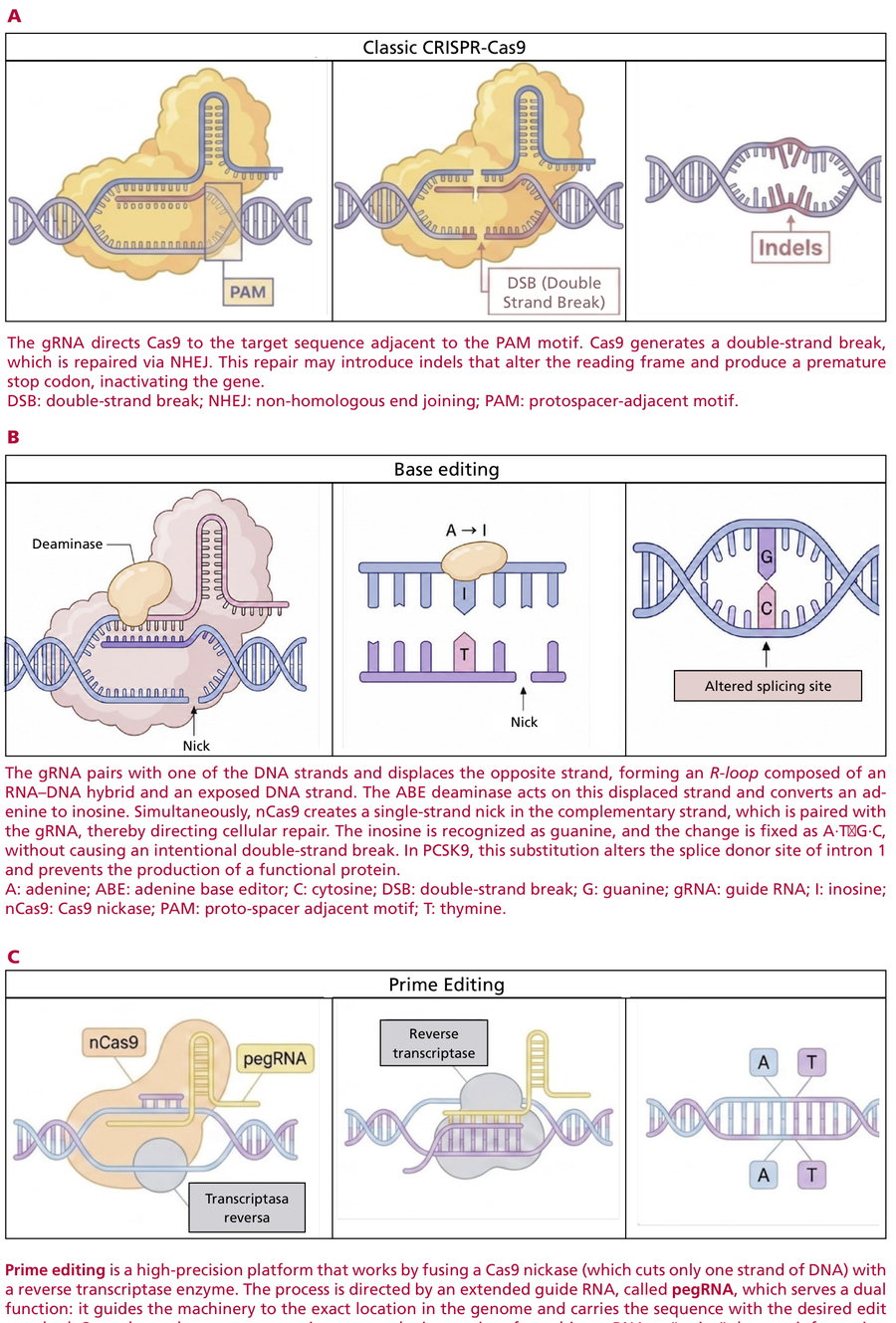
Clustered Regularly Interspaced Short Palindromic Repeats–CRISPR-associated protein 9 (the CRISPR-Cas9 system)—derived from a bacterial adaptive immune mechanism against bacteriophages—was the first to enable targeted editing of the human genome with clinically relevant efficiency. (13) Its central component is the Cas9 nuclease, which is directed to a specific genomic sequence by a complementary guide RNA (gRNA) that also recognizes a short adjacent sequence called Protospacer Adjacent Motif (PAM). Once positioned, Cas9 generates a double-strand break (DSB) in the DNA, which the cell repairs via non-homologous end joining (NHEJ)—an error-prone mechanism that introduces random insertions or deletions (indels). When these alterations affect a coding region, they can shift the reading frame and generate a premature stop codon, functionally inactivating the gene. This was the principle used in the first preclinical approaches to PCSK9 inactivation using classical CRISPR-Cas9.
Base editing represents a subsequent refinement that prevents the generation of double-strand breaks. In this system, a Cas9 modified to act solely as a nickase (nCas9, which cuts only one of the two strands) is fused to a deaminase enzyme. Cytosine base editors (CBE) temporarily convert a cytosine into uracil, which the cellular machinery interprets as thymine; adenine base editors (ABE), on the other hand, convert an adenine into inosine, which is interpreted as guanine. Following DNA repair or replication, these modifications are consolidated as permanent C·G T·A and A·T G·C conversions, respectively, without the need to generate a double-strand break. (14,15) By eliminating the DSB, base editing substantially reduces the formation of indels and chromosomal rearrangements, and is particularly effective at inactivating genes by introducing premature stop codons or altering splicing sites (the mechanism used by PCSK9 editors currently in clinical development), which introduce a point mutation at the splice donor site at the junction between exon 1 and intron 1, generating a nonfunctional transcript due to intron retention and degradation mediated by the messenger RNA surveillance system.
Prime editing constitutes a third, even more versatile platform capable of introducing all twelve possible types of base substitutions, as well as small insertions and deletions, by fusing a Cas9 nickase with a reverse transcriptase and an extended guide RNA (prime editing guide, pegRNA) that directs the system to the target sequence and contains the template specifying the desired modification. (16) Although it offers a wider range of possible edits, its development for in vivo applications remains less advanced than that of base editing; therefore, the most advanced clinical programs in lipidology continue to rely on base editors.
Delivering this molecular machinery to hepatocytes is, in itself, a central technological challenge. Lipid nanoparticles (LNPs)—spheres ranging from 80 to 200 nm in size composed of ionizable lipids, cholesterol, phospholipids, and pegylated lipids—encapsulate the messenger RNA encoding the base editor along with the gRNA, and following intravenous administration, they naturally accumulate in the liver, where they are taken up by receptor-mediated endocytosis. (17) Transient expression of the editor from the mRNA—which degrades within a few days—limits the time window of nuclease activity and, thereby, the risk of off-target editing. An additional refinement involves conjugating N-acetylgalactosamine (GalNAc) to the surface of the LNP, which promotes its uptake by the liver via the asialoglycoprotein receptor, independent of LDLR; this modification is particularly relevant in patients with familial hypercholesterolemia, in whom the reduced availability of LDLR could limit the uptake of unconjugated LNPs. (18)
ONGOING STUDIES
Preclinical validation of PCSK9 editing was conducted in a stepwise manner in primary human, rodent, and nonhuman primate hepatocytes. Musunuru et al. demonstrated that an adenine editor targeting the splice donor site between PCSK9 exons 1 and 2 produced a sustained reduction in cholesterol in primates following a single infusion. (19) Subsequent studies in macaques, using the formulation and sequence that would later be translated to the clinical setting, showed an average hepatic editing rate of 67–83% with sustained reductions in serum PCSK9 and LDL-C of up to 69%, which persisted for more than one year after a single dose, with no evidence of editing in sperm or in the offspring of treated animals. (20)
On this basis, the first in-vivo PCSK9 gene-editing clinical trial in humans, VERVE-101 (Heart-1 study, NCT05398029, Verve Therapeutics), was initiated in adult patients with heterozygous familial hypercholesterolemia and established coronary artery disease. (21) Interim results, presented in 2023, showed dosedependent reductions in LDL-C of up to 55% in the higher-dose cohorts, sustained for at least six months of follow-up. Most adverse events were transient (infusion reactions, mild elevations in transaminases), although three serious cardiovascular events were reported in patients with advanced atherosclerotic disease, including one death from cardiac arrest deemed unrelated to treatment by the independent safety committee. These findings, along with laboratory abnormalities later attributed to the formulation’s lipid component, led to the suspension of recruitment for VERVE-101 and the transition of the program to a second-generation nanoparticle. (22)
VERVE-102 (Heart-2 study, NCT06164730) uses the same adenine editor and guide sequence as VERVE-101 but incorporates a new-generation Gal-NAc-conjugated LNP, designed for LDLR-independent hepatic uptake and a more favorable inflammatory profile. (22) The interim analysis of the study, which included patients with heterozygous familial hypercholesterolemia or premature coronary artery disease, showed mean reductions in PCSK9 and LDLR of 88% and 62%, respectively, in the highest-dose cohort, with an absolute reduction in LDL-C of 78 mg/dL, with no dose-limiting toxicity or deaths, and mild-to-moderate infusion reactions in approximately one-fifth of participants. (23,24) Notably, the magnitude of the LDL-C reduction was comparable to that achieved with anti-PCSK9 monoclonal antibodies in chronic treatment. (23)
In parallel, YOLT-101 (YolTech Therapeutics) is currently in development; this is an adenine editor based on a novel deaminase derived from Hafnia paralvei, also delivered via a GalNAc-conjugated LNP, in a trial specifically targeting patients with heterozygous familial hypercholesterolemia. Interim data from six patients, with follow-up of up to 36 weeks, showed nearly 50% mean LDL-C reduction in the 0.6 mg/kg cohort, with a maximum reduction of over 74% sustained for more than six months in one participant, and an adverse event profile consisting of transient infusion reactions and mild, asymptomatic elevations of liver enzymes. (25)
It is useful to compare these three PCSK9 geneediting programs with the anti-PCSK9 pharmacological strategies already established in clinical practice monoclonal antibodies, inclisiran, and, more recently, lerodalcibep, a monthly-administered adnectin-albumin fusion protein that has demonstrated between 59% and 65% LDL-C reductions in heterozygous familial hypercholesterolemia and at least 60% reduction in populations at high cardiovascular risk. (4,12,26,27) The comparison (Table 1) shows that, in terms of the magnitude of LDL-C reduction, gene editing in its most advanced formulation (VERVE-102) matches or exceeds chronic pharmacological therapies, but with a key qualitative difference: while monoclonal antibodies, inclisiran, and lerodalcibep require indefinite periodic administration, gene editing introduces a permanent modification of hepatic DNA following a single infusion, whose safety profile and long-term durability have not yet been established with the same level of evidence.
Table 1
Comparison between established anti-PCSK9 pharmacological strategies and PCSK9 gene-editing programs in clinical development
| Strategy | Mechanism / Target | Route and Dosage | Reduction in LDL-C | Nature of the effect | Stage of development |
|---|---|---|---|---|---|
| Monoclonal antibodies (evolocumab, alirocumab) | Neutralization of circulating PCSK9 | SC, every 2 weeks (or monthly, alirocumab 300 mg) | 50–70% | Reversible; requires ongoing dosing | Approved; demonstrated reduction of CV events (FOURIER, ODDYSEY Outcomes) (12) |
| Inclisiran | Hepatic RNA; silences PCSK9 mRNA | SC; Day 0, Month 3, then every 6 months | ~40–50% | Reversible (transient silencing); dose-dependent effect | Approved; ongoing CV outcome trials. (4) |
| Lerodalcibep | Anti-PCSK9 adnectin + albumin fusion protein | SC, monthly (300 mg) | 58.6–65% (HeFH); ≥60% (high CV risk) | Reversible; requires ongoing dosing | Approved (FDA, 2025) (26,27) |
| VERVE-101 (Heart-1) | PCSK9 base editing (ABE); unconjugated LNP | IV, single infusion | Up to 55% | Permanent (irreversible genomic editing) | Phase 1b; recruitment stopped (21,22) |
| VERVE-102 (Heart-2) | Same editor; 2nd-generation LNP-GalNAc | IV, single infusion | PCSK9 −88%; c-LDL −62% (absolute change 78 mg/dL) | Permanentt | Ongoing Phase 1b (23,24) |
| YOLT-101 | Base editor (Hafnia paralvei deaminase); LNP-GalNAc | IV, SINGLE INFUSION | ~50% (max. >74%) | Permanent | Ongoing Phase 1 (25) |
CV: cardiovascular; GalNAc: N-acetylgalactosamine; HeFH: heterozygous familial hypercholesterolemia; IV: intravenous; LDL-C: LDL cholesterol; LNP: lipid nanoparticle; RNA: ribonucleic acid; SC: subcutaneous.
Fig. 1
Comparison of the main gene-editing platforms. A) Classic CRISPR-Cas9: the guide RNA (gRNA) directs Cas9 to the target sequence adjacent to the PAM motif, where it generates a DSB. Repair via non-homologous end joining (NHEJ) introduces insertions or deletions (indels) that can inactivate the gene. B) Base editing: a Cas9 nickase (nCas9) fused to a deaminase modifies a specific base without generating a DSB. In the case of adenine editors (ABE), the A→I conversion—subsequently interpreted as G—allows for the introduction of point mutations, such as the alteration of the PCSK9 splice donor site. C) Prime editing: a nCas9 fused to a reverse transcriptase uses an extended guide RNA (pegRNA) to precisely incorporate defined substitutions, insertions, or deletions, without the need for a double-strand break in the DNA
The principle of targeted hepatic editing has expanded beyond PCSK9. VERVE-201 (Pulse-1 study). CTX310—inactivates ANGPTL3—a regulator of lipoprotein lipase whose genetic deficiency is associated with combined familial hypolipidemia and reduced cardiovascular risk—in patients with homozygous familial hypercholesterolemia or refractory hypercholesterolemia. In its highest-dose cohort, CTX310 demonstrated reductions of up to 75% in ANGPTL3, 82% in triglycerides, and 81% in LDL-C, with no serious treatment-related adverse events. (28) CTX320 applies the same principle to the LPA gene to permanently reduce the synthesis of apolipoprotein(a) and, thereby, lipoprotein(a) concentrations—a causal and independent risk factor for atherosclerotic disease and aortic stenosis that remains virtually refractory to conventional lipid-lowering therapies— with Lp(a) reductions of up to 94% sustained for seven months in nonhuman primates. (29,30) Beyond the field of lipid metabolism, the validation of this hepatic delivery platform has been extended to transthyretin cardiac amyloidosis, where nexiguran ziclumeran (NT-LA-2001)—a CRISPR-Cas9 editor targeting the TTR gene—reduced serum transthyretin levels by 90% at twelve months in a Phase 1 trial, which is currently in Phase 3. (31)
OPPORTUNITIES AND CHALLENGES
The primary safety concern with any permanent gene-editing strategy is off-target activity, which can lead to extensive deletions, chromosomal rearrangements, or oncogene activation. (32) Although base editors substantially reduce this risk by preventing double-strand breaks, they do not eliminate it entirely, and their evaluation requires the combined use of computational tools and highly sensitive experimental methods, such as GUIDE-seq, along with high-fidelity Cas9 variants. (33,34) Added to this is uncertainty regarding the durability of the effect, given that the dose-escalation design of the early trials means that the higher-dose cohorts—which exhibit the most pronounced lipid-lowering effect—still have the shortest follow-up periods.
A second area of discussion is the appropriate selection of patients. Unlike severe monogenic diseases with no therapeutic alternatives, hypercholesterolemia has multiple effective and safe treatments backed by decades of clinical experience; therefore, the incremental benefit of a permanent and irreversible intervention must be carefully weighed against the risk, especially in young, reproductive-age populations, in whom the theoretical possibility of germline transmission of the edit becomes relevant—even though it has not yet been detected. Regulatory agencies, including the FDA, currently require a minimum of fifteen years of follow-up for recipients of gene therapies, which poses logistical and sustainability challenges for sponsors and long-term registry systems. (35)
Finally, the clinical implementation of gene editing raises economic, regulatory, and ethical questions that extend beyond the strictly biomedical realm. Funding for a one-time, very high-cost intervention is difficult to integrate into fragmented health care systems or those based on insurers and employers with limited coverage periods. Added to this is the need to ensure equitable access both to these therapies and to the genetic testing necessary to identify potential candidates—testing that is currently underutilized even in cases of familial hypercholesterolemia. Furthermore, the permanent nature of somatic genomic modifications requires specific frameworks for regulation, monitoring, and informed consent, commensurate with technologies whose long-term risks are not yet fully understood. (36,37) On the other hand, the possibility of achieving lifelong cardiovascular protection through a single intervention in individuals at high genetic risk, even before the clinical manifestation of the disease, redefines the horizon of primary prevention and has already led to the first application of personalized N-of-1 base editing in a newborn with a severe monogenic metabolic disorder, serving as a proof of concept for how quickly these platforms can be adapted to an individual genotype. (38)
CONCLUSIONS
PCSK9 is currently the best-validated gene target genetically, pharmacologically, and clinically—for the development of in vivo gene-editing therapies aimed at preventing atherosclerotic cardiovascular disease. Ongoing clinical trials, including VERVE-102 and YOLT-101, have demonstrated sustained, dosedependent reductions of LDL-C comparable to those attained with anti-PCSK9 monoclonal antibodies, achieved through a single intravenous infusion, with generally acceptable short-term safety profiles following the incorporation of second-generation lipid nanoparticles. However, these are still Phase 1 data from small populations with limited follow-up: the durability of the long-term effect, the cumulative risk of off-target events, and the appropriate selection of candidates are open questions that only larger, randomized studies with prolonged follow-up will be able to answer. For the clinical lipidologist, the immediate challenge is not yet to prescribe this technology, but rather to understand its biological basis, closely monitor its development, and actively participate in the discussion regarding the clinical and ethical criteria that should guide its eventual incorporation into clinical practice.