http://dx.doi.org/10.7775/rac.v91.i1.20595
ORIGINAL ARTICLE
Implications of the COVID-19 Pandemic
and Social Isolation on the Cardiometabolic Profile
of a Cohort of Individuals from the City of Buenos Aires
Implicancias de la pandemia por covid-19 y el aislamiento
social sobre el perfil cardiometabólico de una
cohorte de individuos en la Ciudad de Buenos Aires
Gustavo A. GiuntaMTSAC, 1, Pablo D. Cutine1, Maria Florencia
Aguiló2, Daniel Antokoletz3, Daniel Pirola4,
María Isabel
Rodríguez Acuña1, Laura BrandaniMTSAC,1
1 Fundación Favaloro, Metabolic Unit, Lipid and Atherosclerosis Department,
Ciudad Autonomous City of Buenos Aires, Argentina,
2 Fundación Favaloro, Nutrition Service, Autonomous City of
Buenos Aires, Argentina
3 Universidad René G. Favaloro, Information Technology Department, Autonomous
City of Buenos Aires, Argentina
4 Fundación Favaloro,
Central Laboratory, Autonomous City of Buenos Aires, Argentina
Address for reprints: Gustavo A. Giunta,
Fundación Favaloro –
Hospital Universitario. Avenida
Belgrano 1782. Buenos Aires, Argentina, C1093AAS +54 11-4378-1200. ggiunta@ffavaloro.org
This article received
the 48º Congreso Argentino de Cardiología Award
ABSTRACT
Background: The COVID-19 pandemic has shocked humanity. During the pandemic, the
need for social isolation has encouraged low adherence to a healthy lifestyle
in many individuals. However, evidence of the metabolic impact of COVID-19
pandemic on our field is scarce.
Objective: To evaluate the impact of social isolation produced by the COVID-19
pandemic on the body weight and the cardiometabolic
parameters of an adult population in the Autonomous City of Buenos Aires.
Methods: Based on an observational design, we analyzed the data from patients
who attended a prevention and health promotion program in the City of Buenos
Aires. Data from participants who attended for testing in 2019 and repeated
testing in 2021 were individualized. Medical records were used as source for
collecting general data, anthropometric measurements, and laboratory values.
The National Cholesterol Education Program (NCEP) criteria were used to define
the presence of metabolic syndrome (MS).
Results: A total of 558 patients with available evaluations in 2019 and 2021
were identified. The average age of the population was 52.2 ± 12.8 years, and
41% was female. An increase in body weight (82.1 ± 17.7 kg vs. 83.1 ± 18.5 kg;
p<0.0001) and body mass index (29.4 ± 5.4 vs. 29.8 ± 5.7, p<0.0001) was
observed. Increases in systolic (123.1 ± 15.1 mmHg vs. 126.6 ± 16.3 mmHg;
p<0.0001) and diastolic (77.7 ± 9.3 mmHg vs. 79.6 mmHg± 9.4 mmHg,
p<0.0001) blood pressure values were also observed. As regards the
laboratory parameters, we noted an increase in plasma glucose levels with a
median and an interquartile range (IQR) of 95 (89-103 mg/dL)
vs. 99 (92-107 mg/dL), p<0.0001, and a decrease in
HDL cholesterol (51, 8 ± 12.7 mg/dL vs. 49.3 ± 12.8
mg/dL, p<0.0001). No changes were observed in LDL
cholesterol (116.4 ± 32.6 mg/dL vs. 116.1 ± 34 mg/dL; p=NS), total cholesterol (194.9 ± 37.4 vs. 193 ± 39.6
mg/dL; p=NS) or triglyceride levels, with a median
(IQR) of 114.5 (83.2-162.7 mg/dL) vs. 118 (88-169 mg/dL; p=NS). This was accompanied by an increased prevalence
of MS (21.5% vs. 34%; p<0.0001). The proportion of patients with carotid
plaques also increased, without reaching statistical significance (36.4% vs.
40.7%; p=NS). Besides, it was observed that 18.8% of the patients increased
their body weight by more than 5%. This population was represented by younger
patients (47.6 ± 14 years vs. 53.3 ± 12 years; p< 0.0001) showing a reverse
correlation between age and scope of weight increase (r=-0.1; p<0.02).
Conclusion: Social isolation during the COVID-19 pandemic was shown to have
important consequences on the risk factors of the population studied. The
prospective implications of these findings might become apparent in the next
few years if these metabolic alterations are not reversed.
Keywords: Heart Risk Factors - Obesity - Hypertension - Treatment Adherence and
Compliance - COVID-19
RESUMEN
Introducción: La pandemia por COVID-19 ha conmocionado a
la humanidad. Durante la misma, la necesidad de aislamiento social ha fomentado
la baja adherencia a un estilo de vida saludable en muchos individuos. Sin
embargo, existe poca evidencia del impacto metabólico que ha tenido la pandemia
por COVID-19 en nuestro medio.
Objetivos: Evaluar el impacto del aislamiento social
producido por la pandemia COVID-19 sobre el peso corporal y los parámetros cardiometabólicos de una población de adultos en la Ciudad
Autónoma de Buenos Aires.
Materiales y métodos: En un diseño observacional, se analizaron
los datos de pacientes que asistieron a un programa de prevención y promoción
de salud en la Ciudad de Buenos Aires. Se individualizaron datos de
participantes que concurrieron a realizarse estudios en el año 2019 y
repitieron los mismos en el año 2021. Los registros médicos se utilizaron como
fuente para la recopilación de datos generales, medidas antropométricas y
valores de laboratorios. Se utilizaron los criterios NCEP para definir la
presencia de Síndrome Metabólico (SM).
Resultados: Se identificaron un total de 558
pacientes. con evaluaciones disponibles en 2019 y 2021. La edad promedio de la
población fue 52,2 ± 12,8 años, con 41% de mujeres. Se observó un incremento en
el peso corporal (82,1 ± 17,7kg vs. 83,1 ± 18,5kg; p<0,0001) y del índice de
masa corporal (29,4 ± 5,4 vs. 29,8 ± 5,7, p<0,0001). También se observaron
incrementos en la presión arterial sistólica (123,1 ± 15,1 mmHg
vs. 126,6 ± 16,3 mmHg; p<0,0001) y diastólica
(77,7 ± 9,3 mmHg vs. 79,6 ± 9,4 mmHg;
p<0,0001). Dentro de los parámetros de laboratorio, se evidenció un
incremento en los valores de glucemia plasmática, con mediana y rango intercuartílico (RIC) de 95 (89-103 mg/dL)
vs. 99 (92-107 mg/dL), p<0,0001; y descenso del
colesterol HDL (51,8 ± 12,7 mg/dL vs. 49,3 ± 12,8 mg/dL; p<0,0001). No se observaron cambios en el colesterol
LDL (116,4 ± 32,6 mg/dL vs. 116,1 ± 34 mg/ dL; p=NS), colesterol total (194,9 ± 37,4 vs. 193 ± 39,6
mg/dL; p=NS) o la concentración de triglicéridos, con
mediana (RIC) de 114,5 (83,2-162,7 mg/dL) vs. 118
(88-169 mg/dL), p=NS. Esto se acompañó de un aumento
de la prevalencia de SM (21,5% vs 34%; p<0,0001). También se incrementó la proporción
de pacientes. con placas a nivel carotídeo, sin
llegar a significancia estadística (36,4% vs. 40,7%; p=NS). El 18,8% de los
pacientes. incrementaron su peso corporal más del 5%. Esta población estuvo
representada por pacientes. más jóvenes (47,6 ± 14 años vs. 53,3 ± 12 años;
p< 0,0001), y se observó correlación inversa entre edad y magnitud del
incremento del peso (r=-0,1; p<0,02).
Conclusiones: El aislamiento social, durante la pandemia
COVID-19, mostró tener importantes consecuencias en los factores de riesgo de
la población estudiada. Las implicancias prospectivas de estos hallazgos
podrían verse en los próximos años, si estas alteraciones metabólicas no se
revierten.
Palabras clave: Factores de Riesgos Cardíacos - Obesidad -
Hipertensión - Cumplimiento y Adherencia al tratamiento - COVID-19
Received: 09/21/2022
Accepted: 12/02/2022
INTRODUCTION
In December 2019, 27 index cases of a pneumonia of unknown etiology in Wuhan (Hubei, China) led
to a pandemic caused by SARS-CoV-2 that shocked humanity. (1) COVID-19
infection, at first of a respiratory nature, progresses to a severe multisystem
condition with an etiology consisting of strong inflammatory and immunological
activation caused by the virus. (2) Epidemiological studies have early
shown that patients with a higher risk of serious complications are elderly
patients with underlying cardiovascular or pulmonary disease, or those with a
higher cardiovascular risk as a result of blood hypertension (HTN), diabetes
mellitus (DM), dyslipidemia, or obesity. (3) To reduce
the impact of the pandemic, global social distancing and quarantine actions
were taken with both direct and indirect consequences on people’s health. (4, 5)
Permanent isolation evidenced
increased morbidity and mortality as a result of non- COVID-19 conditions. (6) Factors such
as decreased physical activity, stress, and diet changes were typical during
this period. (7-9) The
pandemic and social isolation, in particular, increased the already high
prevalence of obesity, an aspect that seems to be exacerbated in our region. (10, 11) In addition,
it is known that even mild increases in body mass index (BMI) may have a strong
long-term impact on cardiovascular health. (12, 13) All these
aspects promote emergence or impair management of cardiovascular risk factors
(CVRF), such as hypertension, dyslipidemia, and diabetes.
Measuring the impact of this period
of time on the cardiometabolic profile will provide
relevant information helpful to establish management strategies avoiding any
long-term consequences. Therefore, the aim of this study was to assess the cardiometabolic profile of a population before and after
COVID-19 lockdown. It was also to analyze the prevalence and characteristics of
the population with increased weight and obesity in this period.
METHODS
An observational retrospective cohort
design was used to compare the times before and after lockdown as a result of
the COVID-19 pandemic. This study was conducted at Hospital Universitario René G. Favaloro,
in the Autonomous City of Buenos Aires, Argentina. Fundación
Favaloro has a Cardiovascular Health Prevention
Program (Programa de Prevención
de Salud Cardiovascular, PPS) aimed at monitoring
general health, giving advice, educating on healthy lifestyle habits, and
identifying patients with a high cardiovascular risk. In Argentina, the
national government ordered the start of preventive and mandatory social
isolation on March 19, 2020. Thereafter, medical services were restricted, and
healthcare was readjusted to the requirements of the pandemic. The program
began to become flexible and reopened after December 2020. All male and female
individuals aged over 18 taking part in the program during 2019 (the time immediately
preceding the pandemic) were included and took part again in 2021 (the time
following the strict lockdown). The aim was to have individual information on
each participant before and after lockdown. Patients with untreated
hypothyroidism, a history of acute or chronic hepatic and/ or renal disease,
pregnant or breastfeeding women, and patients with malignancies or diseases
with less than one year life expectancy were excluded. For HTN and type 2 DM,
the incidence of new cases was compared to a similar period of time in patients
attending the program between 2017 and 2019.
Data were collected from medical
records, including anthropometric parameters, medical history, and laboratory
results. Only data derived from clinic visits on the days scheduled for the
program were considered.
Night fasting venous blood samples
were collected from each subject. Fasting glycemia
(GLY), total cholesterol (TC), triglycerides (TG), high-density lipoprotein
cholesterol (HDL-C), and glycosylated hemoglobin (HbA1c) were measured using
colorimetric methods with a semi-automatic biochemistry analyzer (Architect
8000/4000, Abbott Diagnostics, USA). Low-density lipoprotein cholesterol
(LDL-C) was estimated using the Friedewald’s formula.
The waist circumference (WC) was
measured using a non-expanding metric tape on a midpoint between the lower edge
of ribs and the iliac crests with the patient standing in normal exhalation.
The BMI, weight/height2, was estimated, and obesity was diagnosed
with an BMI of ≥30 kg/m2. The
characteristics of the group of patients with a higher than 5% increase in their body weight (W+5%) were explored and
compared to the rest of the population (W-5%). DM was diagnosed when the
patient had a history of fasting glycemia ≥126
mg/dL in at least 2 measurements, or was administered
insulin or oral hypoglycemic drugs. (14) HTN was considered with a repeated
systolic blood pressure (SBP) ≥140 mmHg and/or diastolic blood pressure
(DBP) ≥90 mmHg, or use of antihypertensive drugs. (15) Smoking
(SMK) was considered with a history of >100 cigarettes in a lifetime and
ex-smoker (ex-SMK) with no cigarette use in the last six months. (16) Metabolic
syndrome (MS) was diagnosed based on National Cholesterol Education Program –
Adult Treatment Panel III (NCEP-ATP III) criteria. (17)
Subclinical carotid atheromatosis, as a dichotomic
variant, was evaluated through an ultrasound using an Affinity 50 ultrasound
system (Philips HealthCare, USA) and a vascular 9-12 Mhz probe. Images were defined as a focal protrusion
towards arterial lumen with a thickness over 0.5 mm, or an increase over 50% in
the adjacent intima-media thickness (IMT), or a diffuse >1.5-mm increase in
the IMT measured between the media-adventitia and intima-lumen. (18.19)
This study was approved by the
institutional ethics committee.
Statistical analysis
Quantitative variables are described
as the mean ± standard deviation, or median and interquartile range, based on distribution.
Comparisons before and after the pandemic were made using the Student’s t-test
for paired data, or Wilcoxon test for paired data, as appropriate. Categorical
variables were described as the total number and percentage and compared with
the Chi-square test or the Fisher’s exact test, or McNemar
test in case of paired proportions. The odds ratio was estimated with its
corresponding 95% confidence interval when comparing the incidence of DM and
HTN between 2017-2019 and 2019-2021. To evaluate the correlation between
increased weight and age, the Pearson correlation test, expressed with the
correlation coefficient r and its statistical significance, was used. All
tests were 2-tailed, and a <0.05 p-value was considered to be statistically
significant.
RESULTS
There were 5423 patients in the PPS
in 2019, and 3423 patients in 2021. Patients who were part of the program both
in 2019 and 2021 were 558. In 2019, the average age was 52.2 ± 12.8 years, and
41.2% were women. An average of 1.8 ± 0.5 years elapsed between both
evaluations. Table 1 shows baseline demographics and
compares data in 2019 to data in 2021. A mild but significant 1.2% increase was
observed in body weight (p<0.0001), similar for the BMI (1.4% increase;
p<0.0001). No changes were observed in the percentage of patients with
obesity. There was an absolute 3% increase in HTN diagnosis during the
pandemic, together with increased mean SBP and DBP levels. As for glycemia, 3% new cases of DM were diagnosed. The median glycemia increased 4 mg/dL in the
2-year follow-up (p<0.0001). In the overall population, the frequency of SMK
and ex-SMK was similar between visits, with 4.5% (n=25) new smokers in 2021,
and 3% (n=17) patients who had quitted smoking upon the evaluation that year.
The lipid profile was affected, with an HDL-C decrease (51.8 ± 12.7 vs. 49.3 ±
12.8 mg/dL; p<0.0001), and no changes in other
aspects under analysis. MS diagnosis significantly increased in the population
(21.5% vs. 34.1%; p<0.0001) (Figure 1). The average criteria in the MS
increased from 1.5 ± 1.2 to 2 ± 1.3 (p<0.0001).
Table 1. Demographics
|
|
Before the pandemic (n = 558) |
After the pandemic (n = 558) |
p-value |
|
Weight (kg) |
82.1 ± 17.7 |
83.1 ± 18.5 |
p<0.0001 |
|
BMI (kg/m2) |
29.4 ± 5.4 |
29.8± 5.7 |
p<0.0001 |
|
Obesity (%) |
227 (40.7) |
236 (42.3) |
NS |
|
Hypertension, n (%) |
176 (31.5) |
192 (34.4) |
<0.01 |
|
Type 2
diabetes, n (%) |
49 (8.8) |
66 (11.8) |
<0.001 |
|
Glycemia (md/dL) Median Interquartile range |
95 89-103 |
99 92-107 |
p<0.0001 |
|
Smoking,
n (%) |
94 (16.8) |
86 (15.4) |
NS |
|
Ex-smoker, n (%) |
163 (29.2) |
177 (31.7) |
NS |
|
SBP
(mmHg) |
123.1 ± 15.1 |
126.6 ± 16.3 |
p<0.0001 |
|
DBP (mmHg) |
77.7 ± 9.3 |
79 ± 9.4 |
p<0.001 |
|
Total cholesterol (mg/dL) |
194.9 ±
37.4 |
193 ± 39.6 |
NS |
|
HDL
cholesterol (mg/dL) |
51.8 ± 12.7 |
49.3 ± 12.8 |
p<0.0001 |
|
Triglycerides (mg/dL) Median Interquartile rangeֲ |
114.5 83.2-162.7ֲ |
118 88-169 |
NS |
|
LDL
cholesterol (mg/dL) |
116.4 ± 32.6 |
116.1 ± 34 |
NS |
BMI: Body Mass Index. DBP: Diastolic Blood Pressure.
HDL: High-Density Lipoproteins
LDL: Low-Density Lipoproteins. SBP: Systolic Blood
Pressure
Quantitative variables are expressed as the mean ±
standard deviation, or the median and interquartile range
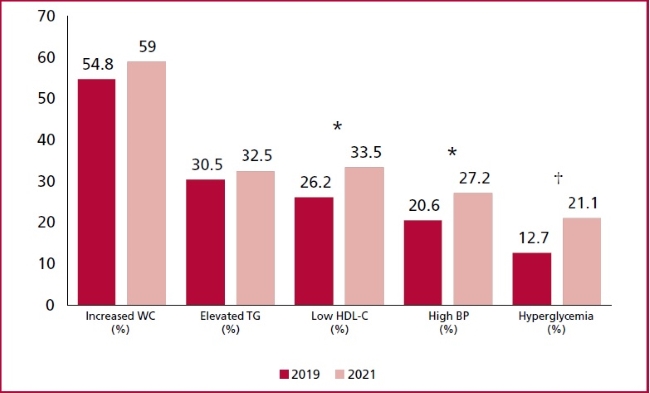
BP: Blood Pressure; HDL-C: High-Density Lipoprotein
Cholesterol; TG: Triglycerides; WC: Waist Circumference. * p<0.01, †
p<0.0005
Fig. 1. Prevalence of metabolic syndrome diagnostic criteria in 2019 vs. 2021
New HTN and DM diagnoses in 2017-2019
and in 2019-2021 were evaluated. There were 7884 participants in the PPS in
2017, of whom 2111 repeated the test in 2019. Of
these, 165 had DM and 629 were hypertensive patients at the beginning of the
period. In 2017-2019, 23 new cases of DM and 26 new cases of HTN were
identified. The incidence of new cases was higher in 2019-2021, with 17 newly
diagnosed cases of DM (OR 3.5, 95% CI 1.8-6.7; p<0.001) and 16 of HTN (OR
2.4, 95% CI 1.3-4.6; p<0.005).
In the W+5% group (n=105), no
differences were observed in the baseline weight in 2019 (W+5% 81.8 ± 20.3 kg
vs. W-5% 82.1 ± 17.1 kg; p=NS) or the BMI (W+5% 29.3 ± 5.2 vs. W-5% 29.6 ± 6.3
kg/m2; p=NS). However, this population was represented by younger
patients (W+5% 47.6 ± 14 years vs W-5% 53.3 ± 12
years; p<0.0001), and a significant reverse correlation was observed between
age and scope of weight increase (r=-0.1; p<0.02). In addition, it was
observed that W+5% patients were less likely to have HTN (22.8% vs 33.6%; p<0.05). No differences were observed in this
group as for DM (W+5% 7.6% vs W-5% 9%; p=NS), SMK
(W+5% 20.9% vs W-5% 15.9%; p=NS), ex-SMK (W+5% 27.6% vs W-5% 29.6%; p=NS), frequency for females (W+5% 48.6% vs W-5% 39.5%; p=NS), or a history of cardiovascular
disease (W+5% 1.9% vs W-5% 4.2%; p=NS).
The analysis of adherence to
treatment showed that, out of 39 patients using metformin in 2019, 3 (7.7%)
discontinued this drug. However, out of 13 patients using another antidiabetic treatment, 23.1% (3 patients) discontinued
their medication. Of the total number of patients with HTN in 2019, 96% (169 patients)
received drug therapy. In 2021, 19.9% of patients with HTN had discontinued
their medication, 12.5% (22 patients) reduced the number of drugs, and 11.4%
(20 patients) increased the number of drugs used. The most common hypolipidemic agent in 2019 were statins (116 patients,
20.8%), followed by ezetimibe (9 patients, 1.6%) and
fibrates (8 patients, 1.4%). By 2021, the use of statins among participants was
24.7% (138 patients), fibrates 2.3% (13 patients), and ezetimibe
2% (11 patients), with no significant differences as compared to 2019. Of the
total number of patients receiving statins in 2019, 14.6% (17 patients)
discontinued treatment. During the study period, 7% of the population (39
patients) began to use statins.
The evaluation of carotid atheromatosis showed a non-significant increase between
2019 and 2021 (36.4% vs 40.7%; p=NS). In the period
under analysis, patients had 3 acute myocardial infarctions, 2 coronary
angioplasties, and 1 coronary artery bypass grafting.
DISCUSSION
The COVID-19 pandemic has shocked the
world. The World Health Organization (WHO) defines a disaster as a series of
events that disrupt daily life in a community or society causing material,
economic or environmental damage. (20) The COVID-19 pandemic is a
biological disaster which is still unsolved and with consequences for many
years to come. (21) This paper could identify an
increased prevalence of risk factors in the period before and after the
pandemic, reflected by a higher prevalence of hypertension, dyslipidemia
(characterized by lower HDL-C), high BMI, hyperglycemia, and type 2 DM. This
was associated to an increased prevalence of MS, particularly as a result of
more frequent hyperglycemia, low HDL-C, and elevated blood pressure. Various
studies have assessed the incidence of new cases of DM, HTN, and dyslipidemia,
with inconsistent results. Particularly glycemia
worsened in patients with DM, with no changes in glycosylated hemoglobin
according to a recent meta-analysis. (22) Burekovic
et al. have shown more new cases of DM in a period similar to the one under
analysis. (23) These authors also suggest that
acute COVID-19 infection might favor hyperglycemia and a subsequent DM
diagnosis. During the pandemic and lockdown, increased HTN has also been
observed; the direct impact of the infection and interaction with the
renin-angiotensin-aldosterone system as the root cause cannot be ruled out. (24) The
incidence observed in new cases of DM and HTN was significantly higher in
2019-2021, as compared to 2017-2019; this result suggests an increase due to
the pandemic and lockdown. Further studies should elucidate whether the
impaired cardiometabolic profile results from adverse
lifestyle changes or the direct influence of COVID-19 infection.
Observations regarding the BMI and
obesity should be considered separately. Several reports have shown increased
obesity and overweight relative to lockdown. (10, 11) This may be
because physical and social isolation are well-known risk factors for obesity. (25) A
lower-quality diet has also contributed. The combination of lack of physical
activity, staying at home, increased intake of snacks and high-calorie meals
lead to rapid weight gain. (26) Overeating is particularly increased
when there are emergency food stocks available. (27) It is
important to note that about 1 in 5 patients increased weight by more than 5%.
In this respect, Mozaffarian et al. showed that
moderate weight gain has an adverse effect on metabolism, increases the risk of
diabetes and the incidence of cardiovascular events. (12) Therefore,
preventing the weight gain frequently observed in the pandemic may be one major
way to avoid long-term consequences. In our study, weight gain was associated
to a younger age. Simone et al. showed that 70% of individuals from a young
population admitted that the events related to the COVID-19 pandemic affected
their eating habits. (28) This group mentioned lack of concern
about food, higher food intake, or eating “to bear the situation,” among other
characteristics of their eating habits during the pandemic. Variables relative
to these findings were anxiety/depression, stress management, financial
difficulties, and sudden changes of schedule. These factors, associated with a
lower concern for the future consequences of weight changes, might partly
explain this.
Adherence to treatment was one major
health problem during the pandemic, mainly due to impaired access to drugs. (29) In a study
evaluating difficulties in access to drugs for 1103 patients with chronic diseases,
51% of patients found it hard to find their medication during the pandemic and
lockdown, and the most reported cause was doctor’s unavailability. (30) Many of
these conditions were likely to be temporary in the first stage of the period.
In our population, the patients most prone to discontinue medication were those
who received antihypertensive agents and those with diabetes under treatment
with a combination of drugs. There was no lack of adherence to hypolipidemic agents.
Note that our study had some
limitations. The population consists in PPS participants, rather than the
general population. Even so, the frequency of CVRF is similar to the one
reported in the 4th National Survey on Risk Factors. (31) The
retrospective design makes it impossible for us to know what happened between
both periods of time under analysis. This is important, as many of the
variables being assessed may have been temporarily altered (e.g., changes in
bodyweight or medication availability) throughout the pandemic.
In conclusion, our study shows
increased exposure to CVRF during the pandemic and social isolation because of
COVID-19. This aggravates the adverse landscape of exposure to such factors,
already present before the pandemic. We need to identify the changes above,
particularly those relative to an increased BMI in young individuals, to seek a
healthy lifestyle for our patients. The prospective implications of these findings
might become apparent in the next few years if these metabolic changes are not
reversed. Future studies need to prospectively monitor the progress of these
findings.
Conflicts of interest
No conflicts of Interest or financing
concerning the study have been declared.
(See authors' conflict of interests forms on the web/Additional material.)
Project funding
The authors wish to thank the
collaboration of the doctors from Centro de Vida de Fundación
Favaloro in collecting data: Bianco
Raúl, Cheluja Anibal, Granja Andrés, Kerbage Soraya, Lizzi Carolina, Merbilhaa Raúl, Molina Teodoro, Oviedo María Carolina, Paolini Julieta, Pérez Luján Mercedes, Ponce Victor, Rodriguez Noelia,
Rossi Evelyn, Rojo Alfredo, Santos Máximo, Smodlaka Sonia.
They also thank the professionals
from the Echocardiography and Doppler Department of Fundación
Favaloro.
1. Platto S, Wang Y Zhou J, Carafoli E. History of the COVID-19 pandemic: origin,
explosion, worldwide spreading. Biochem Biophys Res Commun 2021;538:14-23. https://doi.org/10.1016/j.bbrc.2020.10.087
2.
Cenko E, Badimon L, Bugiardini R, Claeys M, De Luca
G, de Wit C, et al. Cardiovascular disease and COVID-19:
a consensus paper from the ESC Working Group on Coronary Pathophysiology &
Microcirculation, ESC Working Group on Thrombosis and the Association for Acute
CardioVascular Care (ACVC), in collaboration with the
European Heart Rhythm Association (EHRA). Cardiovasc
Res 2021;117:2705-29. https://doi.org/10.1093/cvr/cvab298
3. Nalbandian A, Sehgal K, Gupta A, Madhavan MV, McGroder C, Stevens JS, et al. Post-acute COVID-19
syndrome. Nat Med 2021;27:601-15. https://doi.org/10.1038/s41591-021-01283-z
4. CDC COVID-19 Response Team. Severe
outcomes among patients with coronavirus disease 2019 (COVID-19) - United
States. MMWR Morb Mortal Wkly Rep 2020;69:343-6. https://doi.org/10.15585/mmwr.mm6912e2
5. Ismail L, Materwala H, Znati T, Turaev S, Khan MA.
Tailoring time series models for forecasting coronavirus spread: case studies
of 187 countries. Comput Struct Biotechnol
J 2020;18:2972-3206. https://doi.org/10.1016/j.csbj.2020.09.015
6. Lau V, Dhanoa S, Cheema H, Lewis K, Geeraert P, Lu
D, et al. Non-COVID outcomes associated with the coronavirus disease-2019
(COVID-19) pandemic effects study (COPES): A systematic review and
meta-analysis. PLoS One. 2022;17(6):e0269871. https://doi.org/10.1371/journal.pone.0269871
7. Sassone B, Mandini S, Grazzi G, Mazzoni G, Myers J, Pasanisi G.
Impact of COVID-19 pandemic on physical activity in patients with implantable cardioverter-defibrillators. J Cardiopulm
Rehabil Prev 2020;40:285-6. https://doi.org/10.1097/HCR.0000000000000539
8. Bourdas D, Zacharakis E. Impact of COVID-19 lockdown on physical activi-ty in a sample of Greek adults. Sports 2020;8:1-13. https://doi.org/10.3390/sports8100139
9. Cindrich S, Lansing J,
Brower C, McDowell C, Herring M, Meyer J. Associations between change in
outside time pre-and post-COVID-19 public health restrictions and mental
health: brief research report. Front Public Health 2021;9:8.
https://doi.org/10.3389/fpubh.2021.619129
10. Khan M, Menon P, Govender R, Samra A, Allahan K, Nauman J, et al. Systematic
review of the effects of pandemic confinements on body weight and their
determinants. Br J Nutr 2022;127:298-317.
https://doi.org/10.1017/S0007114521000921
11.
Halpern B, Costa Louzada M,
Aschner P, Gerchman F, Brajkovich I, J Far-ia-Neto. Obesity and COVID-19 in Latin America: A tragedy of
two pandemics—Official document of the Latin American Federation of Obesity Socie-ties. Obes Rev 2021;22:e13165. https://doi.org/10.1111/obr.13165
12. Mozaffarian D, Hao T, Rimm EB, Willett WC, Hu
FB. Changes in diet and lifestyle and long-term weight gain in women and men. N Engl J Med
2011;364:2392–404. https://doi.org/10.1056/NEJMoa1014296
13. Khan MA, Hashim MJ,
Mustafa H, Baniyas MY, Al Suwaidi
SKBM, AlKatheeri R, et al. Global epidemiology of
ischemic heart disease: results from the global burden of disease study. Cureus 2020;12:e9349. https://doi.org/10.7759/cureus.9349
14. Pearson TA, Palaniappan
LP, Artinian NT, Carnethon
MR, Criqui MH, Dan-iels SR
et al. American Heart Association Council on Epidemiology and Prevention. American
Heart Association guide for improving cardiovascular health at the community
level, 2013 update: a scientific statement for public health practitioners,
healthcare providers, and health policy makers. Circulation 2013;127:1730-53. https://doi.org/10.1161/CIR.0b013e31828f8a94
15.
Consenso Argentino de Hipertensión Arterial. Sociedad Argentina de Cardiologia – Federación Argentina de Cardiología – Sociedad
Argentina de Hipertensión Arterial. Rev Argent Cardiol 2018;86(Supl 2):1-49
16. Ford ES, Giles WH, Mokdad
AH. The distribution of 10-year risk for coro-nary
heart disease among US adults: findings from the National Health and Nutrition
Examination Survey III. J
Am Coll Cardiol. 2004;43:1791-6. https://doi.org/10.1016/j.jacc.2003.11.061
17. Expert Panel on Detection, Evaluation, and
Treatment of High Blood Cholesterol in Adults. Executive Summary of The Third Report of The National Cholesterol Education
Program (NCEP) Expert Panel on Detection, Evaluation, And Treatment of High
Blood Cholesterol In Adults (Adult Treatment Panel III). JAMA 2001;285:2486-97. https://doi.org/10.1001/jama.285.19.2486
18. Stein JH, Korcarz CE,
Hurst RT, Lonn E, Kendall CB, Mohleret
ER, et al. Use of carotid ultrasound to identify subclinical vascular disease
and evaluate cardiovascular disease risk: a consensus statement from the
American Society of Echocardiography Carotid Intima-Media Thickness Task Force.
Endorsed by the Society for Vascular Medicine. J Am Soc Echocardiogr 2008;21:93-111. https://doi.org/10.1016/j.echo.2007.11.011
19. Touboul PJ, Hennerici MG, Meairs S, Adams H, Amarenco P, Bornstein N, et al. Mannheim carotid
intima-media thickness consensus (2004-2006). An update on behalf of the
Advisory Board of the 3rd and 4th Watching the Risk Symposium, 13th and 15th European
Stroke Conferences, Mann-heim, Germany, 2004, and
Brussels, Belgium, 2006. Cerebrovasc Dis 2007;23:75-80.
https://doi.org/10.1159/000097034
20. Mohamed SI. An overview on
disasters. Disaster Prev Manag
2007;16:687–703. https://doi.org/10.1108/09653560710837000
21.
De Rubeis V, Lee J, Answer
M, Yashida-Montezuma Y, Andreacchi
A, Stone E, et al. Impact of disasters, including pandemics, on cardiometabolic outcomes across the life-course: a
systematic review. BMJ Open 2021;11:e047152. https://doi.org/10.1136/bmjopen-2020-047152
22.
Wafa IA, Pratama NR, Sofia NF, Anastasia ES, Konstantin
T, Wijaya MA, et al. Impact of COVID-19 Lockdown on the
Metabolic Control Parameters in Patients with Diabetes Mellitus: A Systematic
Review and Meta-Analysis. Diabetes
Metab J 2022;46:260-72. https://doi.org/10.4093/dmj.2021.0125
23. Burekovic A, Asimi Z, Divanovic A, Halilovic D. Diabetes - a Consequence of COVID-19
Infection. Mater Sociomed 2022;34:4-7.
https://doi.org/10.5455/msm.2022.33.4-7
24. Akpek M. Does COVID-19
Cause Hypertension? Angiology 2022;73:682-7. https://doi.org/10.1177/00033197211053903
25.
Oliveira AJ, Rostila M, de Leon
AP, Lopes CS. The influence of social relationship
on obesity: sex differences in a longitudinal study. Obesity 2013;21:1540-7. https://doi.org/10.1002/oby.20286
26.
Diaz-Zavala RG, Castro-Cantú MF, Valencia ME, et al. Effect of the holiday season on
weight gain: a narrative review. J
Obes 2017;2085136. https://doi.org/10.1155/2017/2085136
27. Pearl RL. Weight Stigma and the
‘Quarantine-15’. Obesity 2020;28:1180-1. https://doi.org/10.1002/oby.22850
28. Simone M, Emery RL, Hazzard
VM, Eisenberg ME, Larson N, Neumark-Sztainer D.
Disordered eating in a population-based sample of young adults during the
COVID-19 outbreak. Int J Eat Disord
2021;54:1189-201. https://doi.org/10.1002/eat.23505
29. Kretchya M, Asiedu M, James D, Kretchyb P.
Medication management and adherence during the COVID-19 pandemic: Perspectives
and experiences from low-and middle-income countries Research in Social and
Administrative Pharmacy 2021;17:023-6. https://doi.org/10.1016/j.sapharm.2020.04.007
30. Ismail H, Marshall V, Patel M, Tariq M, Mohammad
R. The impact of the COVID-19 pandemic on medical conditions
and medication adherence in people with chronic diseases. Journal of the
American Pharmacists Association 2022;62:834-9. https://doi.org/10.1016/j.japh.2021.11.013
31.
4ta Encuesta Nacional de Factores de Riesgo. Ministerio de Salud. República
Argentina. Available
in: https://bancos.salud.gob.ar/sites/default/files/2020-01/4ta-encuesta-nacional-factores-riesgo_2019_principales-resultados.pdf. Acceso
(16 de agosto de 2022).