

Basis of the Polygenic Risk Score
In 2003, the Human Genome Project revealed the first sequence of the human genome: an ‘instruction manual’ contained in the deoxyribonucleic acid (DNA), a molecule present in the nucleus of all cells, made up of 4 nucleotides or bases, cytosine (C), guanine (G), thymine (T) and adenine (A), in a sequence of 3300 million of them, which determines the genetic code. (1). Thus the era of genomic medicine was born.
Genomics is the scientific study of DNA. All the information to "manufacture" a human being and maintain its functions represents only 1% of the DNA. "Segments" of DNA with instructions for making proteins are called genes. We believe that humans have 25 000 genes separated by large amounts of intergenic DNA. Genetics is the study of each gene.
Next Generation Sequencing (NGS) technology has significantly reduced costs and increased efficiency, allowing its use in what is now known as the era of post-genomic medicine
Post-genomic medicine uses DNA information from thousands of individuals of different races to create "reference patterns" of "normal" sequences, currently based on European population data.
In 2017, the HapMap Project revealed that humans share 99.9% of the genetic sequence, i.e., they are "nearly identical."
There are different types of genetic variants. The most common is the substitution of one nucleotide for another. If this variant has a frequency greater than 1% in the population, it is called a Single Nucleotide Polymorphism (SNP).
Some genetic variations in DNA determine appearance, others the response to drugs, some protect or predispose to suffer from certain conditions, or are directly responsible for causing disease. For many we still do not know the implications.
Genetic cardiology studies the association between a genetic variant in a patient or population with gene expression or phenotype. If the variant is associated with the phenotype, genetic causation of the disease is demonstrated. These variants are known as mutations; however, the correct name is "pathogenic genetic variants".
This "model gene+mutation=disease" can follow a pattern of expression and autosomal dominant Mendelian inheritance; in this case a carrier of the mutation will generally develop the disease with varying degrees of severity, and has 50% risk of transmitting it to his or her offspring regardless of gender. These mutations are rare and are responsible for autosomal dominant monogenic diseases, the most studied and important in cardiology, especially within the group of genetic dilated cardiomyopathies formerly called "idiopathic or non-ischemic" cardiomyopathies.
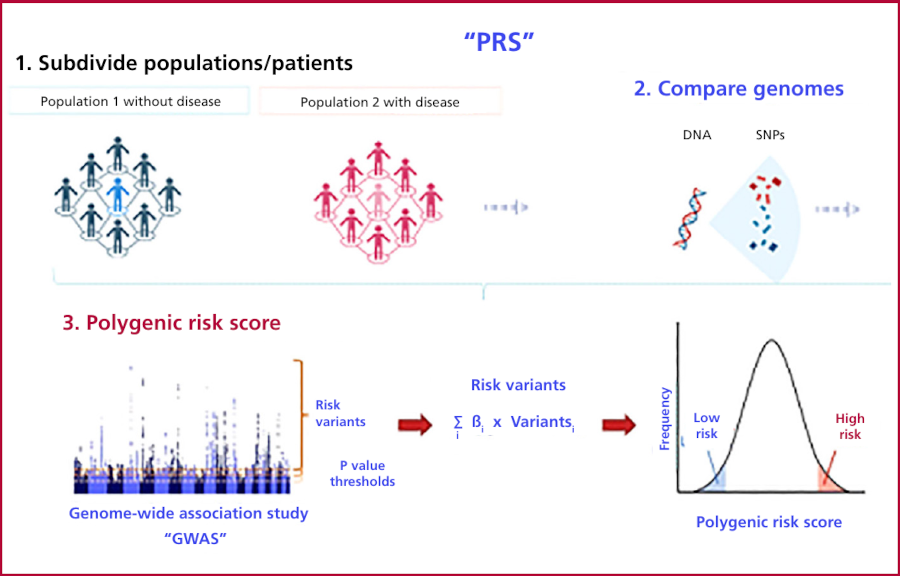
Genome Wide Association Studies (GWAS) incorporated a different paradigm configured according to the "polygenic risk" scheme. This risk contemplates many SNPs, in different genes, frequent in the general population, that combined can have an additive large effect on the expression of a condition. (2)
The combination of the effects of all these SNPs captures much of the genetic heritability and can be used to construct predictive models or polygenic risk scores (PRS), which are considered a quantitative measure of genetic susceptibility to estimate an “individual probability”. (Figure 1)
Since the germline genotype does not change, this precludes reverse causality, indicating that PRSs ideally represent a stable measure unaffected by age and environment. They can be estimated on a one-time basis at any point in time and overcome many obstacles associated with other biomarkers or risk modifiers. Most include hundreds and sometimes thousands of SNPs. (3)
Polygenic risk score in primary prevention
An ideal PRS will allow predicting a condition with an interindividual variability in accordance with the variability of the trait studied, defining the endophenotype, an intermediate position in the pathway “genotype-endophenotype-phenotype", reflecting the individual genetic predisposition. An ideal PRS discriminates endophenotypes into low, moderate or high risk. (4)
Understanding the highly polygenic architecture of disorders with an inherent etiological complexity may allow for changes as in those with high interaction between environmental factors and lifestyle, or early pharmacological treatment in those with a high-risk endophenotype. (5) (Figure 2 )

Polygenic risk score in secondary prevention
The value of PRS in secondary prevention is gaining much interest. (6) As in the work of Principato et al. is left ventricular systolic function, (7) the challenge is to identify clearly the outcome against which to measure the prognostic value of the score. The authors use left ventricular ejection fraction, which is highly dependent on both the ventricular geometry and the operator. However, in the future, assessment by magnetic resonance imaging and the use of artificial intelligence may mitigate this pitfall. It is worth mentioning the importance that this work, which, in addition to incorporating PRS, includes artificial intelligence algorithms. However, it would be desirable to expand the criteria used in the selection of the SNP studied.
In this population with ethnicity from southern Bolivia and northern Argentina, diverse allelic frequencies should be expected, whose future consideration would improve the estimation, allowing statistical adjustment with ancestral information. (8) In addition, the inclusion of other risk factors such as obesity, smoking, dyslipidemia, socioeconomic environment and access to health care of the population could optimize uniformity within the sample. Further multicenter studies with randomized selection of participants for external validation will be required to assess the fit of the model in other populations.
Challenges and perspectives
The use of PRS to predict causal propensity genetically determined and independent of traditional risk factors that have so far not demonstrated detection power in presymptomatic or preclinical stages is bringing important insight to cardiovascular disease research, especially cardiomyopathies
There are no precedents for studies of PRS in chagasic cardiomyopathy, and this highlights the importance of this work performed with the intention of having local data and accurately detecting individuals who could benefit from early intervention.
The potential of PRS has recently led to position papers from the American Heart Association (9) and the European Society of Cardiology, (10) both of which advise against the routine use of PRS as there are still many challenges. For example, current scores only assess "common" SNPs, without investigating the potential to include rare variants such as those responsible for monogenic diseases.
It is essential to carry out prospective studies in heterogeneous populations, ensuring compliance with strict quality standards in processing and reporting data, with rigorous control protocols and uniform reference frameworks that ensure the validity and reproducibility of the results.
Genetic information, because of its unfamiliar language to cardiologists is less intuitive than any of the traditional risk factors, clinical or imaging data, but its proper incorporation into our predictive models can influence the strength and direction of shared decisions to improve the quality of medical care in the era of personalized and precision medicine.
Etical considerations
Not applicable.
Conflicts of interest
None declared. (See conflict of interest form on the website).