
Coronary Angiography. Analysis of Quality Image and Radiation Dose.
pp 259-267
DOI:
https://doi.org/10.7775/rac.v77i4.2381Keywords:
Coronary Angiography, Tomography, Coronary Stenosis, Radiation DosageAbstract
Background
Multidetector row computed tomography coronary angiography (MDCT-CA) has become a useful diagnostic tool for the direct quantification of coronary stenosis, for identifying coronary anomalies and for the assessment of coronary artery bypass grafts. Despite its clinical value has been questioned due to the effective radiation dose (ERD) received by each patient, radiation exposure is similar to other studies. However, different strategies are permanently tested in order to reduce the ERD maintaining adequate and diagnostic image quality.
Objectives
To determine the image quality and effective radiation dose (ERD) of prospective electrocardiogram-gated multidetector row computed tomography coronary angiography (PMDCT- CA) (the x-ray beam is turned on for only a short portion of diastole) compared to retrospective ECG gating (RMDCT-CA) (the x-ray beam is turned on throughout the cardiac cycle) and a preliminary approach of its diagnostic accuracy compared to digital invasive coronary angiography (CA).
Material and Methods
Fifty consecutive patients with suspected coronary artery disease and sinus rhythm were evaluated with PMDCT-CA and compared to a control group who underwent RMDCT-CA. Image quality was analyzed by two reviewers. Interobserver concordance and ERD were determined. The diagnostic accuracy of PMDCT-CA compared to CA to detect coronary artery stenosis > 50% was assessed in 30 patients.
Results
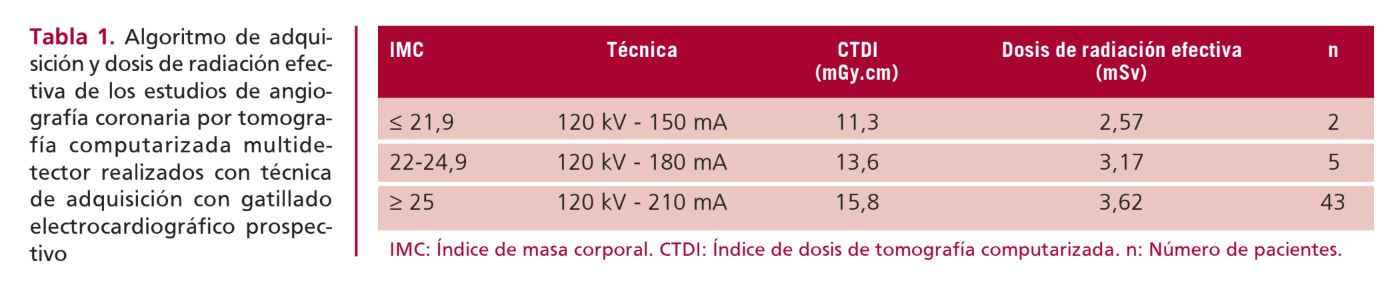
There were no significant differences in the image quality between both groups. Agreement between the reviewers for segment image quality scores was k = 0.92. Mean ERD was 3.5 mSv for PMDCT-CA compared to 9.7 and 12.9 mSv for RMDCT-CA with and without tube current modulation, respectively. Individual analysis including all segments showed that the sensitivity, specificity, positive predictive value and negative predictive value of PMDCT- CA for the detection of coronary stenosis were 94.74%, 81.82%, 90% and 90%, respectively.
Conclusion
Our initial experience demonstrated that use of PMDCT-CA has similar subjective image quality scores with a substantial reduction ERD when compared to use of RMDCT-CA in a selected population.
Downloads
Published
Issue
Section
License
Copyright (c) 2025 Argentine Journal of Cardiology

This work is licensed under a Creative Commons Attribution-NonCommercial-ShareAlike 4.0 International License.





