
Events Prediction Ability in Patients with Hypertension using Artificial Neural Network Analysis of Ambulatory Blood Pressure Monitoring Compared to Clinical Risk Stratification
pp. 31-40
DOI:
https://doi.org/10.7775/rac.es.v93.i1.20854Keywords:
Risk Assessment, Artificial neural networksAbstract
Background: There is no available evidence comparing the predictive value of an artificial neural network (ANN)-based analysis method that integrates ambulatory blood pressure monitoring (ABPM) variables versus clinical risk stratification (CRS) for serious events in hypertensive patients at follow-up.
Methods: We analyzed ABPM studies that included 27 measurements each one. The variables were daytime, nighttime and 24-hour mean, systolic and diastolic blood pressure, pulse pressure and heart rate; hypertensive load; standard deviations of pressures and heart rate; circadian rhythm. The dependent variable was the combined endpoint of death, stroke, acute myocardial infarction, heart failure and kidney disease. For clinical risk stratification, the Argentine Consensus on Hypertension was used as a model. We evaluated the discriminative ability to predict the endpoint using ANN-ABPM and CRS by logistic regression through the analysis of the area under the receiver operating characteristic curve (AUC-ROC). Both AUC-ROC were compared by De Long test. SPSS 23.0 Statistics was used for statistical analyses and ANN modelling.
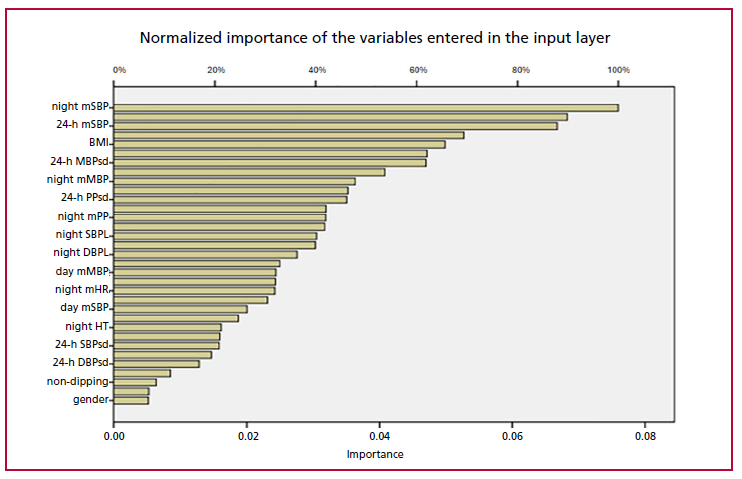
Results: Data from 491 ABPM studies were analyzed. Mean age was 69 ± 14 years; 53% of population was female; 11.6% had diabetes; 51% had dyslipidemia; mean body mass index was 26 ± 4 kg/m2; 14.3% were smokers. Median follow-up was 6.6 years (95% interquartile range 4.5-8). The best predictive ANN model was the Multilayer Perceptron one with a hidden layer; neuronal architecture (27/7/2). Nocturnal systolic blood pressure (SBP) had 100% independent normalized significance for modelling. The AUC-ROC for the combined endpoint was 0.81 (95% CI 0.77-0.90) using neural network analysis with ABPM variables, and 0.67 (95% CI 0.56-0.77) using CRS; De Long's test p < 0.001.
Conclusion: We observed a higher discriminative ability to predict events at follow-up using ANN analysis with ABPM variables compared to conventional CRS. This observation raises a research hypothesis to be validated prospectively to optimize risk stratification and treatment in hypertensive patients.
How to cite this article:
Di Gennaro FP, Catalano María P, García Aguirre A, Fernández María L, Llanos Romina, Pérez Lloret S, et al. Events Prediction Ability in Patients with Hypertension using Artificial Neural Network Analysis of Ambulatory Blood Pressure Monitoring Compared to Clinical Risk Stratification. Rev Argent Cardiol 2025;93:31-40. https://doi.org/10.7775/rac.v93.i1.20854
Downloads
Published
Issue
Section
License
Copyright (c) 2025 Argentine Journal of Cardiology

This work is licensed under a Creative Commons Attribution-NonCommercial-ShareAlike 4.0 International License.





