Antithrombotic Strategies in Atrial Fibrillation. The XIX CONAREC Registry
pp. 210-216
DOI:
https://doi.org/10.7775/rac.es.v83.i3.5723Keywords:
Atrial Fibrillation - Anticoagulation - Hemorrhage - StrokeAbstract
Background: Atrial fibrillation (AF) represents the most common sustained arrhythmia. Treatment has evolved since the last survey performed in our setting, with a marked trend towards the use anticoagulation therapy, and the development of new anticoagulation drugs. However, Argentina lacks updated data about antithrombotic therapy or the use of novel oral anticoagulants (NOAC).
Objective: The aim of the study was to assess antithrombotic strategies in AF patients admitted for cardiovascular causes in centers with cardiology residency.
Methods: Between September and November 2013, 927 patients with at least one episode of atrial fibrillation within the last 12 months and hospitalized for cardiovascular causes in centers with cardiology residency were enrolled in the study.
Results: Median values (interquartile range) of CHADS2 and CHA2 DS2-VASc and HASBLED scores were: 2 (1-3), 3 (2-4) and 1 (1-2), respectively. At admission, only 54% of patients with history of AF without contraindication and CHADS2≥1 (n=253)
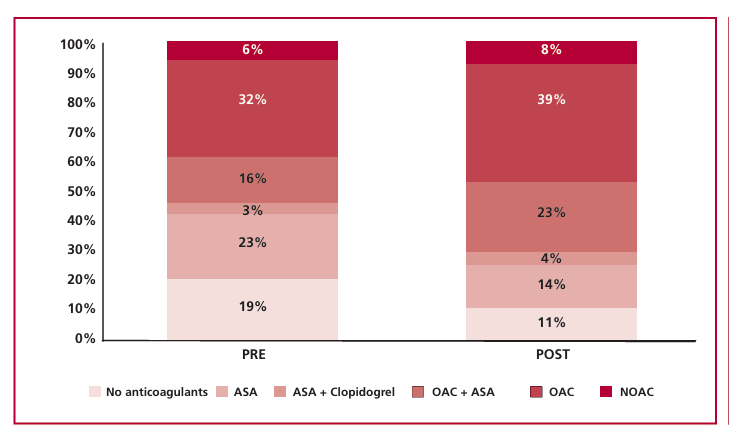
received anticoagulation therapy; 89% with dicoumarinic agents and only 26.5% in the therapeutic range. At discharge, anti coagulation rates increased up to 70%, and including all patients without contraindication, 59.74% received anticoagulation
therapy at discharge. Aspirin as single strategy was used in 26% of patients. The major reasons for not prescribing anticoagulants included contraindications (36%), social limitations (21%) and unknown reasons (14.8%). Stroke [OR 2.18 (95% CI 1.02-4.67); p=0.04], age [OR 1.01 (95% CI 1-1.03); p=0.009], hypertension [OR 1.54 (95% CI 0.99-2.41); p=0.05], heart failure [OR 1.68 (95% CI 1.1-2.55); p<0.01] and severe ventricular dysfunction [OR 4.99 (95% CI 1.71-14.55); p=0.003] were independent predictors of anticoagulation. High level of education was a predictor for the use of NOAC (OR 1.84, 95% CI 1.08-3.14).
Conclusions: The population of this survey performed in centers with cardiology residency has moderate thromboembolic risk and low bleeding risk. The rate of oral anticoagulation increased during hospitalization and high level of education was associated with the indication of NOAC.
Downloads
Published
Issue
Section
License
Copyright (c) 2015 Argentine Journal of Cardiology

This work is licensed under a Creative Commons Attribution-NonCommercial-ShareAlike 4.0 International License.