Prognosis in congestive heart failure and predictors of mortality
pp 31-39
DOI:
https://doi.org/10.7775/rac.v61i1.3171Abstract
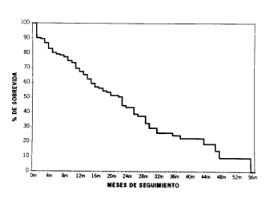
In order to evaluate the probability of survival and the prognostic significance of several variables on death and type of death in patients with congestive heart failure (CHF), 183 cases from a prospective data bank initiated in 1986 were studied. The mean age of the study group was 56.7 ± 13.9 years; left ventricular ejection fraction (LVEF) X =18.8 ± 6.7%; 124 patients (67.8%) were in functional class (FC) III-IV and 59 (32.2%)in classI-I!. The cause of CHF was interpreted as secondary to coronary artery disease in 89 cases (48.6%) and idiopathic in 69 (37.7%).During the follow up to one to 56 months (X: 15.4 ± 11.2), 99 patients (54%) died; 45.4% by sudden death and 53.5 % due to progressive heart failure. The probability of the population survival was 79.4% at 6 months, 67.6 % at one year, 43.4 %at two years and24.5 % at three years. By means of bivariate correlation of different variables at entrance, the FC (p <0.001), natremia (p<0.001), presence of R3 (p<0.005), left ventricular end diastolic pressure (p<0.01) LVEF (p<0.05) were related significantly with mortality. Cox multivariate regression analysis only showed FC (p<0.001) and natremia (p<0.01) as independent predictors of death. The association of FC III-IV and hyponatremia (Na<136 mEq/1) identified a group of high risk patients with 41.7% survival at one year vs 87% for patients without this combination. The patients who died of sudden death were differentiated from those who died progressively only in their lower FC (3.07±0.62vs3.47±,0.54).Conclusions: with present pharmacological treatment, mortality remains high in patients with CHF. Functional class and natremia were the variables with highest prognostic values in determining different risk groups. The forms of death were not related to ventricular function impairment nor the presence of ventricular tachycardia.
Downloads
Published
Issue
Section
License
Copyright (c) 2026 Argentine Journal of Cardiology

This work is licensed under a Creative Commons Attribution-NonCommercial-ShareAlike 4.0 International License.