
Triple Contractile Imaging in the Stress Echo Lab: the Additive Prognostic Value of Pressure–Volume and Preload Recruitable Stroke Work Relationships
pp 489-497
DOI:
https://doi.org/10.7775/rac.85.i6.12856Keywords:
Stress echocardiography, Triple imaging, Contractility, Preload, Starling.Abstract
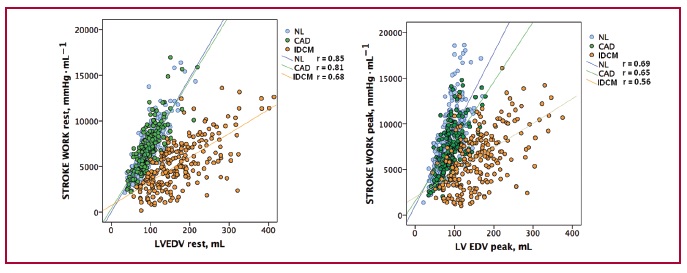
Background: Stress echo positivity based on regional wall motion abnormalities has been declining as new positivity criteria based on left-ventricular contractile reserve (stress/rest ratio of left-ventricular elastance) have been proposed. In addition, the slope of preload-recruitable stroke work, i.e. the slope of the relationship between ventricular stroke work and end-diastolic volume, provides
a preload and afterload independent measure.
Objective: The aim of this study was to assess the incremental prognostic value of left-ventricular contractile reserve and of the slope of preload-recruitable stroke work.
Methods: A total of 692 patients (62±12 years) with negative stress echo (exercise n=130; dipyridamole n=438; dobutamine n=124) and no dilation (n=470) or idiopathic dilated cardiomyopathy (n=222) were selected from the Stress echo multicenter study CNR data bank. All underwent triple imaging to assess: 1- wall motion abnormality 2- left-ventricular contractile reserve and 3- the slope of preload-recruitable stroke work.
Results: By selection, all patients had negative stress echo by wall motion abnormality criterion. The overall positivity rate was 49 % for contractile reserve, 36 % for the slope of preload-recruitable stroke work (positivity criteria ≤ 64 erg×cm−3×10³), 19% for both criteria positivity and 33 % for both criteria negativity. In the 692 patients with median follow-up of 20 months, there were 132 events. Event rate was lowest in patients with double negativity, and highest in those with double positivity (X2 = 51, p<0.001).
Conclusions: The stress echo positivity rate and prognostic yield are sharply increased if the stress contractile reserve and the resting slope of preload-recruitable stroke work are added to conventional regional wall motion abnormalities.
Downloads
Published
Issue
Section
License
Copyright (c) 2025 Argentine Journal of Cardiology

This work is licensed under a Creative Commons Attribution-NonCommercial-ShareAlike 4.0 International License.





