
Percutaneous Coronary Intervention in Octogenarian Patients: Longterm Outcomes and Predictors of Adverse Outcome
pp 108-113
DOI:
https://doi.org/10.7775/rac.es.v86.i2.12065Keywords:
Aged, 80 and over, Angioplasty /Mortality, Angioplasty /complications, ComorbidityAbstract
Background: Coronary percutaneous intervention in octogenarian patients is growing due to the rise in life expectancy. However, this population is underrepresented in randomized trials due to its high risk.
Objectives: The aim of this study was to evaluate short and long-term outcomes of coronary percutaneous intervention in octogenarian patients, and to identify independent predictors of adverse outcome.
Methods: This was a retrospective study including consecutive patients undergoing percutaneous coronary intervention at a general hospital from June 2011 to September 2013. Octogenarian patients (age ≥80 years) were compared with younger patients. Medical history, procedure characteristics and clinical outcomes were evaluated. Major adverse cardiovascular events (MACE consisting of death, myocardial infarction or stroke) were evaluated at 1 month, and 1 and 3 years. Multivariate analysis was performed to assess independent predictors of adverse outcome.
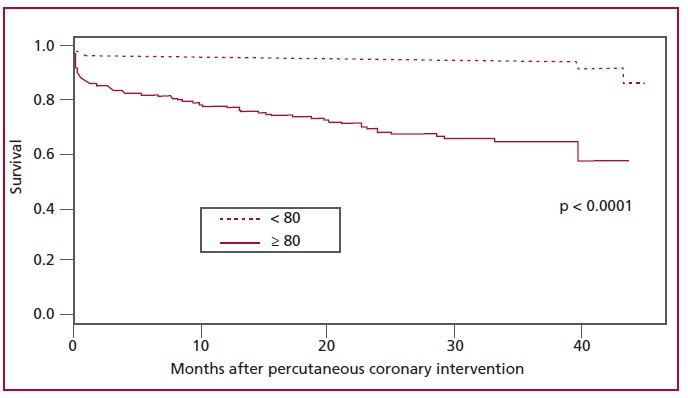
Results: A total of 1,030 patients (20.2% octogenarians) were included in the study. Mean age of octogenarian patients was 83 years (IQR 81-86). This population had more cardiovascular risk factors and comorbidities. No differences were observed in procedure success and number of implanted stents. The rate of MACE was significantly higher in octogenarian patients at 1 month (14.4%
vs. 4.9%; p<0.001), 1 year (23.9% vs. 8.5%; p<0.001) and 3 years (p<0.0001), due to increased mortality, without differences in myocardial infarction (4.8% vs. 3.8%), stroke (1.7% vs. 1.6%), or procedural complications. Independent predictors of mortality in octogenarian patients were kidney failure, chronic obstructive pulmonary disease and ventricular dysfunction. Age ≥80 years was an independent predictor of MACE in the overall population.
Conclusions: Technical success was acceptable in octogenarian patients undergoing percutaneous coronary intervention, but octogenarian patients showed increased early and long-term mortality that appears to be independent of the procedure. Kidney failure, chronic obstructive pulmonary disease and ventricular function impairment were independent predictors of adverse outcome in these patients.
Downloads
Published
Issue
Section
License
Copyright (c) 2025 Argentine Journal of Cardiology

This work is licensed under a Creative Commons Attribution-NonCommercial-ShareAlike 4.0 International License.





