Clinical, Diagnostic and Prognostic Characterization of Patients with Suspected Pulmonary Embolism Before and During COVID-19
pp. 246-252
DOI:
https://doi.org/10.7775/rac.v90i4.29Keywords:
Pulmonary embolism, D-dimer, SARS-CoV-2, COVID-19, DiagnosisAbstract
Background: Pulmonary embolism (PE) is a frequent disease generating important hemodynamic effects and high mortality rate, with great incidence in coronavirus disease (COVID-19).
Objective: The aim of this study was to characterize the clinical, diagnostic, and prognostic behavior of patients with suspected PE before and during the SARS-CoV-2 pandemic.
Methods: A prospective cohort study of adult patients with suspected PE undergoing computed tomography pulmonary angiography was carried out during two periods: a) the pre-COVID-19 phase: June 2018 to December 2019, and b) during the COVID-19 phase: June to December 2020. Bivariate analyses were conducted and ROC curves were built calculating the
areas under the curve (AUC) for D-dimer PE diagnosis and clinical prediction rules.
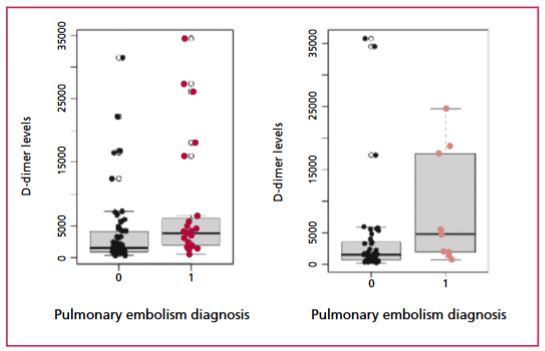
Results: Three-hundred and two pre-COVID-19 patients and 55 patients with COVID-19 were included in the study. D-dimer showed a moderate performance for the diagnosis of PE, with AUC 0.73 (95% CI 0.62-0.84) in pre-COVID-19 phase vs. 0.75 (95% CI 0.58-0.92) in COVID-19 phase. The AUC of each of the clinical prediction rules had moderate to low performance in the pre-COVID-19 phase (AUC 0.623 to 0.697), with a non-discriminatory AUC in the COVID-19 phase (0.355 to 0.450).
Conclusions: Traditional risk factors were poorly prevalent in patients with COVID-19 and PE. Although D-dimer was higher in those with PE, the difference was not statistically significant. Clinical prediction rules for PE diagnosis showed low discriminative power in COVID-19 patients.
How to cite this article:
Aponte I, Taboada N, Fierro DM, Veronesi LA, Coral DC, Sprockel JJ. Clinical, Diagnostic and Prognostic Characterization of Patients with Suspected Pulmonary Embolism Before and During COVID-19. Rev Argent Cardiol 2022;90:246-52. http://dx.doi.org/10.7775/rac.v90.i4.20534
Downloads
Published
Versions
- 2022-08-31 (2)
- 2023-02-19 (1)