Painless ST-segment depression in exercise testing (silent ischemia). I: Evaluation and follow-up of aymptomatics patients without history of coronary artery disease
pp 347-353
DOI:
https://doi.org/10.7775/rac.v61i4.3405Abstract
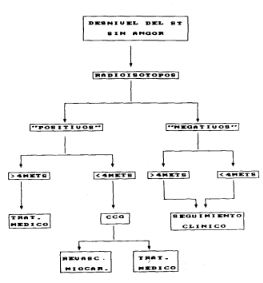
According to a previously designed protocol for diagnosis and treatment, a group of "apparently healthy"individuals with risk factors for coronary heart disease and asymptomatic ST segment depression in an exercise tolerance test was analyzed. The aims of the study were: 1) to build a registry of patients recruited according to the inclusion criteria, 2) to assess the value of the different clinical, exercise, radionuclide and angiographic variables, 3) to evaluate patient prognosis and 4) to evaluate the relative risk of variables analysed for the development of clinical events. Forty-one individuals were included (28 male) with a mean of 55.9 years (range 31 to 69); 37 were followed-up during a mean period of 48 months (range 10 to 65 months). In 26 patients (63 %) the radioisotopic studies were positive; 4 of them had a functional capacity lower than 4mets and a were studied with cinecoronary-angiography. One had 1 vessel-disease, 1 had 2 vessel-disease and 2 had 3 vessel-disease. One of the patients with 3 vessel-disease received bypass surgery. Seven of the 37 patients had coronary events (18.9% or 4.7 %per year). The first event was angina in every case. Subsequently, 2 patients suffered myocardial infarction (5.4% or 1.2 per year), one of them followed by death (2.7 % or 0.6% per-year). The variables that showed a higher relative risk for clinical events were a history of hypertension (2.27), threshold heart rate of 130 beats/min (7.0), impairment of exercise test (10.7) and 2 or more areas with reversible ischemia in the radioisotopic test (2.75).
Downloads
Published
Issue
Section
License
Copyright (c) 2026 Argentine Journal of Cardiology

This work is licensed under a Creative Commons Attribution-NonCommercial-ShareAlike 4.0 International License.