Painless ST-segment depression in exercise testing (silent ischemia). II: Evaluation and follow-up of asymptomatics patients with history of coronary artery disease
pp 441-448
DOI:
https://doi.org/10.7775/rac.v61i5.3521Abstract
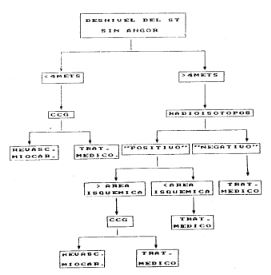
The aims of this study were: 1) to obtain a registry of asymptomatic patients with coronary heart disease and ischemic ST segment depression in an exercise tolerance test, 2) to assess their prognosis, 3) to evaluate the relative risk of several variables to anticipate coronary events and 4) to investigate the predictive value of coronary events of ST segment depression occurring ata workload of 4 mets or less. Fifty seven patients (54 male) with a mean age of 58.2 years (between 36 and 74) were included in a previously designed protocol for study and treatment. Thirty five had prior myocardial infarction: 23 inferior, 7 anteroseptal, 3 lateral and 2 anterior. Fourteen had a history of angina and 8 had prior coronary revascularization (4 bypass and 4 angioplasty). Nine cases developed ST depression segment at4 mets or less (16 %). Cinecoronary angiography in these patients showed 6 cases with 3 vessel disease (66.6 %), 2 with 2 vessel (22.2 %) and 1 with 1 vessel (11.11 %). Coronary artery revascularization was performed in 5 of these cases. Forty eight patients had a threshold functional capacity higher than 4 mets; 29 of them showed an abnormal radionuclide study demonstrating myocardial ischemia (60%). In 16 of them a coronary angiographic study was obtained: 4 had 3 vessel (25 %), 9 had 2 vessel (56.3 %), 2 had 1 vessel (12.5 %) and 1 had normal arteries(6.2'x@).Coronary artery revascularization was performed in 3 cases of this subgroup. The remaining 13 patients showed non-significant area of ischemia at radionuclide study and a functional capacity higher than 7 mets, so they werenot considered candidates for revascularization and angiographic were not indicated. The 19 patients with negative radionuclide studies were followed-up under medical treatment. In one of them coronary angiography was done out of the protocol, and showed normal arteries. All the patients were followed-up during a mean period of 44.2 months (between 4 and 65). Seventeen events occurred in the whole population (29.8 % or 7.959 % per year). Angina was the first event in 14 cases (24.6% or 6.6% per year), heart failure in 2 (3.5 % or 0.95 % per year) and asymptomatic myocardial infarction in 1 patient (1.75 % or 0.4 % per year).The variables that showed the higher risk for predicting cardiac events were prior hypertension, dyslipidemia, worsening of the exercise test and an ischemia response in the radionuclide study. A functional capacity of 4 mets or less had a predictive value of 66.6 % for 3 vessel disease at angiography.
Downloads
Published
Issue
Section
License
Copyright (c) 2026 Argentine Journal of Cardiology

This work is licensed under a Creative Commons Attribution-NonCommercial-ShareAlike 4.0 International License.