
Atrioventricular Reentrant Tachycardia Mediated by Mahaim Fibers. Transcatheter Mapping and Ablation
pp 579-588
DOI:
https://doi.org/10.7775/rac.v67i5.3145Keywords:
Mahaim fibers, Atriofascicular pathways, Accessory pathway, Mapping, Transcatheter ablationAbstract
Objectives To describe the results of radiofrequency catheter ablation guided by the direct record of the accessory pathway potentials. Methods Ten patients, (29.6±14 years, 8 females), with antidromic atrioventricular tachycardia and left bundle branch block pattern underwent catheter ablation. Nine subjects had right atriofascicular pathway and the other one a right long atrioventricular pathway, all exhibiting only anterograde conduction with decremental properties. Associated atrioventricular accessory pathways were observed in two patients and atrioventricular nodal reentry tachycardia in one of them. Atriofascicular and long atrio-ventricular pathway potentials, were localized by mapping the tricuspid annulus. Radiofrequency energy was applied either in sinus rhythm, atrial stimulation or during tachycardia to observe loss of conduction through the pathway.ResultsIn patients with atriofascicular pathways in sinus rhythm, discrete potentials were recorded between the anterolateral and posterolateral regions of the tricuspid annulus, 67 ± 7 msec after atrial electro-grams, and 67 ± 19 msec before ventricular ones. Ventricular electrograms were recorded 15.6 ± 7.7 msec following the onset of QRS complexes. Incremental atrial stimulation and adenosine elicited a gradual increase in the atrial-potential intervals and Wenckebach block proximal to the potential. Atrial-long atrioventricular pathway potential interval was 75 msec and potential-ventricular interval 30 msec. Local ventricular electrogram was re-corded 40 msec before the onset of the QRS complex. Catheter ablation was successfully performed at the site where accessory pathway potentials were recorded (8 patients) and at the site of catheter mechanical conduction block in 2 additional subjects.Any other arrhythmic substrate was successfully ablated. Recurrence of atriofascicular conduction was observed in 4 patients. Successful additional sessions were performed in 3 of them. Conclusions Right atriofascicular and right long atrioventricular accessory pathway potentials can be recorded at the tricuspid annulus, far from the AV node. They allow an accurate localization of these pathways for their successful ablation.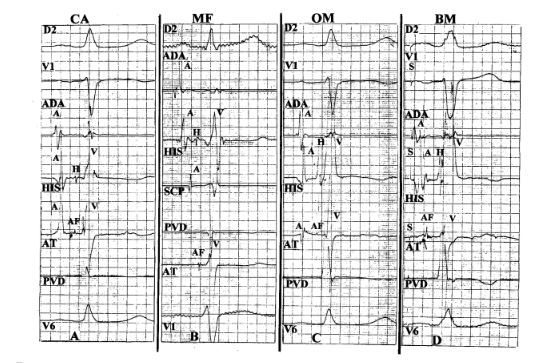
Downloads
Published
2026-03-11
Issue
Section
ORIGINAL ARTICLES
License
Copyright (c) 2026 Argentine Journal of Cardiology

This work is licensed under a Creative Commons Attribution-NonCommercial-ShareAlike 4.0 International License.





