
Different Articles Considered for Publication
INTRODUCTION
For information on how to prepare an article to be submitted for review to the Argentine Journal of Cardiology, please carefully follow the Instructions of this section. If the articles prepared by the authors are not in agreement with the specifications of these guidelines, the editors of the Argentine Journal of Cardiology (correct abbreviation for citing the publication: Rev Argent Cardiol) will return them so that the appropriate changes can be made.
Original articles, brief articles, review articles and research hypotheses are submitted to peer review (see peer review policy).
Original article
Original articles are scientific reports of the results of an original basic or clinical investigation.
The text word count should be no more than 3500 words and the abstract no more than 350 words. The total number of tables or figures should be no more than 7, and the article should include between 20 and 40 references, and no more than 12 authors.
Brief report
Brief reports are original investigations. The introduction and discussion are shorter than in an original article.
The text word count should be no more than 2000 words and the abstract no more than 200 words. The total number of tables and figures should be no more than 4, and the article should include no more than 20 references, and no more than 8 authors.
Review Article
Review Articles are usually requested by the editors, from well-known local and foreign authors, but articles submitted to the Editorial Office will be considered for review. All review articles are subjected to the same editorial and peer review process as original research articles.
Review Articles refer to different aspects of cardiovascular diseases, including, but not limited to, the following:
Current Concepts: topics in clinical cardiology, including those of subspecialty areas, but of broad interest.
Mechanisms of Disease: these articles discuss the cell and molecular mechanism of a disease or categories of diseases.
Epidemiological Aspects: description of local, regional or national setting of the disease, differential socioeconomic characteristics and association with traditional and nontraditional risk factors.
Therapeutics: these articles develop topics related to general or specific therapeutics, from behavioral interventions through the different pharmacological alternatives to surgical interventions, interventional cardiology procedures or devices to treat a particular disease or syndrome.
Medical Progress: scholarly review of important clinical topics, with primary (but not exclusive) focus on development occurred during the last five years. Each article describes how the perception of a disease or disease category, workup or therapeutic intervention has developed in recent years.
Clinical Practice: these articles are evidence-based reviews of the practical aspects of issues relevant to daily practice of primary care or general physicians, clinicians or specialists. They include clinical setting, strategies and evidence, areas of uncertainty, professional society guidelines and recommendations.
The text word count of Review Articles should be no more than 3500 words and the abstract no more than 250 words. The total number of tables or figures should be no more than 6, and the article should include no more than 80 references, and no more than 6 authors.
Systematic reviews and, if possible, meta-analysis, are encouraged.
Because the essence of review articles is selection and interpretation of the literature, the Journal expects that authors of such articles will not have any significant financial interest in a company (or its competitor) that makes a product discussed in the article.
Editorial
Editorials provide comments and analysis of an article appearing in that issue of the Journal and are requested by the Editorial Board to well-known authors in the field of the subject to which the article refers. The word count is limited to 1200 words. The total number of tables or figures should be no more than 2, and the article should include no more than 15 references, and no more than 3 authors.
Controversies
Controversies are always submitted upon request. The Editorial Board designates two authors to express an opinion on a relevant aspect of cardiovascular disease. One of the authors supports the defense of the issue in question (agonist) and the other criticizes it (antagonist). The text word count should be no more than 3500 words. The total number of tables and figures should be no more than 6, and the article should include no more than 60 references.
Opinion Articles
They express an author's opinion on a current topic related to diagnosis, prognosis, treatment or health policies. They are generally unsolicited. The text word count should be no more than 2000 words, with no more than 3 authors, no more than 20 references and no more than 2 tables or figures.
Images in Cardiology
They present common and classic images of different aspects of cardiovascular diseases. Each article should contain no more than 4 high quality images, no more than 350 words, no more than 3 references and no more than 3 authors.
Letters to the Editor
Each Letter to the Editor is an opinion of an article published in the last issue of the Journal. Letters should be limited to 400 words and may include one table or figure, if essential, no more than 5 references and no more than 3 authors.
Scientific Letters (case reports)
Scientific Letters involve the presentation and discussion of clinical cases by the treating medical group. They should not exceed 6 authors, 1000 words, 2 figures or tables and 6 references.
Research Hypothesis
These articles involve the presentation of an original idea an investigator or research group are working on: its pathophysiological or clinical foundations, and the protocol and the process of implementing the research, with its limitations and difficulties. They should not exceed 6 authors, 1200 words, 2 figures or tables and 8 references.
Book Review
This article refers to a book in the specialty considered relevant by the Editorial Board because it deserves particular attention. Book reviews are usually written by a well-known specialist in the subject upon request and are limited to 700 words, 1 author, and 1 table/figure.
Table. Different types of articles considered for publication
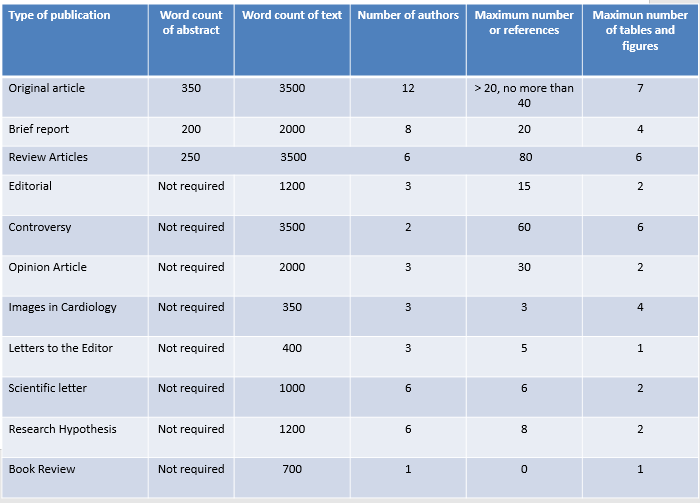
The maximum number of words does not include the abstract, bibliographical references, tables, or figure legends.





