Cardiac Injury after COVID-19 and its Association with the Severity of the Acute Presentation, Persistent Symptoms and Vaccination
pp. 398-405
DOI:
https://doi.org/10.7775/rac.v90i6.103Abstract
Background: COVID-19 is associated with cardiovascular involvement in the acute phase. The information about cardiac
involvement after COVID-19 is heterogeneous, and the indication to routinely perform cardiac imaging tests is still controversial.
There is no updated information on the effect mass vaccination has on the incidence of cardiac injury after COVID-19.
Objectives: The primary objective of this study was to evaluate the prevalence of cardiac injury after COVID-19 by transthoracic
echocardiography and its association with the severity of the acute phase and with persistent symptoms after recovery. The
secondary objective was to explore the association of the prevalence of cardiac injury with the beginning of the vaccination
campaign against COVID-19 in Argentina.
Methods: We conducted an observational, single-center, and retrospective study. All the consecutive patients who consulted
for post-COVID-19 evaluation were included. All the patients underwent transthoracic echocardiography. The date the
vaccination campaign started (12/29/2020) was considered the cut-off point for the analysis of the pre-vaccination and postvaccination subgroups.
Results: The first 1000 patients who consulted in our center between 09/01/2020 and 09/01/2021 were included. Thirty-nine
patients (3.9%) had new abnormal echocardiographic findings suggestive of cardiac injury after COVID-19, including left
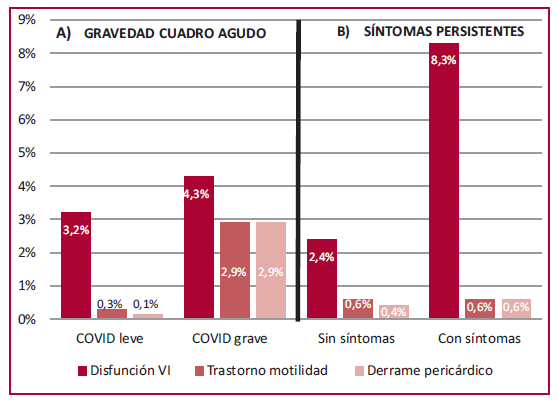
ventricular dysfunction (2.8%), pericardial effusion (0.5%), and wall motion abnormalities (0.6%). Patients with moderate
or severe acute COVID-19 presented a higher prevalence of wall motion abnormalities (2.9% versus 0.3%, p= 0.001) and
pericardial effusion (2.9% versus 0.14%, p = 0.001) compared to those with asymptomatic or mild COVID-19 and this association
remained after adjusting for cardiovascular risk factors and age (OR 6.7, 95% CI 1.05-4.2, p = 0.04, and OR 25.1, 95%
2.1-304.9, p = 0.01 respectively). The percentage of patients who reported persistent symptoms during consultation after
COVID-19 was 19.3%, and they had higher evidence of new left ventricular dysfunction (8.3% vs. 2.4%, p < 0.005); however,
this association lost significance on multivariate analysis. When the association of cardiac injury with the start of vaccination
was considered, the 330 patients who underwent post-COVID assessment before the vaccination campaign started had
a higher prevalence of injury than the 670 patients evaluated after this date (6.3% vs. 2.7%, p = 0.006). and this association
persisted on multivariate analysis (OR 0.35; 95%CI 0.17-0.69).
Conclusion: The prevalence of cardiac injury assessed by echocardiography after COVID-19 was 3.9%. There was a significant
and independent association between the severe initial presentations and the abnormal echocardiographic findings after
COVID-19, but not with persistent symptoms. Patients who consulted after the vaccination campaign started in Argentina
had a lower prevalence of cardiac injury compared with those patients in the first wave.
Downloads
Published
Issue
Section
License

This work is licensed under a Creative Commons Attribution-NonCommercial-ShareAlike 4.0 International License.