
Role of Adenosine A1 Receptors in Remote Ischemic Preconditioning Protection
pp 84-87
DOI:
https://doi.org/10.7775/rac.es.v86.i2.12901Keywords:
Myocardial Infarction, Receptor, Adenosine A1, Ischemic Preconditioning, Myocardial/methods, Receptor, Adenosine A3Abstract
Background: Adenosine is involved in classical preconditioning acting especially through adenosine A1 and A3 receptors.
Objective: The objective of our study was to evaluate whether remote ischemic preconditioning (rIPC) activates adenosine A1 receptors before ischemia or at the onset of reperfusion to reduce myocardial infarct size.
Methods: Isolated rat hearts were subjected to 30-min ischemia and 60-min reperfusion (I/R). In a second group, a rIPC protocol (3 cycles of hindlimb ischemia/reperfusion) was performed. Infarct size was measured with triphenyltetrazolium staining.
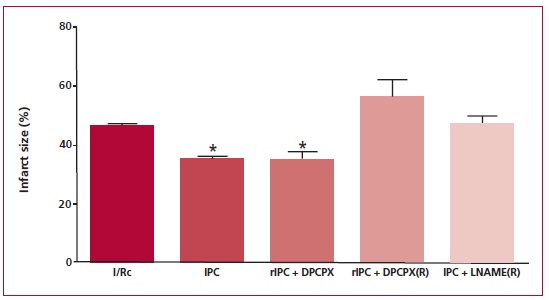
Results: Remote IPC significantly decreased infarct size. This effect was abolished when DPCPX (A1 receptor blocker) or L-NAME (nitric oxide synthesis inhibitor) were administered during reperfusion.
Conclusions: We demonstrated in the isolated rat heart that rIPC reduces myocardial infarction by activation of the adenosine A1 receptor at the onset of the reperfusion period. This protective effect would be also mediated by the activation of nitric oxide synthase during reperfusion.
Downloads
Published
Issue
Section
License
Copyright (c) 2025 Argentine Journal of Cardiology

This work is licensed under a Creative Commons Attribution-NonCommercial-ShareAlike 4.0 International License.





