
Concordance between Carotid and Femoral Ultrasound for the Diagnosis of Subclinical Atherosclerosis in Patients with Low or Intermediate Cardiovascular Risk
pp. 426-432
DOI:
https://doi.org/10.7775/rac.es.v84.i5.9510Keywords:
Plaque, Atherosclerotic - Femoral Artery - Carotid Arteries - Ultrasonography, DopplerAbstract
Background: Approximately 50% of coronary events and sudden death occur in patients with low or intermediate cardiovascular risk, as determined by the Framingham risk score. Subclinical atherosclerosis in the carotid and femoral territories is a powerful predictor of cardiovascular events. Identifying patients with subclinical atherosclerosis allows reclassification of the cardiovascular risk in an individualized manner.
Objective: The aim of this study was to investigate the prevalence of subclinical atherosclerosis in both territories in patients with low or intermediate cardiovascular risk, to evaluate the diagnostic agreement between carotid and femoral Doppler ultrasound, and to determine the independent predictors of subclinical atherosclerosis in both locations.
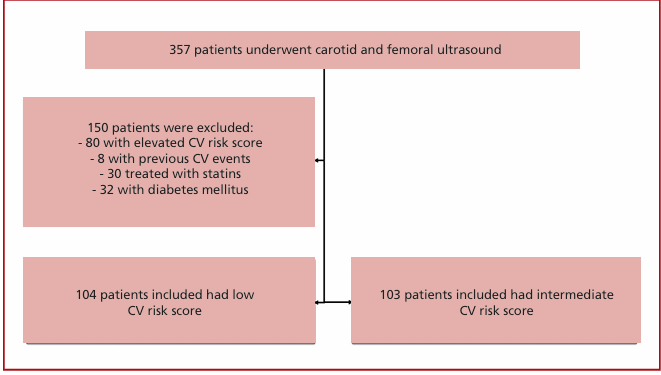
Methods: Patients with low or intermediate risk of the Framingham risk score underwent carotid and femoral Doppler ultrasound for the diagnosis of subclinical atherosclerosis; patients with diabetes and those treated with statins were excluded.
Results: A total of 207 patients were included: 50.2% were classified as low-risk patients, 50.2% were women, and mean age was 52±9 years. The prevalence of subclinical atherosclerosis was 42.5%. The concordance between carotid and femoral Doppler ultrasound was weak (kappa 0.28; 95% CI, 0.13-0.44). Age and sex were independent predictors of subclinical atherosclerosis in both territories, while smoking was an independent and powerful predictor only in the femoral arteries.
Conclusions: Approximately 40% of patients with low or intermediate cardiovascular risk of the Framingham risk score have evidence of subclinical atherosclerosis. Concordance between the carotid and femoral Doppler ultrasound is weak, implying that the two methods identify subclinical atherosclerosis in different populations of patients.
Downloads
Published
Issue
Section
License
Copyright (c) 2016 Argentine Journal of Cardiology

This work is licensed under a Creative Commons Attribution-NonCommercial-ShareAlike 4.0 International License.





