
Cost-Effectiveness of Drug Eluting Stents Versus Bare Metal Stents in Coronary Heart Disease. A Systematic Literature Review
DOI:
https://doi.org/10.7775/rac.es.v80.i5.1024Keywords:
Stents, Cost-benefit analysis, Coronary disease, Myocardial infarction, Systematic reviewAbstract
Objective
The purpose of this study was to perform a systematic literature review to determine whether coronary disease endo-
vascular therapy with drug eluting stents (DES) compared with bare metal stents (BMS) is cost-effective.
Methods
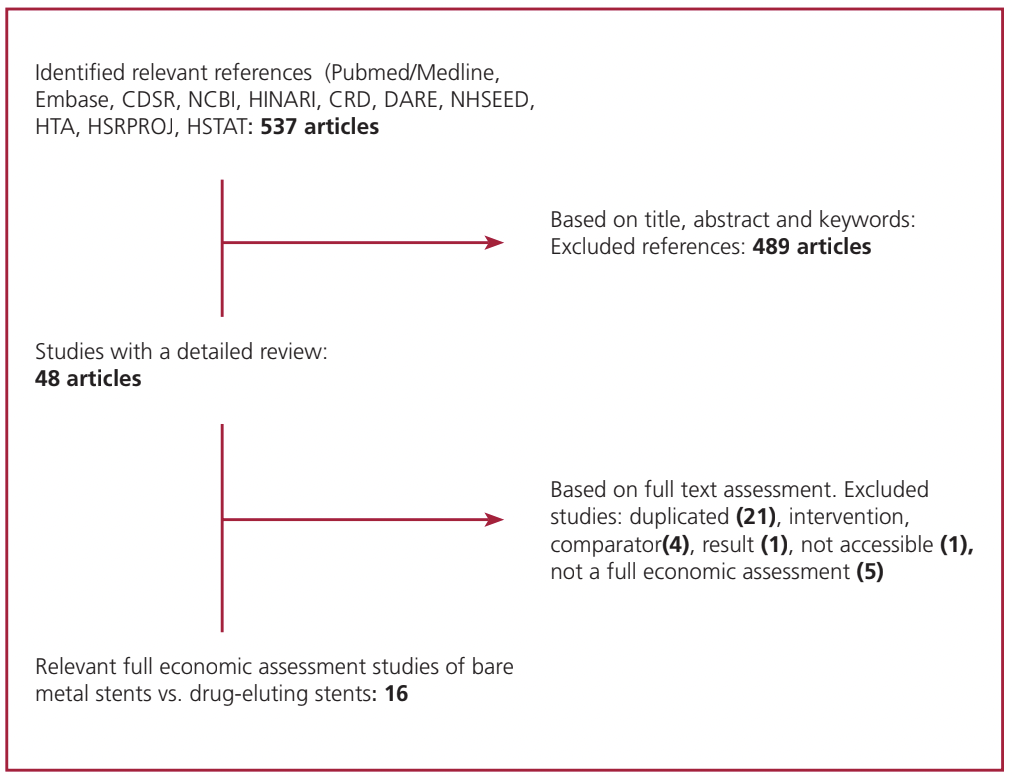
A systematic review was performed in Pubmed/Medline, Embase, CDRS, NCBI, Hinari, CRD, DARE, NHSEED, HTA, HSRPROJ, HSTAT electronic databases to identify full economic evaluation studies with health care perspective reporting the relationship between cost/absolute risk reduction and cost/QALY, without date or language limitations.
Results
Sixteen studies were included (21807 participants). Paclitaxel or sirolimus DES compared with BMS were evaluated in five studies (31.25%), 31.25% assessed only sirolimus eluting stents, 25% only paclitaxel eluting stents and 12.5% zotarolimus eluting stents. Health care payment perspective was explicit in 93.75% of the studies. The distribution of patient characteristics was similar in all groups and balanced in observational studies. Six of the 16 studies concluded that DES were not cost-effective in their population, but that in
subgroups at greater risk of restenosis or with multiple vessel disease the therapy was cost-effective.
Conclusions
The studies were consistent in the reduction of target vessel revascularization frequency with DES compared to BMS without affecting mortality at 12 month follow-up. The intervention was cost-effective in studies at greater risk of restenosis or with multiple vessel disease.
Downloads
Published
Issue
Section
License
Copyright (c) 2025 Argentine Journal of Cardiology

This work is licensed under a Creative Commons Attribution-NonCommercial-ShareAlike 4.0 International License.





