Applicability of the Framingham 30-Year Risk Score Based on Body Mass Index. Usefulness in Cardiovascular Risk Stratification and Diagnosis of Carotid Atherosclerotic Plaque
pp. 514-520
DOI:
https://doi.org/10.7775/rac.v79i6.1969Keywords:
Risk Assessment, Obesity, Carotid Arteries, Atherosclerotic PlaqueAbstract
Background
The traditional Framingham 10-year risk score (FS10) underestimates cardiovascular risk in certain populations. Extending its time-scale to 30 years and assessing its relationship with the presence of carotid atherosclerotic plaque (CAP) may improve risk stratification.
Objective
1) To determine the percentage of patients previously classified with the FS10 who were reclassified when using Framingham 30-year risk score based on body mass index (FS30I); 2) to evaluate the consistency between both methods of classification; 3) to analyze the prevalence of CAP stratified by the FS30I; and 4) to determine the diagnostic potential of the FS30I to detect CAP.
Material and Methods
A carotid Doppler ultrasound study was performed and the FS10 and FS30I for “hard” cardiovascular events were calculated in a population of primary prevention patients. The prevalence of CAP was determined. Receiver operating characteristic analysis and the consistency between both methods of classification were evaluated.
Results
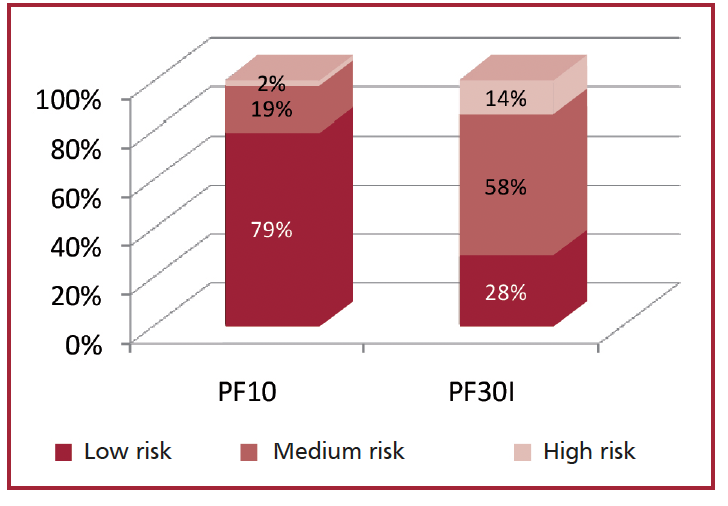
A total of 410 subjects were included (age 48±11 years, 54% were men, 79% had low risk according to the FS10). The FS30I reclassified 64% of the total population and 66% of the low-risk subgroup. The prevalence of CAP was 28% and was gradually associated with the risk category. The area under the curve and optimal cutoff points of the FS30I to detect CAP were 0.862 and 21%, respectively. The consistency between FS10 and FS30I was low (kappa 0.15).
Conclusions
The 30-year score reclassified a large number of patients and discriminated between those with or without evidence of carotid plaques.
Downloads
Published
Issue
Section
License
Copyright (c) 2025 Argentine Journal of Cardiology

This work is licensed under a Creative Commons Attribution-NonCommercial-ShareAlike 4.0 International License.