
Evaluation of Endothelial Function through Pulse Wave Velocity
pp. 17-22
DOI:
https://doi.org/10.7775/rac.v77i1.2102Keywords:
Endothelium / Physiology, Hypertension, Pulsating Flow/ PhysiologyAbstract
Background
Endothelial dysfunction occurs early in the development of atherosclerosis and constitutes the physiopathologic basis of this condition and of cardiovascular disease (CVD). Ultrasound is useful to study endothelial function through the assessment of flow-mediated dilation (FMD). Endothelial function may also be evaluated by the change in pulse wave velocity (PWV) with results that are similar to those obtained by other methods according to the Moens-Korteweg equation.
Objectives
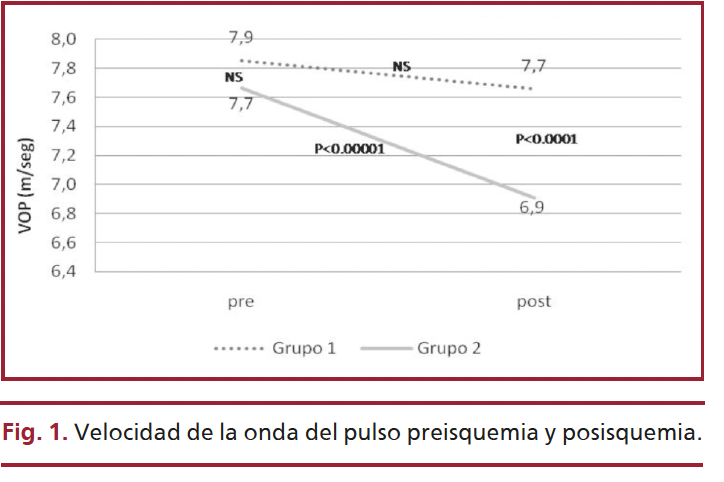
To evaluate endothelial function through the changes in the carotid-radial PWV before and after inducing ischemia at the level of the brachial artery.
Material and Methods
Carotid-radial PWV was determined in 24 hypertensive patients (160 women, 63.6±12.3 years and 88 men, 63.1±11.6 years) and in 56 controls (38 women, 63.1±12.6 years and 18 men, 56.1±13.7 years). A reduction in PWV <5% was considered a normal endothelial response. Patients with abnormal response received 5 mg of sublingual isosorbide dinitrate to evaluate endothelium-independent vasodilation for validation of the method.
Results
An average reduction by 9.3% was recorded in healthy subjects compared to a reduction by 1.5% in hypertensive patients (p<0.0005). The reduction in PWV after the administration of sublingual isosorbide dinitrate was even greater compared to normal subjects (18.2%) (p<0.0001).
Conclusions
The measurement of carotid-radial PWV before and after inducing ischemia is a reliable method to evaluate endothelial function.
Downloads
Published
Issue
Section
License
Copyright (c) 2025 Argentine Journal of Cardiology

This work is licensed under a Creative Commons Attribution-NonCommercial-ShareAlike 4.0 International License.





