
Elevated Defibrillation Threshold: Are Defibrillation Vectors Important?
pp 182-185
DOI:
https://doi.org/10.7775/rac.v79i2.2368Keywords:
Defibrillators, Implantable, Azygous VeinAbstract
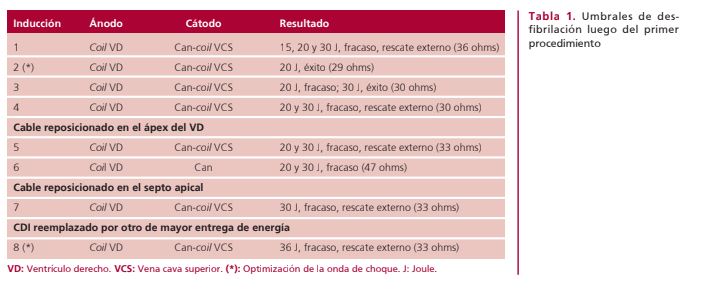
The evaluation of the defibrillation threshold (DFT) is common after the implantation of implantable cardioverter defibrillator (ICD) devices. The goal of this standard of care is to achieve successful defibrillation of ventricular fibrillation. In patients with elevated defibrillation thresholds, alternative techniques are required to correct the situation. We describe a case in which an uncommon strategy was used to improve DFT after failed defibrillation. A 78-year old man with a history of dilated cardiomyopathy was referred to the electrophysiology laboratory to have an ICD implanted as primary prevention strategy. During the procedure, the ICD failed to defibrillate the patient even after the lead was placed in different areas of the right ventricle and after optimizing the shock wave. A defibrillation lead was implanted in the azygous vein, and the shock vector was directed towards the posterior axis; a successful defibrillation was thus achieved.
Downloads
Published
Issue
Section
License
Copyright (c) 2025 Argentine Journal of Cardiology

This work is licensed under a Creative Commons Attribution-NonCommercial-ShareAlike 4.0 International License.





