Clinical and Functional Profile of Patients with Systolic Heart Failure and Renal Dysfunction
pp 286-292
DOI:
https://doi.org/10.7775/rac.v77i4.2385Keywords:
Heart Failure, Renal Failure, Electrical Impedance, Body CompositionAbstract
Background
Renal dysfunction is strongly associated with chronic heart failure, and is a frequent and progressive complication of this condition, with clinical outcomes which depend on the functional class and pharmacological treatment.
Objectives
To define the prevalence and the clinical and functional profile of patients with renal dysfunction in the setting of heart failure with depressed ejection fraction.
Material and Methods
Creatinine clearance was measured in 132 patients with heart failure and an ejection fraction <40%. Renal dysfunction was defined as a creatinine clearance <60 ml/min. Patients underwent routine lab tests, echocardiogram, bioelectrical impedance analysis and 6 minute walk test.
Results
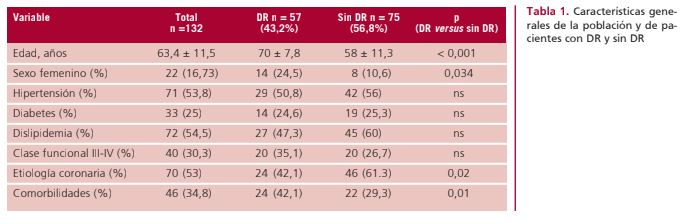
The prevalence of renal dysfunction was 43.2% (57 patients). Among these patients, there was a greater prevalence of women and elder subjects, yet the prevalence of coronary artery disease was low. Lab tests showed lower levels of hemoglobin, albumin, ferritin and triiodothyronine, and greater prevalence of measurable levels of troponin T. Body mass index (BMI), basal metabolic rate, muscle mass and phase angle were lower, while the ratio of extracellular water to total body water was greater in patients with renal dysfunction. The distance walked in the 6-minute test was lower. The use of beta blockers and amiodarone was the only difference in therapy. At multivariate analysis, age, NT-proBNP level, the presence of positive troponin T and muscle mass as a continuous variable were independent predictors of renal dysfunction in patients with systolic heart failure.
Conclusions
Renal dysfunction is frequent in patients with heart failure with depressed ejection fraction and is associated with distinctive features that may contribute to explain the clinical picture.
Downloads
Published
Issue
Section
License
Copyright (c) 2025 Argentine Journal of Cardiology

This work is licensed under a Creative Commons Attribution-NonCommercial-ShareAlike 4.0 International License.