Immunological Assessment of Benznidazole Therapy in Chronic Chagas Disease
pp 260-265
DOI:
https://doi.org/10.7775/Keywords:
Chagas disease, Benznidazole, Lymphocytes, Trypanosoma cruziAbstract
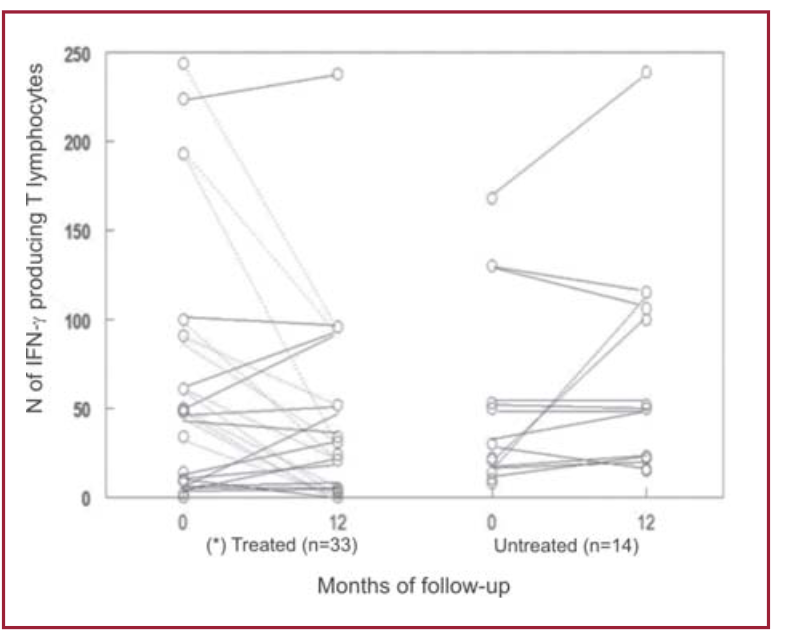
To determine the effect of benznidazole therapy on memory T cells specific for Trypanosoma cruzi, 47 patients between 30 and 50 years old and three positive serological tests for T. Cruzi without heart involvement were selected. Benznidazole was administered in a dose of 5 mg/kg/d during 30 days. Serological, immunological and clinical assessment was performed at basal (time 0) and at 2, 6 and 12 months following treatment, and once a year thereafter. IFN-γ ELISPOT assay was used to evaluate T lymphocytes response against a T. cruzi lysate obtained from amastigotes. The frequency of IFN-γ -producing memory Tlymphocytes specific for T. cruzi was significantly lower in the treatment group (n=33) compared to the control group (n=14) 12 months after the therapy. IFN-γ response became negative in 11 patients in the treatment group (44%). Among these 11 patients, conventional serology also became negative in 4 patients (36%) after 2 years of treatment. No clinical manifestations occurred during follow-up. These findings show that benznidazole is capable of modulating T lymphocytes response specific against T. cruzi. Measuring the frequency of memory T lymphocytes producing IFN-γ might become a more sensitive test to determine earlier the impact and/or efficacy of the specific treatment against this parasite.
Downloads
Published
Issue
Section
License
Copyright (c) 2026 Argentine Journal of Cardiology

This work is licensed under a Creative Commons Attribution-NonCommercial-ShareAlike 4.0 International License.