Index of Pressure Wave Reflection Assessed from Radial Pulse Wave Analysis
pp 272-277
DOI:
https://doi.org/10.7775/Keywords:
Arterial pulse, Radial artery, PhysiologyAbstract
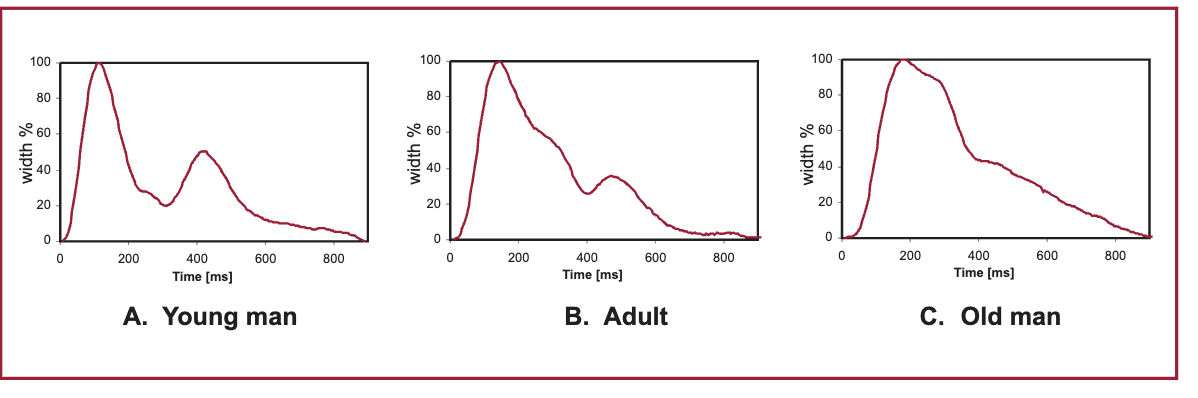
Systolic wave width, a parameter obtained from the record of radial pulse wave, is easier to measure than the radial augmentation index. The aim of this study was to analyze the possibility of using systolic wave width as a complementary tool for the assessment of systolic wave reflection which is directly related to the degree of endothelial dysfunction and to aortic augmentation. We performed a population study on 120 healthy men between 17 and 65 years old with normal blood pressure. Records of the radial wave pulse were obtained, based on the movement of the arterial walls, by a capacitive sensor in contact with the surface of the wrist over the radial artery. Each record was processed and its amplitude was normalized; the augmentation index and systolic wave width at half its maximum height were calculated. We found that systolic wave width was different among subjects with the same augmentation index, showing different values of the amplitude of the reflected wave. Both parameters increased with age (r correlation value 0.9). The systolic wave width is an alternative index of ageing. It might assess the arterial system when it is difficult to measure augmentation index or when comparisons between individuals result ambiguous.
Downloads
Published
Issue
Section
License
Copyright (c) 2026 Argentine Journal of Cardiology

This work is licensed under a Creative Commons Attribution-NonCommercial-ShareAlike 4.0 International License.