
Randomized prospective trial comparing femoral versus humeral approach for lower limbs arteriography
pp 40-47
DOI:
https://doi.org/10.7775/rac.v71i1.2893Keywords:
Humeral approach, Femoral approach, ArteriographyAbstract
Background
The femoral artery is the most commonly selected site of puncture for lower limbs arteriography (LEA). The humeral access appears as an alternative route. lt is more comfortable for the patient (P) and can be used even when the femoral approach is contraindicated.
Objectives
To compare efficacy and safety of both femoral and humeral access in a prospective, randomized fashion, in ambulatory P subjected to LEA.
Methods
Between March 1999 and September 2000, 575 patients were referred to us for LEA. Two hundred and ninety three subjects (50%) matched the inclusion criteria and were randomized to either procedure. A series of 10 variables were compared both in a global manner and divided between the first and second half of the group, with the intention to evaluate the "learning curve" effect. We used the "t" test to compare quantitative variables and the "chi square" or the "Fisher 's exact test" for the qualitative ones. We considered significant all differences bigger than 0.05. We used the SPSS program (8.0 version) to process the data.
Results
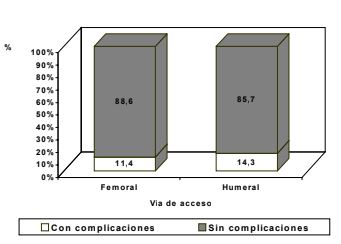
The demographic characteristics of the population were similar in both groups (p=NS). The rate of cross-over was higher for the humeral access. However, if we consider only the second half of the group, the difference was not statistically significant. There were no major complications in any patient. The humeral approach involves longer procedure and radiation time and also requires a larger number of 2-wall punctures of the artery. There were no differences in the number of punctures per patient, time to obtain access or contrast volume between the groups.
Conclusions
The humeral access is as safe as the femoral one for LEA. No major complications were registered. The femoral access allows shorter procedure radiation time, as well as less 2-wall punctures. The "learning curve" effect neutralized the more frequent cross-over rate and higher number of minor complications observed in the first half of the study. We conclude that our "ambulatory vascular radiology program" provides a reasonable safety approach.
Downloads
Published
Issue
Section
License
Copyright (c) 2026 Argentine Journal of Cardiology

This work is licensed under a Creative Commons Attribution-NonCommercial-ShareAlike 4.0 International License.





