
Glycerol Increases Fructose-Induced Hypertension in Rats
pp 87-92
DOI:
https://doi.org/10.7775/rac.v68i1.3098Keywords:
Arterial hypertension, Hyperinsulinemia, Protein kinase-C (PKC), Vascular contractilityAbstract
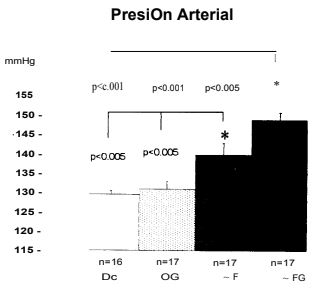
A fructose-enriched diet is known to promote arterial hypertension in the rats. The aim of this study was to evaluate blood pressure changes induced by glycolipidic alterations related to hypertension. Four groups of rats were studied:1)controls (C),fed with a standard diet and tap water; 2) glycerol (G), maintained on a standard diet with the addition of 5% glycerol in tap water; 3)fructose (F), fed with 55% fructose in the diet; and 4) fructose + glycerol (FG), the same diet of F plus 5% glycerol in tap water. At the end of the second week the results wereas follows: blood pressure and insuline-mia increased in FG vs. C, G and F groups. Triglyceridemia increased in FG, F and G groups vs C one. Aorta rings showed a lower ED, to phorbol 12,13-dibutirate (PDBu) in FG vs. C group. There was a high positive correlation between ED., PDBu and BP (r = 0.69 r2=0.48).We conclude that glycerol administration to rats on a diet rich in fructose, potentiates the development of hypertension. Furthermore, correlations between ED50 to PIDBu-insulinemia, and between ED50 to PDBU-BP suggests a role forPKC in the mechanisms leading to the blood pressure elevations.
Downloads
Published
Issue
Section
License
Copyright (c) 2026 Argentine Journal of Cardiology

This work is licensed under a Creative Commons Attribution-NonCommercial-ShareAlike 4.0 International License.





