
1:1 Supernormal Conduction
pp 203-212
DOI:
https://doi.org/10.7775/rac.v66i2.3508Keywords:
Supernormalidad, Conducción, Arritmias, Bloqueos auriculoventricularesAbstract
The supernormal phase of conduction, is a brief, early and limited period in the cardiac cycle, during which a stimulus can induce an unexpected response or one less abnormal than the expected one taking into account its relationship from the last beat. Clinical trials demonstrated to the end of theT wave, within prolonged absolute refractory period and its independent rate changes, leading t othe fact that 1:1 conduction in supernormal phase could not be found yet.
Material and method
Thirty patients undergoing serious atrioventricular and intra ventricular conduction disturbances, were studied using conventional electrophysiological techniques. Rate-dependent changes under steady state and non steady state were evaluated.A stress test and 24 hours-Holter were performed in all patients.
Results
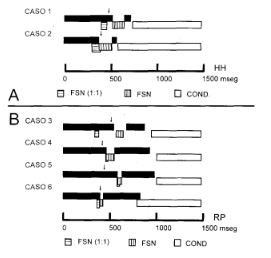
1:1 conduction in supernormal phase was found in six patients, three men, aged between 26 and 69 years (middle = 51.5),three with LBBB and Mobitz type II second-degree AV block, one undergoing RBBB with Mobitz II second-degree AV block, one with trifascicular branch block and the last patient with intermitent LBBB. The supernormal phase was localized in the right branch in three cases, in the left branch in two cases and in its posterior division one case. 1:1 conduction in supernormality was found (n = 2) during the electrophysiological study, (n = 2) on the electrocardiogram, (n =1) during a Holter and (n = 1) in a stress test. The super-normal phase was localized in the cardiac cycle between 350 and 670 m sec, and 1:1 conduction be-tween 320 and 580 msec.
Conclusions
1:1 conduction in supernormal phase is dependent on the sincron between the cardiac rate and the supernormal phase, was an unstable phenomena and it could only be recorded during a few beats. This mechanism could play an important role in the genesis of some cardiac arrhythmias.
Downloads
Published
Issue
Section
License
Copyright (c) 2026 Argentine Journal of Cardiology

This work is licensed under a Creative Commons Attribution-NonCommercial-ShareAlike 4.0 International License.





