
Enalapril: Evaluation of Therapeutic Effect
pp 497-503
DOI:
https://doi.org/10.7775/rac.v64i5.3593Keywords:
EnalaprilAbstract
Background
Many pharmaceutical companies trade multiple products which contain enalapril of different origin. Enalapril is a potent inhibitor of the angiotensin converting enzyme, used in antihypertensive therapy.ObjectivesTo compare in a group of healthy volunteers, the effects on the angiotensin converting enzyme concentration and the activity of the plasmatic renin of one enalapril formulation with that of the original producer (ORD. To evaluate the ENA action in a group of hypertensive patients in order to validate the efficiency of this formulation, different from that of the original producer.
Methods
The healthy volunteers (n = 5) were orally treated with 10 mg of ENA every 24 hours for 3 days. A venous blood sample was taken at hours 0, 5 and 53 in order to study the angiotensin converting enzyme and the activity of the plasmatic renin concentrations. The same was performed 45 days later but with ORI. Venous blood samples were taken from the hypertensive patients (n = 13) to determine the angiotensin converting enzyme and the activity of the plasmatic renin concentrations athours 0 (previous ENA administration), 1 and 4. Arterial blood pressure was determined by 24hours ambulatory blood pressure and by the sphygmomanometer method. ENA was administered at a dose of 5-20 mg every 24 hours (10 mg in 6 patients) during 90 days, and all the initial studies were repeated.
Results
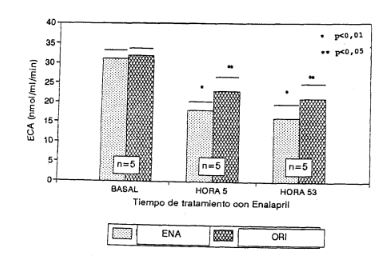
A significantly reduced angiotensin converting enzyme activity at 5 and 53 hours of treatment in the ENA (p < 0.01) as in the ORI (p < 0.05) was observed in the volunteers. The hypertensive patients treated with ENA showed a significant reduction in the angiotensin converting enzyme levels (p < 0.01) with a significant increase of the activity of the plasmatic renin levels (p < 0.01 at the first hour and p < 0.05 at the fourth hour). Arterial blood pressure determined by the sphygmomanometer method showed a decrease in both, systolic and diastolic pressure: 156.15/101.2 to 134.62/86.85 mmHg (p < 0.05). Ambulatory blood pressure in these patients showed a significant decrease of diurnal (150.8/93 to 132.8/84.3; p < 0.01) and nocturnal values (140/84.4 to121.8/77.2 mmHg; p < 0.05), withouth affecting the circadian rhythm. The percentage of abnormal values (> 140/90 mmHg) diminished after treatment with ENA, from 40.7% to 17.5% in the systolic pressure and from 37% to 12.1% in the diastolic pressure (p < 0.05).
Conclusion
The properties studied in the formulation made with enalapril of different origin than that of the original producer, were similar to those of the original enalapril found in this and previous studies. Consequently, it is considered that the clinical use of ENA maintains the pharmacological properties of the original product.
Downloads
Published
Issue
Section
License
Copyright (c) 2026 Argentine Journal of Cardiology

This work is licensed under a Creative Commons Attribution-NonCommercial-ShareAlike 4.0 International License.





