
Indirect Assessment of Membrane Integrity with Tallium201 24 HS Redistribution and Reinjection for Diagnosis of Myocardial Viability. Cost-Benefit Analysis and Correlation with the Damaged Vessel
pp 371-376
DOI:
https://doi.org/10.7775/rac.v64i4.3688Keywords:
Thallium 201, Myocardial viabilityAbstract
Background
Thallium 201 perfusion studies were used in order to evaluate patients with coronary artery disease proving to be useful for the diagnosis and prognosis of these patients. In recent years significant information has been developed regarding "myocardial viability" representing patients with myocardial dysfunction secondary to coronary artery dis-ease. Two protocols were widely used: late thallium201 redistribution and reinjection images to evaluate myocardial viability. Clinical information about the relative importance of each may be useful.
Objectives
The aim of this study was to evaluate additional information obtained with thallium reinjection images over the late thallium redistribution in the diagnosis of viable segments in patients with previous myocardial infarction, and correlate segments with the diseased vessels.
Poblation
Twenty five patients with previous history of documented myocardial infarction and 4 hours redistribution defects after exercise stress testing were prospectively studied.
Methods
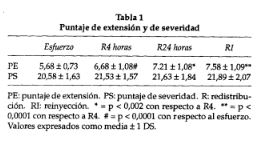
All patients underwent a thallium 201 stress test and 2.2 m Ci were injected at maximal exercise level.Planar images were acquired post-stress, 4 hours and 24 hours later. Aditional 1 m Ci was injected and 15 minutes later reinjection images were obtained. On the basis of the acquired images, two scores were performed over 900 studied segments:1) extension score (number of segments with hypoperfusion) and 2) severity score (intensity of hypoperfusion). The number of viable segments also correlated with coronary angiography data.
Results
Fifteen > 70% obstructions were found at the left descending coronary artery, 14 at the right coronary artery and seven in the circumflex artery. Significant differences were found between 24 hours redistribution (p < 0.002) and reinjection (p < 0.0001) versus 4 hours redistribution extension score. Meanwhile, 4 hours redistribution severity score values were not statistically different versus 24 hours redistribution or reinjection. Over 82 segments with stress perfusion defects, 25 (30.49%) in 4 hours redistribution, 30 (36.58%) in 24 hours redistribution, and 47 (57.32%) in reinjection improved their perfusion. Thirty-five segments (42.68%) had no changes and were considered to have no viability. When viable segments were correlated with significant coronary angiography lesions, 57.44% were found in left descending coronary artery territories, 58.06% in right coronary artery and 50% in circumflex artery.
Conclusions
Extension score could be better than severity score in visual evaluation of myocardial viability. Late24 hours redistribution and thallium reinjection images significantly increased diagnosis of myocardial viability. From the "cost-benefit" point of view, the administration of 1 mCi thallium 201 reinjection dose is only recomended in studies that must be made in the same day, or when 24 hours redistribution is negative for myocardial viability.In this selected population, the infarct related area has high viable tissue prevalence wich was similar for the three major coronary arteries.
Downloads
Published
Issue
Section
License
Copyright (c) 2026 Argentine Journal of Cardiology

This work is licensed under a Creative Commons Attribution-NonCommercial-ShareAlike 4.0 International License.





