
Therapeutic Coverage: Amlodipine versus Enalapril in Hypertensives that Miss Doses. A Multicenter Prospective Randomized Double Blind Study with Ambulatory 24 Hour Monitoring
pp 739-745
DOI:
https://doi.org/10.7775/rac.v67i6.3824Keywords:
Therapeutic overage, Compliance, Amlodipine, Enalapril, Ambulatory blood pressure monitoring, Missing doseAbstract
Background
The lack of compliance of the antihypertensive treatment is a common problem. In fact, half of the patients do not have their medication as prescribed and missing doses are a common problem. In this study the efficacy of amlodipine and enalapril in the treatment of mild to moderate essential hypertension was assessed. The main objective of this trial was to compare the antihypertensive efficacy of amlodipine and enalapril and whether the anti-hypertensive effect persists even after a missing dose.
Material and methods
A multicenter, comparative, prospective and double blind trial was performed. After a washout period of two weeks, those patients whod had a diastolic blood pressure (DSP) between 95-115 mmHg at the office, and a daily average > 90 mm Hg in the ambulatory blood pressure monitoring (ABPM) were randomized to receive amlodipine (group A)or enalapril (group B) during 8 weeks of active treatment. At the end of active phase, anew 48 hours ABPM was performed. The first 24 hours of this test under the effect of active drug and the last24 hours a missing dose was simulated with a placebo administration.
Results
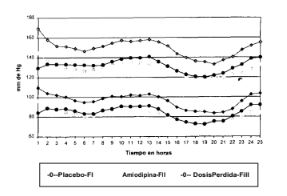
Fifty-five patients were randomized, 27 to group A and 28 to group B. Patients in both treatment groups had the same demographic characteristics. At the end of the active phase both treatment produced significant reduction of blood pressure. During the first 24 hours in final ABPM a significant reduction in the systolic and diastolic blood pressure levels was observed in both groups. How-ever, decrement in group A was greater than in group B (-20.53/-14.11 mm Hg versus -14.5/-9 mmHg [p < 0.01] respectively). During the second day of ABPM the antihypertensive effect of the enalapril fade progressively and the average value registered during the last 8 hours was similar to that observed during the placebo phase. In the amlodipine group, the antihypertensive effect was maintained and the average of the last 8 hours of the ABPM was significantly less than the one observed during the administration of placebo (p <0.01).
Conclusion
Amlodipine and enalapril were effective drugs to reduce blood pressure. However, a missing dose elicited different results: while enalapril effect vanished progressively, amlodipine maintained its antihypertensive action even 48 hours after the last dose.
Downloads
Published
Issue
Section
License
Copyright (c) 2026 Argentine Journal of Cardiology

This work is licensed under a Creative Commons Attribution-NonCommercial-ShareAlike 4.0 International License.





