Treatment Gap in Very High-Risk Patients with Cardiorenal Disease: An Analysis of the Implementation of Evidence-Based Therapies
pp. 301-309
DOI:
https://doi.org/10.7775/rac.es.v94.i4.21027Keywords:
Type 2 diabetes mellitus, Chronic kidney disease, Heart failure, Cardiovascular disease, Treatment gap, Evidence-based treatmentAbstract
Background: In patients with type 2 diabetes mellitus (T2DM) and cardiorenal disease, various therapies reduce cardiovascular and renal events. However, their implementation in clinical practice remains suboptimal.
Objective: To quantify the treatment gap in patients with T2DM and very high-risk cardiorenal disease using a proportional index that differentiates between Class IA and IIA indications, and to evaluate associated clinical factors.
Methods: An observational study based on data collected prospectively from the FERICODIAB registry. The study included 367 adults with T2DM and heart failure (HF) and/or chronic kidney disease (CKD). Therapeutic eligibility criteria were established according to international guidelines, and a weighted treatment gap index (IBT-prop), ranging from 0 (no treatment gap) to 1 (complete treatment gap), was developed. Associated factors were evaluated using multivariate linear regression and, as a sensitivity analysis, beta regression was performed.
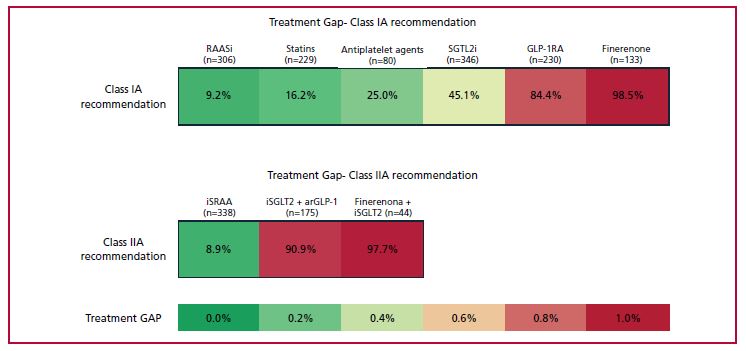
Results: The mean age was 70.0 ± 11.1 years; 61.6% were men, 80.7% had CKD, and 25.6% had HF. The mean IBT-IA was 0.491 (median: 0.483), and 45.4% had an IBT-IA >0.5. The mean IBT-IIA was 0.454 (median: 0.778), and 51.2% had an IBT-IIA >0.5. The largest gaps were observed for finerenone (98.5%), GLP-1 receptor agonists (84.4%), and the combinations of finerenone + SGLT2 inhibitors (97.7%) and SGLT2 inhibitors + GLP-1 receptor agonists (90.9%). Older age, higher body mass index, and female sex were associated with a larger treatment gap in the linear model, although the associations with age and female sex were no longer statistically significant in the beta regression model.
Conclusion: There is a significant treatment gap between recommendations and their implementation, particularly for the most recent cardiorenal therapies and recommended combination therapies. Systematic and interdisciplinary strategies are needed to optimize their use.
Downloads
Published
Issue
Section
License
Copyright (c) 2026 Argentine Journal of Cardiology

This work is licensed under a Creative Commons Attribution-NonCommercial-ShareAlike 4.0 International License.