
Implications of the COVID-19 Pandemic and Social Isolation on the Cardiometabolic Profile of a Cohort of Individuals from the City of Buenos Aires
pp. 31-36
DOI:
https://doi.org/10.7775/rac.es.v91.i1.20595Keywords:
Heart risk factors, Obesity, Hypertension, Treatment adherence and compliance, COVID-19Abstract
Background: The COVID-19 pandemic has shocked humanity. During the pandemic, the need for social isolation has encouraged
low adherence to a healthy lifestyle in many individuals. However, evidence of the metabolic impact of COVID-19 pandemic on our field is scarce.
Objective: To evaluate the impact of social isolation produced by the COVID-19 pandemic on the body weight and the cardiometabolic parameters of an adult population in the Autonomous City of Buenos Aires.
Methods: Based on an observational design, we analyzed the data from patients who attended a prevention and health promotion
program in the City of Buenos Aires. Data from participants who attended for testing in 2019 and repeated testing in 2021 were individualized. Medical records were used as source for collecting general data, anthropometric measurements, and laboratory values. The National Cholesterol Education Program (NCEP) criteria were used to define the presence of metabolic syndrome (MS).
Results: A total of 558 patients with available evaluations in 2019 and 2021 were identified. The average age of the population
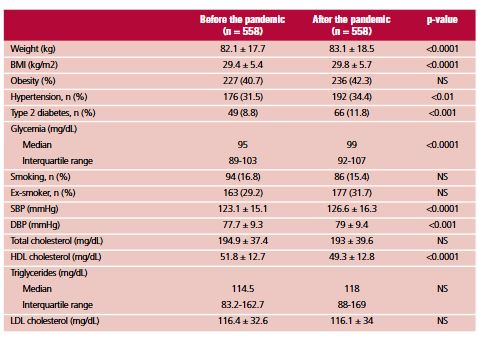
was 52.2 ± 12.8 years, and 41% was female. An increase in body weight (82.1 ± 17.7 kg vs. 83.1 ± 18.5 kg; p<0.0001) and body mass index (29.4 ± 5.4 vs. 29.8 ± 5.7, p <0.0001) was observed. Increases in systolic (123.1 ± 15.1 mmHg vs. 126.6 ± 16.3 mmHg; p <0.0001) and diastolic (77.7 ± 9.3 mmHg vs. 79.6 mmHg± 9.4 mmHg, p <0.0001) blood pressure values were also observed. As regards the laboratory parameters, we noted an increase in plasma glucose levels with a median and an interquartile range (IQR) of 95 (89-103 mg/dL) vs. 99 (92-107 mg/dL), p <0.0001, and a decrease in HDL cholesterol (51, 8 ± 12.7 mg/dL vs. 49.3 ± 12.8 mg/dL, p<0.0001). No changes were observed in LDL cholesterol (116.4 ± 32.6 mg/dL vs. 116.1 ± 34 mg/dL; p=NS), total cholesterol (194.9 ± 37.4 vs. 193 ± 39.6 mg/dL; p=NS) or triglyceride levels, with a median and IQR of 114.5 (83.2-162.7 mg/dL) vs. 118 (88-169 mg/dL; p=NS). This was accompanied by an increased prevalence of MS (21.5% vs. 34%; p<0.0001). The proportion of patients with carotid plaques also increased, without reaching statistical significance (36.4% vs. 40.7%; p=NS). Besides, it was observed...
How to cite this article:
Giunta GA, Cutine PD, Aguiló MA, Antokoletz D, Pirola D, Rodríguez Acuña MI et al. Implications of the COVID-19 Pandemic and Social Isolation on the Cardiometabolic Profile of a Cohort of Individuals from the City of Buenos Aires. Rev Argent Cardiol 2023;91:31-6
https://doi.org/10.7775/rac.v91.i1.20595
Downloads
Published
Versions
- 2023-02-27 (2)
- 2023-02-23 (1)
Issue
Section
License
Copyright (c) 2023 Argentine Journal of Cardiology

This work is licensed under a Creative Commons Attribution-NonCommercial-ShareAlike 4.0 International License.





