
Reverse Electrical Remodeling in Patients under Cardiac Resynchronization Therapy
pp. 37-44
DOI:
https://doi.org/10.7775/rac.es.v91.i1.20760Keywords:
Cardiac resynchronization therapy, Response, Reverse electrical remodelingAbstract
Introduction: Cardiac resynchronization therapy (CRT) is indicated in patients who often present cardiac remodeling due to dilatation and contractile dyssynchrony. CRT contributes to reverse remodeling which is associated with reduced mortality and heart failure (HF) hospitalizations. Improvements in intraventricular conduction with decreased ventricular activation time have also been observed. The quantification of reverse electrical remodeling has been underused as a parameter of response, and there are few reports on its association with the clinical-structural response.
Objective: To analyze intraventricular reverse electrical remodeling as a parameter of response to CRT in living individuals.
Methods: We included patients implanted at least 6 months ago. A deactivated stimulation ECG (post-CRT intrinsic QRS) was obtained, and by means of transthoracic echocardiography (TTE), the left ventricular ejection fraction (LVEF), the left
ventricular end-diastolic diameter (LVEDD) and the presence of mitral regurgitation were defined. Patients were classified according to their clinical-structural response. Electrical remodeling was characterized by comparing pre- and post-CRT QRS duration and assessing QRS changes (ΔiQRS) between groups.
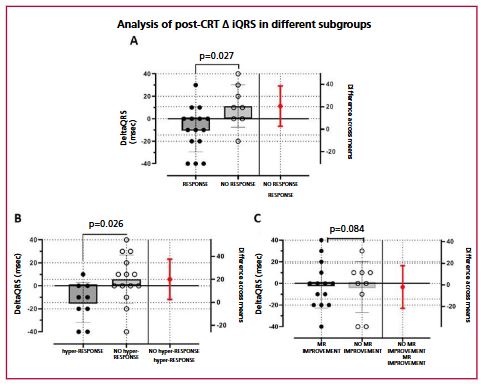
Results: A total of 23 patients were included, 39% of which showed a >10 ms decrease in iQRS. We observed a ΔiQRS of -9.3±20.7 ms in responders, and of 11.25±18.9 ms in non-responders (p=0.027), more marked in hyper-responders (ΔiQRS: -14.44±17.40 ms, p=0.026). Women with pre-CRT QRS ≥150 ms showed a significant decrease in iQRS (p=0.0195).
Conclusion: Reverse electrical remodeling was found in 39% of the patients under CRT. We noted a significant relationship between ΔiQRS and clinical-structural response, higher in hyper-responders. Women with wider pre-CRT QRS showed more marked reverse electrical remodeling. This parameter is accessible and easy to read in outpatient visits.
How to cite this article:
Vázquez J, Ferrando F, Murguía S, Ichazo J, Escobar N, Cuesta A et al. Reverse electrical remodeling in patients under cardiac resynchronization therapy.
Rev Argent Cardiol 2023;91:37-44
https://doi.org/10.7775/rac.v91.i1.20591
Downloads
Published
Versions
- 2023-02-27 (2)
- 2023-02-23 (1)
Issue
Section
License
Copyright (c) 2023 Argentine Journal of Cardiology

This work is licensed under a Creative Commons Attribution-NonCommercial-ShareAlike 4.0 International License.





