Development of the Hemodynamic Instability Index in Acute Kidney Failure and its association with in-hospital mortality
pp. 340-347
DOI:
https://doi.org/10.7775/rac.es.v93.i5.20936Keywords:
Hemodinamic monitoring, Acute kidney injury, In-Hospital mortality, Survival analysis, Disease severity indexAbstract
Background: Hemodynamic instability increases the risk of in-hospital mortality in patients with acute kidney injury (AKI), but there is no specific tool to quantify this risk.
Objective: The aim of the present study was to develop the Hemodynamic Instability Index in Acute Kidney Injury (IIH-AKI), analyze its association with in-hospital mortality in patients hospitalized for AKI and compare its discriminatory ability with other established prognostic scores.
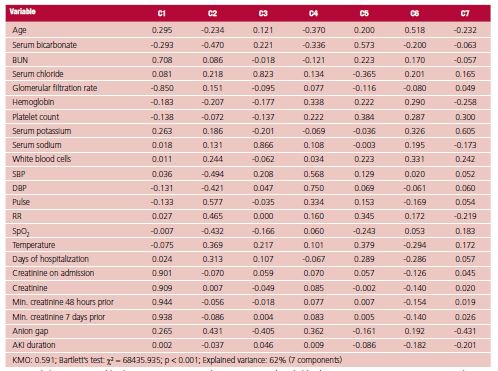
Methods: We conducted an analytical study based on a secondary database derived from a clinical record of 5060 patients hospitalized with AKI. The outcome analyzed was in-hospital mortality. Principal component analysis (PCA) was used to develop the HII-AKI model based on five key parameters: pulse, systolic blood pressure, diastolic blood pressure, respiratory rate, and oxygen saturation. The HII-AKI performance was evaluated using the area under the ROC curve (AUC-ROC), Kaplan-Meier curves, and Cox regression analysis.
Results: The HII-AKI prsented an AUC-ROC of 0.742 (95% CI 0.722-0.762; p<0.001) for predicting in-hospital mortality, surpassing the SOFA score (AUC-ROC=0.723) and the Elixhauser comorbidity index (AUC-ROC=0.465). Patients with high HII-AKI were younger and had a longer hospital stay. They also had more acidosis, lower bicarbonate levels, higher urea nitrogen levels, and lower creatinine levels. In Cox regression analysis, a high HII-AKI was associated with higher in-hospital mortality (HR=2.394; 95% CI: 2.008-2.855; p<0.001).
Conclusion: A high HII-AKI is associated with greater hemodynamic instability, inflammation, metabolic disturbances, and prolonged length of hospital stay, supporting its usefulness as a prognostic marker of mortality in AKI. Its implementation in clinical practice could improve risk stratification and optimize the therapeutic decisions. Further studies are necessary for external validation.
Downloads
Published
Issue
Section
License
Copyright (c) 2025 Argentine Journal of Cardiology

This work is licensed under a Creative Commons Attribution-NonCommercial-ShareAlike 4.0 International License.