
Pre- and Post-Endurance Exercise Gender Differences Between Ultra Marathon Athletes
pp. 13-19
DOI:
https://doi.org/10.7775/rac.es.v89.i1.19245Keywords:
Ventricular function, Cardiac Imaging Techniques / methods, Cardiomegaly, Exercise-Induced, Fatigue, Heart, WomenAbstract
Background: The presence of women in ultramarathon competitions has become increasingly frequent. Physiological adaptations and response to maximum exercise are influenced differently according to gender.
Objectives: The aim of this study was to evaluate the differences observed in ultramarathon or ultratrail athletes (mountain races over 42 km), at rest (physiological adaptations) and post-endurance exercise [exercise-induced cardiac fatigue (EICF)], stratified by training parameters.
Methods: Twenty-five athletes (6 women) who participated in the Mendoza crossing race (55 km in the mountains) were evaluated before and after the end of the race using Doppler echocardiography and myocardial deformation techniques (post-processing). Training and running parameters were documented with sports watches. Immediate post-endurance exercise blood withdrawal was performed to document variables associated with cardiac fatigue.
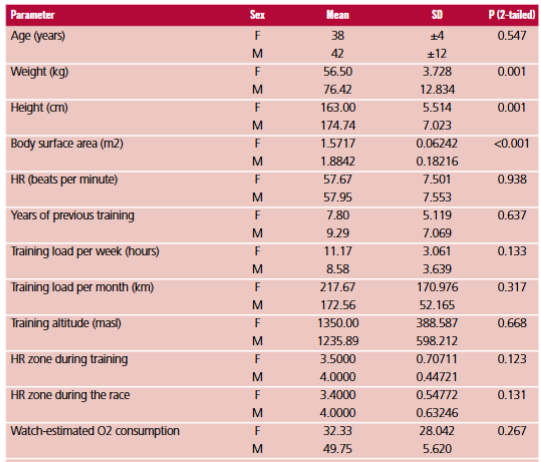
Results: The race was completed by 24 athletes, 19 men (42±12 years) and 5 women (38±4 years). Women and men presented similar training loads and completed the race with no difference in time. Decreased left myocardial function parameters (EICF) were observed in 50% of men and 5% of women.
Conclusions: Despite no differences in training characteristics were found, less baseline physiological adaptation and a lower incidence of EICF was observed in women.
Downloads
Published
Issue
Section
License
Copyright (c) 2025 Argentine Journal of Cardiology

This work is licensed under a Creative Commons Attribution-NonCommercial-ShareAlike 4.0 International License.





