Patterns of myocardial injury in patients recovered from COVID-19: findings on cardiac magnetic resonance imaging studies and their prognosis
pp. 398-405
DOI:
https://doi.org/10.7775/rac.v90i6.95Keywords:
SARS-CoV-2, COVID-19, Coronavirus, Magnetic Resonance Imaging -, Myocarditis, Myocardial InfarctionAbstract
Background: COVID-19 continues to cause significant mortality and morbidity worldwide. Cardiac involvement is associated
with long-term and medium-term negative clinical outcomes. Cardiac magnetic resonance imaging (CMRI) is a useful technique
to detect and characterize myocardial disorders, so it has been used to identify different post-COVID-19 complications.
Objective: This study was aimed to evaluate the presence, the type, and the 6-month prognosis of the CMRI findings in an
unselected cohort of patients referred to our site.
Methods: MSingle-center, prospective, observational cohort study. We included consecutive patients referred to our site for a
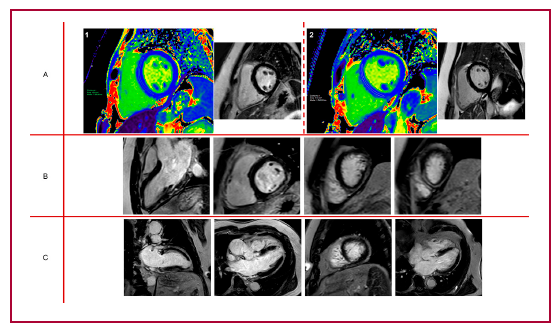
CMRI. They were classified into five groups: normal CMRI (Group A), nonspecific myocardial fibrosis (Group B), isolated
myocardial inflammation (Group C), myocarditis (Group D) and ischemic myocardial fibrosis (Group E). A 6-month followup
was performed.
Results: We enrolled 298 patients, 51% women. CMRI was performed at a median of 68 days following epidemiological discharge.
Patients were assigned to the groups as follows: 64.5% to Group A, 21.8% to Group B, and 10.4% to Group C. CMRI
was repeated in six patients, and it showed that altered basal levels returned to normal. Six patients in Group D (2%) were
diagnosed with myocarditis, and four in Group E (1.3%) suffered from myocardial infarction. Two patients in Group E underwent
a revascularization procedure during their follow-up. The remaining cohort did not suffer from any event.
Conclusion: No pathological findings were found on most patients’ CMRI (86%). Given the scale of the pandemic, we do not
consider advisable to assess post-COVID-19 cardiac complications in general population by means of CMRI. In contrast, CMRI
should be performed on those patients suspected of myocardial injury.
Downloads
Published
Issue
Section
License

This work is licensed under a Creative Commons Attribution-NonCommercial-ShareAlike 4.0 International License.