
Ischemic Stroke in Patients with Percutaneous Patent Foramen Ovale Closure
pp. 216-219
DOI:
https://doi.org/10.7775/rac.es.v85.i3.9817Keywords:
Foramen Ovale, Patent - Septal Occluder Device - Stroke - Heart Septal Defects, Atrial/surgeryAbstract
Background: The prevalence of patent foramen ovale is approximately 50% in patients who have suffered a cryptogenic stroke. The recurrence of ischemic stroke after percutaneous patent foramen ovale closure is approximately 1% per year.
Objective: The aim of this study was to evaluate the prevalence of recurrent ischemic stroke in our population undergoing percutaneous patent foramen ovale closure.
Methods: All patients with diagnosis of cryptogenic ischemic stroke who underwent percutaneous patent foramen ovale closure between January 2007 and September 2015 were retrospectively included. Follow-up detected patients who had either a recurrent stroke and/or a transient ischemic attack after percutaneous patent foramen ovale closure.
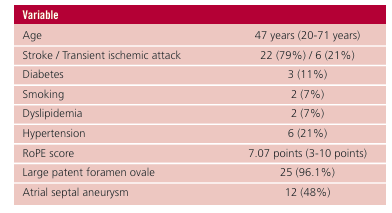
Results: Twenty eight patients with average age of 47 years (20-71 years) at the time of the procedure were included in the study. Fifty percent of patients were females, 79% had previous history of stroke and 21% of transient ischemic attack. The RoPE score was 7.07 points (3-10 points) and percutaneous closure was successful in all cases. During follow-up (median 989 days, interquartile range 670-1766 days), two patients (7%) had a new stroke. In both patients, transesophageal echocardiography revealed closed patent foramen ovale without residual leak.
Conclusions: The incidence of a recurrent stroke is low after percutaneous patent foramen ovale closure and it is possible that a significant number of recurrent cases will not be preventable with its closure.
Downloads
Published
Issue
Section
License
Copyright (c) 2017 Argentine Journal of Cardiology

This work is licensed under a Creative Commons Attribution-NonCommercial-ShareAlike 4.0 International License.





