Contribution of Longitudinal and Circumferential Shortening to Stroke Volume and Ejection Fraction in Severe Aortic Stenosis
pp. 8-13
DOI:
https://doi.org/10.7775/rac.v90i1.123Keywords:
Aortic stenosis - Systolic function - Contractility - Ejection fractionAbstract
Background: Left ventricular (LV) stroke volume (SV) is ejected by a combination of longitudinal shortening (LS), circumferential shortening (CS) and ventricular twist. Longitudinal shortening is caused by the motion of the mitral annulus towards the apex, causing wall thickening (circumferential and radial shortening), and left ventricular cavity and SV reduction. The role of LS in aortic stenosis (AS) is not defined.
Objective: The aim of this study was to analyze the LS and CS contribution to SV and left ventricular ejection fraction (LVEF) in severe AS.
Methods: The study included 152 patients (70±12 years, 64 women) with severe AS (valve area <1 cm2) studied by cardiac Doppler echocardiography. The LS contribution to SV was evaluated by considering the base of the heart as a cylinder, with volume=base x
height; the base was assumed as a circle with radius equal to (systolic septal thickness+systolic posterior wall thickness+end-systolic diameter)/2; and height, as an average of the mitral lateral, septal, anterior and inferior annulus systolic excursion. The CS
contribution to SV was estimated as: SV - LS contribution to SV. Both contributions were expressed in absolute form and as SV percentages (% SV-LS and % SV-CS).
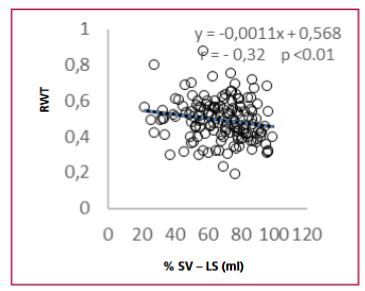
Results: Longitudinal shortening contributed with approximately 2 thirds of SV (68±18 %) and CS with the rest. SV-LS correlated inversely with SV (r= - 0.45 p <0.001) and SV-CS had direct correlation (r=0.45 p <0.001). The % SV-LS contribution was greater in patients with LVEF < 50%. Percent SV-LS correlated inversely with relative wall thickness (RWT) (r=0.32, p < 0.01).
Conclusion: The LS contribution to SV is greater than that of CS, and correlates inversely with SV. Percent SV-LS is higher in patients with LVEF <50%. The aforementioned findings could have implications when considering cut-off points for longitudinal function indices (strain) without considering LVEF and/or ventricular geometry.
How to cite this article:
Migliore RA, Adaniya ME, Dorsch JD, Barranco M, González SC, Miramont GM. Contribution of Longitudinal and Circumferential Shortening to Stroke Volume and Ejection Fraction in Severe Aortic Stenosis. Rev Argent Cardiol 2022;90:8-13. http://dx.doi.org/10.7775/rac.v90.i1.20472