Statins at Discharge in Acute Coronary Syndromes over the past 10 Years. The Epi-Cardio Registry

pp. 438-445

Authors

  • Carolina M. Travetto Investigadores del Registro Epi-Cardio. Grupo de Estudio, Docencia e Investigación Clínica (GEDIC). Hospital de Alta Complejidad en Red El Cruce “Dr. Néstor C. Kirchner” SAMIC
  • Juan J. Bacigalupe Investigadores del Registro Epi-Cardio. Grupo de Estudio, Docencia e Investigación Clínica (GEDIC). Hospital de Alta Complejidad en Red El Cruce “Dr. Néstor C. Kirchner” SAMIC
  • María J. Martínez Investigadores del Registro Epi-Cardio. Grupo de Estudio, Docencia e Investigación Clínica (GEDIC). Hospital de Alta Complejidad en Red El Cruce “Dr. Néstor C. Kirchner” SAMIC
  • Maximi de Abreu Miembro Titular de la Sociedad Argentina de Cardiología. Investigadores del Registro Epi-Cardio. Grupo de Estudio, Docencia e Investigación Clínica (GEDIC). Hospital de Alta Complejidad en Red El Cruce “Dr. Néstor C. Kirchner” SAMIC; Grupo de Estudio, Docencia e Investigación Clínica (GEDIC)
  • Javier Mariani Miembro Titular de la Sociedad Argentina de Cardiología. Investigadores del Registro Epi-Cardio. Grupo de Estudio, Docencia e Investigación Clínica (GEDIC). Grupo de Estudio, Docencia e Investigación Clínica (GEDIC). Hospital de Alta Complejidad en Red El Cruce “Dr. Néstor C. Kirchner” SAMIC; Grupo de Estudio, Docencia e Investigación Clínica (GEDIC)
  • Álvaro Sosa Liprandi Miembro Titular de la Sociedad Argentina de Cardiología. Investigadores del Registro Epi-Cardio. Grupo de Estudio, Docencia e Investigación Clínica (GEDIC). Grupo de Estudio, Docencia e Investigación Clínica (GEDIC); Sanatorio Güemes; Instituto Cardiovascular Lezica
  • Adrián Charask Miembro Titular de la Sociedad Argentina de Cardiología. Investigadores del Registro Epi-Cardio. Grupo de Estudio, Docencia e Investigación Clínica (GEDIC). Grupo de Estudio, Docencia e Investigación Clínica (GEDIC); Clínica Bazterrica-Santa Isabel
  • Juan Gagliardi Miembro Titular de la Sociedad Argentina de Cardiología. Investigadores del Registro Epi-Cardio. Grupo de Estudio, Docencia e Investigación Clínica (GEDIC). Grupo de Estudio, Docencia e Investigación Clínica (GEDIC); Hospital General de Agudos “Dr. Cosme Argerich”
  • Hernán C. Doval Miembro Titular de la Sociedad Argentina de Cardiología. Investigadores del Registro Epi-Cardio. Grupo de Estudio, Docencia e Investigación Clínica (GEDIC). Grupo de Estudio, Docencia e Investigación Clínica (GEDIC)
  • Carlos D. Tajer Miembro Titular de la Sociedad Argentina de Cardiología. Investigadores del Registro Epi-Cardio. Grupo de Estudio, Docencia e Investigación Clínica (GEDIC). Hospital de Alta Complejidad en Red El Cruce “Dr. Néstor C. Kirchner” SAMIC;Grupo de Estudio, Docencia e Investigación Clínica (GEDIC)

DOI:

https://doi.org/10.7775/rac.es.v84.i5.9129

Keywords:

Acute Coronary Syndrome - Statins HMG-CoA - Quality of Health Care

Abstract

Background: Statins have been incorporated for secondary prevention of cardiovascular disease for over two decades, with a remarkable impact in reducing morbidity and mortality. Currently, the evidence available recommends the use of high-intensity statin therapy in all the patients presenting an acute coronary syndrome.


Objective: The aim of this study was to evaluate the use of statins at discharge in acute coronary syndrome patients included in the Epi-Cardio registry and its variation over the past 10 years.


Methods: Patients hospitalized between 2005 and 2014 with diagnosis of acute coronary syndrome were included; those deceased or without data of the treatment at discharge were excluded. The frequency of indication of statins, agents, doses used over the 10-year period and the indication of high-intensity therapy (rosuvastatin 20-40 mg, atorvastatin 40-80 mg) were analyzed. The use according to the field of care was compared.


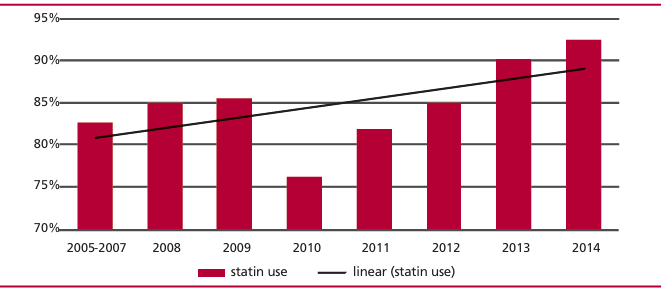
Results: 22,905 records were analyzed. The most common agents used were atorvastatin 68%, simvastatin 22.7% and rosuvastatin 9.1%. The temporal trend revealed higher frequency of statin prescription (from 83% in 2005-2007 to 92.5% in 2014), higher doses, lower indication of simvastatin and higher of other agents, and greater use of high-intensity statin therapy from 7.7% in 2005-2007 to 52.6% in 2014. The use of high-intensity therapy was lower in the public health care system.

Conclusions: The frequency of statin indication reaches optimal levels and the use of high-intensity therapy increased during the period evaluated, including over half of the patients. The differences in the public health care system suggest a lower access to treatment. Additional studies are necessary to identify the barriers for implementing high-intensity statin therapy.
Published

2025-07-16

Issue

Section

ORIGINAL ARTICLES

Most read articles by the same author(s)

1 2 3 4 5 6 7 8 9 10 > >>
