
Vascular and Valvular Load in Low-Flow/Low-Gradient Severe Aortic Stenosis and Normal Ejection Fraction
pp. 30-38
DOI:
https://doi.org/10.7775/rac.v77i1.2104Keywords:
Aortic Stenosis, Systole / Physiology, Arteries, ElasticityAbstract
Background
Some patients with aortic stenosis (AS) may present reduced stroke volume (SV) and low transvalvular gradients despite normal ejection fraction (EF). The reduction in the aortic valve area (AVA) and the increase in the vascular load contribute to decrease the SV.
Objective
To analyze the vascular and valvular load in low-flow/lowgradient severe aortic stenosis and normal ejection fraction.
Material and Methods
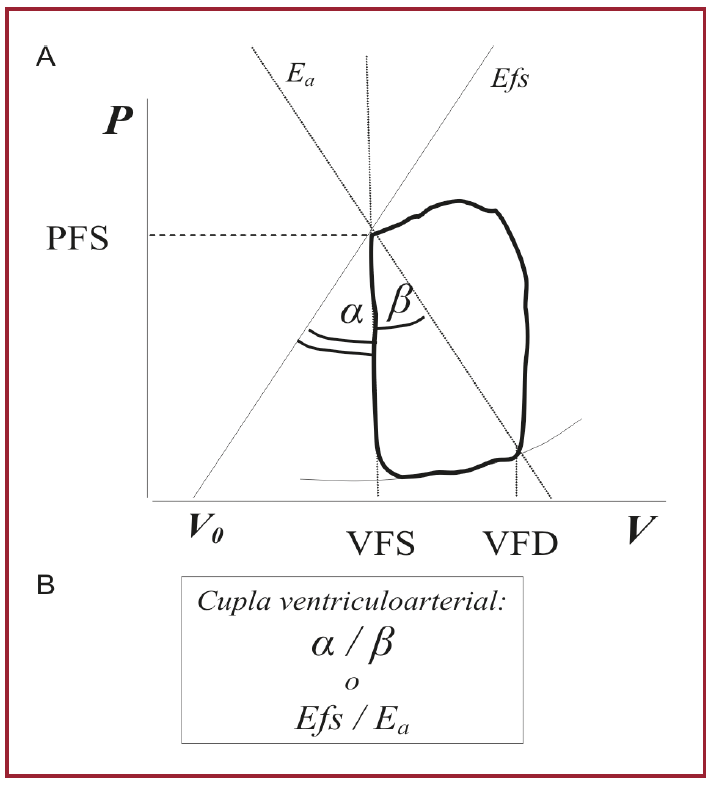
A total of 53 patients (70±12 years) with severe AS (AVA <1 cm2) and EF ≥50% were studied. Valvular load was estimated using the AVA and the energy loss index (ELI). Vascular load was evaluated by means of the effective arterial elastance (Ea) and systemic vascular resistance (SVR). Valvulo-arterial impedance (Zva) was calculated as an estimation of global left ventricular (LV) afterload. Ea was estimated as the ratio between end-systolic pressure and SV. End-systolic pressure was obtained by tonometry. Zva was calculated as: (systolic arterial pressure + mean net pressure gradient) / SV index. Patients were divided in two groups: normal flow (NF) (n=35), defined as a SV index >35 ml/m2, or low flow (LF) (n=18), with a SV index ≤35 ml/m2.
Results
Compared to NF patients, LF patients had lower AVA (0.59±0.18 versus 0.76±0.22 cm2; p<0.01), mean pressure gradient (28±5 versus 45±4 mm Hg; p<0.01) and ELI (0.35±0.13 versus 0.47±0.16 cm2/m2; p<0.01). Vascular load was greater in LF patients than in NF patients, with higher values of Ea (1.91±0.42 versus 1.24±0.33 mm Hg/ml; p<0.00001), SVR (2.119±506 versus 1.625 ± 443 mm Hg · min/L; p<0.001) and global afterload measured by Zva (5.45±1.39 versus 3.95±1.10 mm Hg/ml/m2; p<0.001). At univariate analysis, SV correlated with Ea (r= –0.87, p<0.0001), SVR (r= –0.73, p<0.0001) and Zva (r= –0.71, p<0.0001). Ea was the only independent predictor of reduced SV at multivariate analysis.
Conclusions
In patients with severe AS, the physiopathology of LF seems to be related to a significant increase in the vascular load.
Downloads
Published
Issue
Section
License
Copyright (c) 2025 Argentine Journal of Cardiology

This work is licensed under a Creative Commons Attribution-NonCommercial-ShareAlike 4.0 International License.





