
Drug Eluting Stents for the Treatment of Diffuse In-Stent Stenosis: Clinical and Angiographic Predictors of Events
pp. 465-470
DOI:
https://doi.org/10.7775/rac.v77i6.2199Keywords:
Stent, Drugs, StenosisAbstract
Background
The use of balloon angioplasty, stent implant or atherectomy for the treatment of in-stent restenosis (ISR) has high recurrence rates (~35-80%). For this reason, drug eluting stents (DESs) are the treatment of choice of this condition. However, there is little information regarding predictors of long-term events.
Objective
To evaluate the relation between clinical and angiographic variables with the occurrence of long-term events in an unselected population with diffuse ISR treated with DESs.
Material and Methods
Between January 2004 and July 2008, 137 DESs were implanted in 125 coronary artery lesions from 110 patients with ISR. We only used the currently devices available (Cypherâ 40.0%, Taxusâ 51.8% and Endeavorâ 9.1%). The incidence of mortality, acute myocardial infarction or reintervention was evaluated during follow-up. A logistic regression model was used to analyze the influence of clinical and angiographic variables and of the procedure on the presence of events.
Results
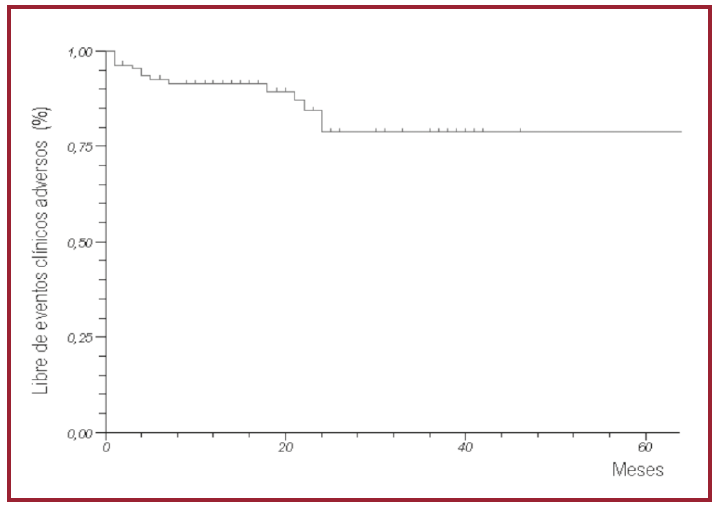
All lesions were successfully treated. The incidence of events after one month was 3.6% (95% CI: 1.2-8.5%). One patient died and four patients underwent reintervention, two of them due to in-stent thrombosis. Mean follow-up was 18 months. There were no cases of defined in-stent thrombosis. Three patients died (two after coronary artery bypass graft surgery and one due to sudden death). Ten patients required reintervention of the culprit vessel (9.1%); five of them underwent percutaneous revascularization. The global incidence of adverse clinical events was 13.6% (95% CI: 8.1-21.0%). Multivariate analysis identified insulin-dependent diabetes mellitus (OR 6.44, p=0.02), multivessel disease (OR 5.78, p=0.02) and ISR Mehran type (OR 2.74, p=0.04) as independent predictors of events. Renal chronic failure and treatment of venous graft obstructions showed a non significant trend. The area under the ROC curve was 0.80 (95% CI: 0.65-0.94).
Conclusions
Drug eluting stents are safe and effective for the treatment of ISR in unselected patients. Long-term outcomes may be predicted based on clinical and angiographic variables.
Downloads
Published
Issue
Section
License
Copyright (c) 2025 Argentine Journal of Cardiology

This work is licensed under a Creative Commons Attribution-NonCommercial-ShareAlike 4.0 International License.





