
Social and economical aspects in the use of resources in patients with acute coronary syndromes
pp 251-260
DOI:
https://doi.org/10.7775/rac.v70i4.2770Keywords:
risk factors, medical insurance , income, mortality, decision making processAbstract
High complexity resources in acute coronary syndromes mean high expenses. Social and economical aspects may be factors conditioning the medical decision-making process.
Goal
To assess whether social and economical features in a population with acute coronary syndromes influence the implementation of resources or the evolution of patients.
Method
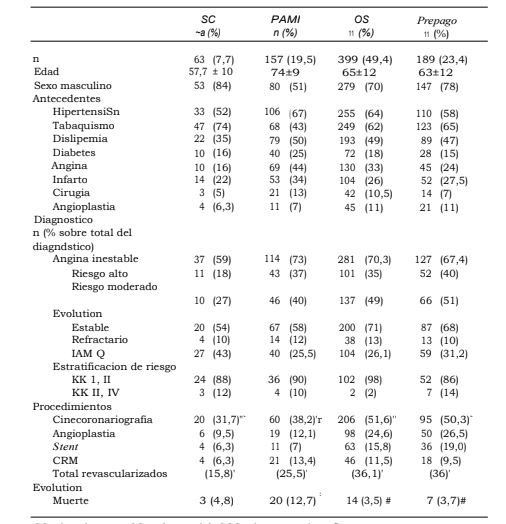
A registry of 828 patients with acute coronary syndromes (unstable angina and acute myocardial infarction) was carried out in a prospective and consecutive way, in 18 centers with high complexity resources availability. Social and economical aspects were registered, as well as types of medical insurance, clinical features at admission and evolution and complementary studies done.
Results
Average age was 65.76±12 years, 69% of patients were male, 26% had had a previous myocardial infarction. Half of the population earned less than $900 monthly. In this group is observed: older age (68 vs. 63 years p>0.001), more number of previous of angina events (35% vs. 27% p=0.01) and high risk unstable angina at admission (43% vs. 36% p=0.07). Similar CCG were performed in this group (43% vs. 49% p=0.09), but less coronary angioplasties (18% vs. 24% p< 0.02) and use of stents (10% vs 16% p<0.01). The group showed a greater mortality during evolution (7% vs. 3% p<0.01). The multiple variable analysis showed that age, previous infarction and low economic income were independent predictors of mortality.
Conclusions
Social and economical factors may influence medical decision-making process.
Downloads
Published
Issue
Section
License
Copyright (c) 2026 Argentine Journal of Cardiology

This work is licensed under a Creative Commons Attribution-NonCommercial-ShareAlike 4.0 International License.





